+
Railway Board Approves Merger of Chennai MRTS With Chennai Metro
RAILWAYS & METRO RAIL

Railway Board Approves Merger of Chennai MRTS With Chennai Metro

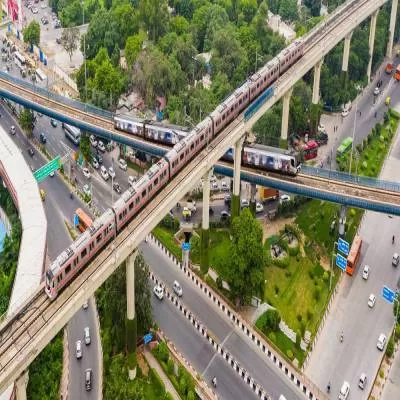
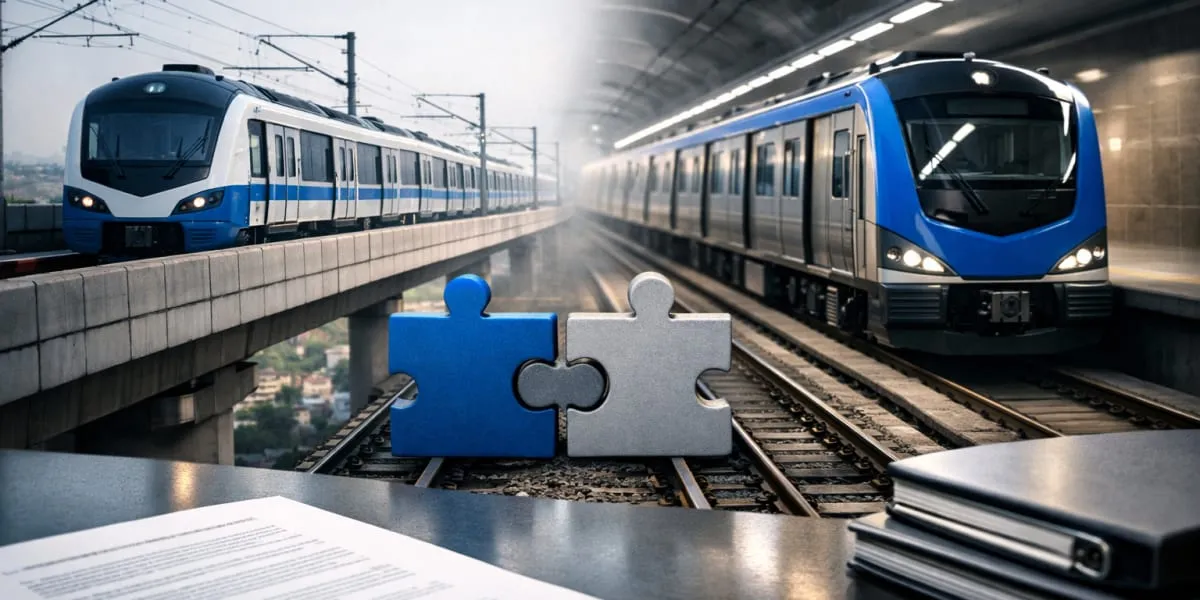
Railway Board has approved the long-awaited merger of Chennai Mass Rapid Transit System (MRTS) with Chennai Metro Rail (CMRL), initiating integration of suburban corridor management under a single state-led framework and a two-year transfer of operations. The approval follows years of talks and is reflected in a draft memorandum of understanding outlining asset and responsibility transfers. The Railway Board issued an update on August 12, 2026 approving the draft MoU signed by Southern Railway and the Tamil Nadu government in May and setting a framework for a phased shift of operation and maintenance.

The transition will proceed in two stages. Under the draft MoU Southern Railway will transfer MRTS assets and general operation and maintenance responsibilities within 90 days while excluding core train operations and maintenance. Over a two-year period train operations and remaining maintenance will be progressively transferred to CMRL, with the state to make the agreed payment in full or in instalments.

Proposed assets for transfer include land, stations and other infrastructure covering 19 of the 21 MRTS stations, together with tracks, signalling and telecom systems, lifts and escalators, foot overbridges and EMU rolling stock. MRTS originated in the 1975 First Master Plan for Chennai and passenger services initially ran between Chennai Beach and Velachery; the corridor was extended to St Thomas Mount and commissioned in March 2026, including Puzhithivakkam and Adambakkam while one station remains not operational.

The merger requires coordination at Chennai Beach and Fort, with platforms 9 and 10 at Beach proposed for MRTS services and a crossing arrangement at Fort to enable track connectivity. A single track between Fort and Beach is currently in place and any proposal to double that section will be reviewed by Southern Railway according to operational needs and land policy. A special committee of senior officials will oversee the merger, coordinated by the Convenor of the Chennai Unified Metropolitan Transport Authority; integration could improve maintenance and passenger facilities but may affect existing services and restoring direct trains from St Thomas Mount to Arakkonam and Gummidipoondi.

Railway Board has approved the long-awaited merger of Chennai Mass Rapid Transit System (MRTS) with Chennai Metro Rail (CMRL), initiating integration of suburban corridor management under a single state-led framework and a two-year transfer of operations. The approval follows years of talks and is reflected in a draft memorandum of understanding outlining asset and responsibility transfers. The Railway Board issued an update on August 12, 2026 approving the draft MoU signed by Southern Railway and the Tamil Nadu government in May and setting a framework for a phased shift of operation and maintenance. The transition will proceed in two stages. Under the draft MoU Southern Railway will transfer MRTS assets and general operation and maintenance responsibilities within 90 days while excluding core train operations and maintenance. Over a two-year period train operations and remaining maintenance will be progressively transferred to CMRL, with the state to make the agreed payment in full or in instalments. Proposed assets for transfer include land, stations and other infrastructure covering 19 of the 21 MRTS stations, together with tracks, signalling and telecom systems, lifts and escalators, foot overbridges and EMU rolling stock. MRTS originated in the 1975 First Master Plan for Chennai and passenger services initially ran between Chennai Beach and Velachery; the corridor was extended to St Thomas Mount and commissioned in March 2026, including Puzhithivakkam and Adambakkam while one station remains not operational. The merger requires coordination at Chennai Beach and Fort, with platforms 9 and 10 at Beach proposed for MRTS services and a crossing arrangement at Fort to enable track connectivity. A single track between Fort and Beach is currently in place and any proposal to double that section will be reviewed by Southern Railway according to operational needs and land policy. A special committee of senior officials will oversee the merger, coordinated by the Convenor of the Chennai Unified Metropolitan Transport Authority; integration could improve maintenance and passenger facilities but may affect existing services and restoring direct trains from St Thomas Mount to Arakkonam and Gummidipoondi.

Related Stories

Gold Stories

Next Story
Infrastructure Transport

MMRDA Targets Completion of Projects by December 2028

The Mumbai Metropolitan Region Development Authority (MMRDA) is targeting the completion of all its ongoing infrastructure projects by December 2028, a year ahead of its December 2029 deadline, Metropolitan Commissioner Dr Sanjay Mukherjee has said.Speaking at the sixth edition of the Real Estate & Infrastructure Investors' Summit (REIIS) 2026 in Mumbai, Mukherjee said the authority was developing an integrated network of roads, tunnels, sea links and Metro corridors under its broader vision of “Mumbai in 59 Minutes”.The objective is to improve east-west and north-south connectivity an..

Next Story
Building Material

High-Performance Façades Gain Ground in Indian Buildings

High-performance façades are gaining greater importance in Indian architecture as developers and architects increasingly focus on energy efficiency, thermal comfort and building performance, according to Shankar Fenestrations & Glasses.The company said modern façade systems are increasingly being considered as part of a building's overall performance strategy rather than being used primarily as aesthetic elements.High-performance glass, curtain wall systems and structural glazing can contribute to thermal regulation, solar control, daylight management and indoor comfort. Their growing ad..

Next Story
Technology

SPML Infra's 104.4 kWh BESS Battery Pack Clears Global Tests

SPML Infra has announced that its proprietary 104.4 kWh Battery Energy Storage System (BESS) battery pack has completed key international safety, performance and transportation testing and certification requirements, marking a step towards its commercial deployment.Developed under the company's own intellectual property, the battery pack has completed requirements under UL9540A, IEC 62619, IEC 63056, IEC 60730, IEC 61000-6-2, IEC 61000-6-4 and UN38.3 standards.The testing covers areas including thermal runaway safety, battery performance, system functional safety, electromagnetic compatibility..

Advertisement

Subscribe to Our Newsletter

Get daily newsletters around different themes from Construction world.

STAY CONNECTED

Advertisement

SPECIAL OFFER
QR Code