Railways to Decongest 76 Major Stations With High-Tech Amenities
RAILWAYS & METRO RAIL

Railways to Decongest 76 Major Stations With High-Tech Amenities

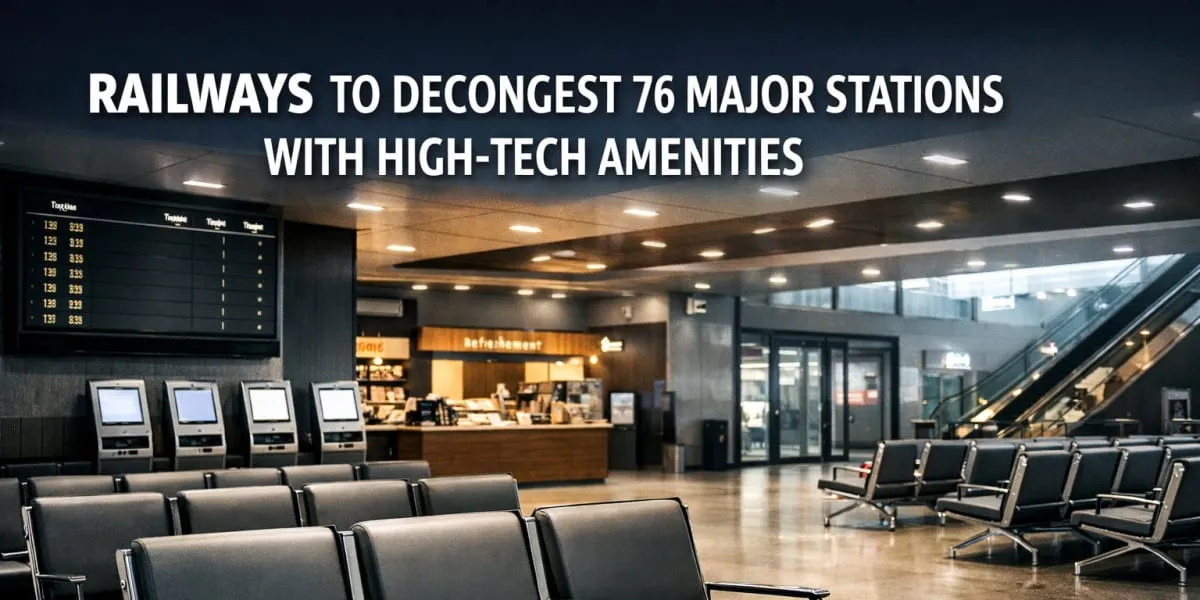
The Ministry of Railways has launched a nationwide plan to establish dedicated passenger holding areas at 76 major stations to decongest platforms and manage peak passenger flows. The initiative by Indian Railways (IR) is intended to provide organised spaces equipped with seating, ticketing facilities and essential services. The zones will aim to streamline passenger movement and reduce platform overcrowding.

A model holding area at New Delhi Railway Station has been commissioned and is reported to have eased congestion by adding ticket counters, Automatic Ticket Vending Machines (ATVMs) and Public Address Systems (PAS) alongside electronic train information boards. Safety and screening measures in the facility include closed-circuit television (CCTV) surveillance, luggage scanners and door frame metal detectors (DFMDs), together with uninterrupted power supply, improved lighting and high volume low speed (HVLS) fans. Amenities also incorporate reverse osmosis (RO) drinking water and separate toilets for men, women and Divyangjans.

Under a revised access control protocol passengers holding confirmed reserved tickets will be allowed direct entry to platforms while those without a valid ticket or holding waiting list tickets will be accommodated in the designated outside holding areas until travel status is verified or space permits. Operational coordination will be strengthened through war rooms at major stations where officers from all departments will work together and through the rollout of the latest digital communications and announcement systems. All staff will receive quick response (QR) based identity cards and uniforms to aid secure access and rapid identification in emergencies.

Further infrastructure upgrades include the introduction of wider foot-over-bridges (FOBs) with two new standard designs of 12 metre and six metre widths to be installed across stations to facilitate smoother movement. Safety monitoring will be augmented by deployment of artificial intelligence enabled CCTV cameras for real-time crowd surveillance and management. The ministry noted that timelines for planning and execution will be subject to iterative optimisation and that the measures were disclosed by the Union Minister for Railways Ashwini Vaishnaw in a written reply to a question in the Rajya Sabha.

The Ministry of Railways has launched a nationwide plan to establish dedicated passenger holding areas at 76 major stations to decongest platforms and manage peak passenger flows. The initiative by Indian Railways (IR) is intended to provide organised spaces equipped with seating, ticketing facilities and essential services. The zones will aim to streamline passenger movement and reduce platform overcrowding. A model holding area at New Delhi Railway Station has been commissioned and is reported to have eased congestion by adding ticket counters, Automatic Ticket Vending Machines (ATVMs) and Public Address Systems (PAS) alongside electronic train information boards. Safety and screening measures in the facility include closed-circuit television (CCTV) surveillance, luggage scanners and door frame metal detectors (DFMDs), together with uninterrupted power supply, improved lighting and high volume low speed (HVLS) fans. Amenities also incorporate reverse osmosis (RO) drinking water and separate toilets for men, women and Divyangjans. Under a revised access control protocol passengers holding confirmed reserved tickets will be allowed direct entry to platforms while those without a valid ticket or holding waiting list tickets will be accommodated in the designated outside holding areas until travel status is verified or space permits. Operational coordination will be strengthened through war rooms at major stations where officers from all departments will work together and through the rollout of the latest digital communications and announcement systems. All staff will receive quick response (QR) based identity cards and uniforms to aid secure access and rapid identification in emergencies. Further infrastructure upgrades include the introduction of wider foot-over-bridges (FOBs) with two new standard designs of 12 metre and six metre widths to be installed across stations to facilitate smoother movement. Safety monitoring will be augmented by deployment of artificial intelligence enabled CCTV cameras for real-time crowd surveillance and management. The ministry noted that timelines for planning and execution will be subject to iterative optimisation and that the measures were disclosed by the Union Minister for Railways Ashwini Vaishnaw in a written reply to a question in the Rajya Sabha.

Next Story
Real Estate

Loomcraft Enters South India with Kerala Store Launch

Loomcraft has launched its exclusive store in Kerala, marking its entry into South India and a key step in its nationwide expansion strategy. The move targets a region driven by tourism and premium real estate demand, where outdoor spaces play a central role in hospitality and residential experiences.Kerala’s growing base of luxury resorts, boutique hotels, villas and gated communities has created strong demand for specialised outdoor furniture. However, the region has remained underserved, with buyers relying on imports or generic products not suited to humid, coastal and monsoon-heavy cond..

Next Story
Building Material

Mild Steel Prices Seen Rising to Rs 61,000 Per Tonne

Mild steel prices in India, currently around Rs 58,000 per tonne, are expected to rise to nearly Rs 61,000 per tonne in April, indicating an increase of about Rs 3,000 per tonne. The anticipated rise reflects structural pressures driven by geopolitical tensions, energy constraints and limited raw material availability.Ongoing global conflict has disrupted energy markets, leading to LNG shortages that are affecting domestic steel production. Small and mid-sized manufacturers, particularly those dependent on gas-based processes, are witnessing production cuts due to constrained energy supply, re..

Next Story
Infrastructure Urban

Vedanta Expands Transgender Workforce to 75 Employees

Vedanta has strengthened its commitment to workplace inclusion by employing 75 transgender individuals across its businesses, including Vedanta Aluminium, Hindustan Zinc, Sesa Goa, FACOR and Cairn Oil & Gas. The initiative reflects sustained hiring efforts since 2022 to build equitable opportunities across operations, corporate and technical roles.Transgender employees are engaged in functions such as operations, finance, logistics, HR, CSR, healthcare and security, with provisions for internal mobility to support career progression. The company has implemented structured policies, includi..

Advertisement

Subscribe to Our Newsletter

Get daily newsletters around different themes from Construction world.

STAY CONNECTED

Advertisement

Advertisement

Advertisement