

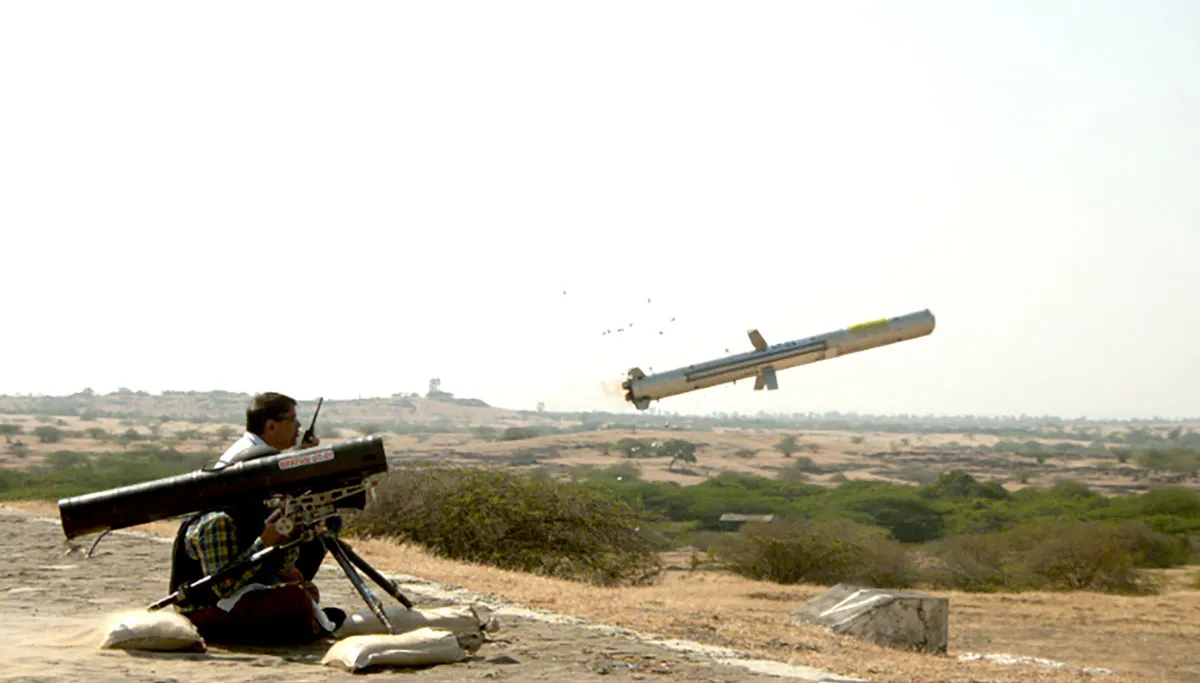




DRDO Successfully Tests MPATGM with Top-Attack Capability
DEFENSE

DRDO Successfully Tests MPATGM with Top-Attack Capability

The Defence Research and Development Organisation (DRDO) has successfully flight-tested the third-generation, fire-and-forget Man Portable Anti-Tank Guided Missile (MPATGM) with top-attack capability against a moving target. The trial was conducted on January 11, 2026, at the KK Ranges in Ahilya Nagar, Maharashtra, marking a significant step towards the induction of the system into the Indian Army.

The test was carried out by DRDO’s Defence Research & Development Laboratory, Hyderabad. The indigenously developed MPATGM incorporates a range of advanced technologies, including an Imaging Infrared (IIR) homing seeker, an all-electric control actuation system, a fire control system, a tandem warhead, a high-performance propulsion system and an advanced sighting system. These critical subsystems have been developed by multiple DRDO laboratories, including Research Centre Imarat, Hyderabad; Terminal Ballistics Research Laboratory, Chandigarh; High Energy Materials Research Laboratory, Pune; and Instruments Research & Development Establishment, Dehradun.

To simulate an enemy tank, a Thermal Target System was developed by Defence Laboratory, Jodhpur. The IIR seeker enables effective engagement of targets in both day and night combat conditions. The tandem warhead is designed to defeat modern main battle tanks, enhancing the missile’s lethality on the battlefield. The MPATGM can be launched from a tripod or a military vehicle-mounted launcher, offering operational flexibility to infantry units.

Bharat Dynamics and Bharat Electronics are the Development-Cum-Production Partners (DcPP) for the weapon system, supporting its transition from development to series production.

Raksha Mantri Rajnath Singh, Defence Minister, Government of India, complimented DRDO, the DcPP partners and industry stakeholders for the successful trial, describing it as a major achievement towards Aatmanirbhar Bharat in defence. Dr Samir V Kamat, Secretary, Department of Defence R&D and Chairman, DRDO, said the successful engagement of the trial target paves the way for the weapon system’s induction into the Indian Army.

The Defence Research and Development Organisation (DRDO) has successfully flight-tested the third-generation, fire-and-forget Man Portable Anti-Tank Guided Missile (MPATGM) with top-attack capability against a moving target. The trial was conducted on January 11, 2026, at the KK Ranges in Ahilya Nagar, Maharashtra, marking a significant step towards the induction of the system into the Indian Army.The test was carried out by DRDO’s Defence Research & Development Laboratory, Hyderabad. The indigenously developed MPATGM incorporates a range of advanced technologies, including an Imaging Infrared (IIR) homing seeker, an all-electric control actuation system, a fire control system, a tandem warhead, a high-performance propulsion system and an advanced sighting system. These critical subsystems have been developed by multiple DRDO laboratories, including Research Centre Imarat, Hyderabad; Terminal Ballistics Research Laboratory, Chandigarh; High Energy Materials Research Laboratory, Pune; and Instruments Research & Development Establishment, Dehradun.To simulate an enemy tank, a Thermal Target System was developed by Defence Laboratory, Jodhpur. The IIR seeker enables effective engagement of targets in both day and night combat conditions. The tandem warhead is designed to defeat modern main battle tanks, enhancing the missile’s lethality on the battlefield. The MPATGM can be launched from a tripod or a military vehicle-mounted launcher, offering operational flexibility to infantry units.Bharat Dynamics and Bharat Electronics are the Development-Cum-Production Partners (DcPP) for the weapon system, supporting its transition from development to series production.Raksha Mantri Rajnath Singh, Defence Minister, Government of India, complimented DRDO, the DcPP partners and industry stakeholders for the successful trial, describing it as a major achievement towards Aatmanirbhar Bharat in defence. Dr Samir V Kamat, Secretary, Department of Defence R&D and Chairman, DRDO, said the successful engagement of the trial target paves the way for the weapon system’s induction into the Indian Army.

Next Story
Technology

Cost intelligence will become a strategic contributor to project success

As India's construction industry accelerates its digital transformation, integrated platforms, AI and connected data are becoming essential to improving cost certainty, project efficiency and sustainability. Ravi Kumar, Sales Director – India, RIB Software India, shares how digital workflows are reshaping project planning, commercial management and decision-making across the construction value chain.India's construction sector is embracing digital technologies at an unprecedented pace. From your perspective, what are the biggest shifts driving this transformation and how is RIB Software enab..

Next Story
Technology

Twin Tracks

Digital-twin adoption in India’s rail sector is gradually making its presence felt across asset management, infrastructure planning, predictive maintenance, construction monitoring and operator training.While large-scale deployments of digital twins are still evolving, Nipun Dumpala, a Senior Technical Lead specialising in digital twins, synthetic data, simulation and mixed reality technologies, points out that several organisations are exploring BIM-integrated digital twins, IoT-enabled monitoring, AI-based analytics and simulation platforms to improve operational efficiency and reduce life..

Next Story
Infrastructure Urban

Centre Clears Power Distribution Upgrade for Uttar Pradesh

The Central Government has approved power distribution projects worth Rs 407.39 billion for Uttar Pradesh under the Revamped Distribution Sector Scheme (RDSS). The investment will be used to modernise the state's electricity distribution infrastructure and strengthen network capacity across urban and rural areas. The package targets one of the country's largest distribution networks as the state experiences rapid urbanisation and rising electricity consumption. Planned interventions include the strengthening of distribution lines, modernisation of substations, replacement of ageing electrical ..

Advertisement

Subscribe to Our Newsletter

Get daily newsletters around different themes from Construction world.

STAY CONNECTED

Advertisement

Advertisement

Advertisement











