Centre Circulates Draft National Water Metro Policy
WATER & WASTE

Centre Circulates Draft National Water Metro Policy

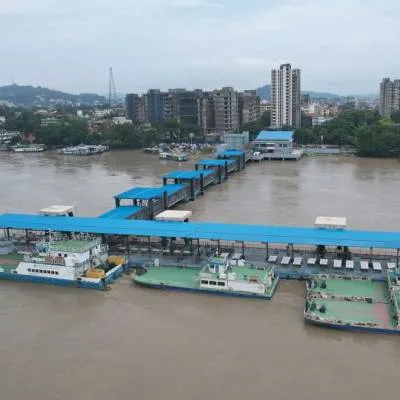
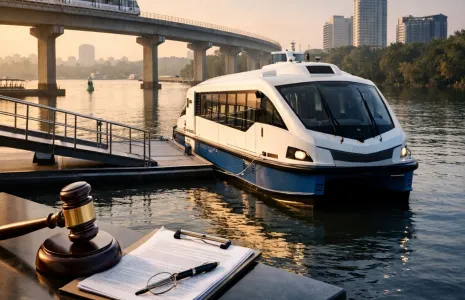
Union Minister Sarbananda Sonowal chaired a review on the national rollout of Water Metro services as the Centre advanced plans to introduce the system in 18 cities. The Draft National Water Metro Policy, 2026 has been circulated for inter-ministerial consultation and preparations are under way.

Guwahati has been identified for Phase I alongside Srinagar, Patna, Varanasi, Ayodhya and Prayagraj, while Tezpur and Dibrugarh are proposed for Phase II. The expansion builds on the Kochi Water Metro and aims to transform inland waterways into sustainable and modern public transport corridors.

Sonowal highlighted that the systems are less capital intensive as they leverage existing waterways with minimal civil works. He said faster delivery, lower land needs and reduced operational costs are achievable through electric and hybrid ferries, enabling reduced congestion and a scenic commuting option.

The policy will be consulted with state governments to gather suggestions and ensure local ownership. The framework adopts an ecosystem approach covering vessels, terminals, charging and navigational infrastructure, while promoting standardisation, indigenisation and multimodal integration. Planning criteria prioritise regions with continuous waterways and cities with populations exceeding one million (mn), though criteria may be relaxed where projects improve connectivity or flood resilience.

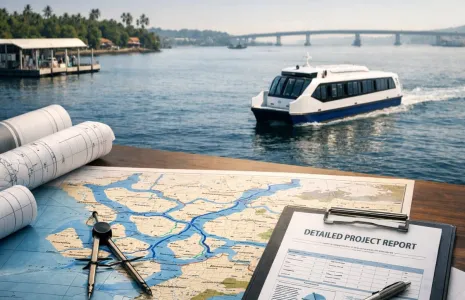
Multiple funding models are under consideration, including joint Centre-State funding, fully State-funded schemes, public-private partnerships and fully Centre-funded initiatives, with cost optimisation to ensure viability. The Inland Waterways Authority of India had tasked Kochi Metro Rail Limited with feasibility studies for 18 cities in February 2025; site visits are complete for all locations, draft reports have been submitted for 17 with Lakshadweep pending, and reports for Srinagar, Patna, Guwahati, Varanasi and Ayodhya have been accepted. The ministry has called for local engagement, heritage-sensitive design and quantification of fuel savings and environmental benefits as part of implementation.

Union Minister Sarbananda Sonowal chaired a review on the national rollout of Water Metro services as the Centre advanced plans to introduce the system in 18 cities. The Draft National Water Metro Policy, 2026 has been circulated for inter-ministerial consultation and preparations are under way. Guwahati has been identified for Phase I alongside Srinagar, Patna, Varanasi, Ayodhya and Prayagraj, while Tezpur and Dibrugarh are proposed for Phase II. The expansion builds on the Kochi Water Metro and aims to transform inland waterways into sustainable and modern public transport corridors. Sonowal highlighted that the systems are less capital intensive as they leverage existing waterways with minimal civil works. He said faster delivery, lower land needs and reduced operational costs are achievable through electric and hybrid ferries, enabling reduced congestion and a scenic commuting option. The policy will be consulted with state governments to gather suggestions and ensure local ownership. The framework adopts an ecosystem approach covering vessels, terminals, charging and navigational infrastructure, while promoting standardisation, indigenisation and multimodal integration. Planning criteria prioritise regions with continuous waterways and cities with populations exceeding one million (mn), though criteria may be relaxed where projects improve connectivity or flood resilience. Multiple funding models are under consideration, including joint Centre-State funding, fully State-funded schemes, public-private partnerships and fully Centre-funded initiatives, with cost optimisation to ensure viability. The Inland Waterways Authority of India had tasked Kochi Metro Rail Limited with feasibility studies for 18 cities in February 2025; site visits are complete for all locations, draft reports have been submitted for 17 with Lakshadweep pending, and reports for Srinagar, Patna, Guwahati, Varanasi and Ayodhya have been accepted. The ministry has called for local engagement, heritage-sensitive design and quantification of fuel savings and environmental benefits as part of implementation.

Related Stories

Gold Stories

Next Story
Infrastructure Urban

KONE Opens India's First Digital Experience Centre in Pune

KONE, a global elevator and escalator manufacturer, has inaugurated its first Digital Experience Centre (DEC) in India, located in Pune. The facility aims to showcase how artificial intelligence (AI), connectivity and data-driven technologies can enhance customer experiences and improve building operations.The centre was inaugurated by Jussi Herlin, Executive Vice Chair, KONE Corporation; Philippe Delorme, President and CEO, KONE; and Nandan Nilekani, Co-founder and Chairman of the Board, Infosys.Designed as an interactive customer environment, the facility demonstrates digital solutions cover..

Next Story
Infrastructure Urban

CII GreenCo Launches Circularity Guidelines for Indian Industry

The Confederation of Indian Industry (CII) GreenCo Council has launched the CII GreenCo Circularity Guidelines – Pilot Version at the 17th CII GreenCo Waste & Resource Management Summit 2026 in Chennai. The initiative aims to strengthen resource efficiency, waste reduction and circular economy practices across Indian manufacturing and process industries.The guidelines introduce a structured framework with circularity indices covering raw materials, consumables, packaging and other resource inputs. These indicators will help industries assess existing practices, identify opportunities to ..

Next Story
Infrastructure Energy

Global Electronics Association Launches IPC-1783-CO2E Standard

The Global Electronics Association has introduced IPC-1783-CO2E, a new international standard aimed at improving consistency, transparency and comparability in product carbon footprint reporting across the electronics manufacturing industry.The standard, titled International Standard for Data Collection and Reporting of CO2 Equivalent (CO2e) Emissions for the Electronics Manufacturing Supply Chain, provides industry-specific guidance for collecting, estimating and reporting carbon emissions data.With increasing regulatory requirements and customer expectations, electronics manufacturers face c..

Advertisement

Subscribe to Our Newsletter

Get daily newsletters around different themes from Construction world.

STAY CONNECTED

Advertisement

SPECIAL OFFER
QR Code