

Delhi Approves Rs 10 Bn For Yamuna Rejuvenation
WATER & WASTE

Delhi Approves Rs 10 Bn For Yamuna Rejuvenation

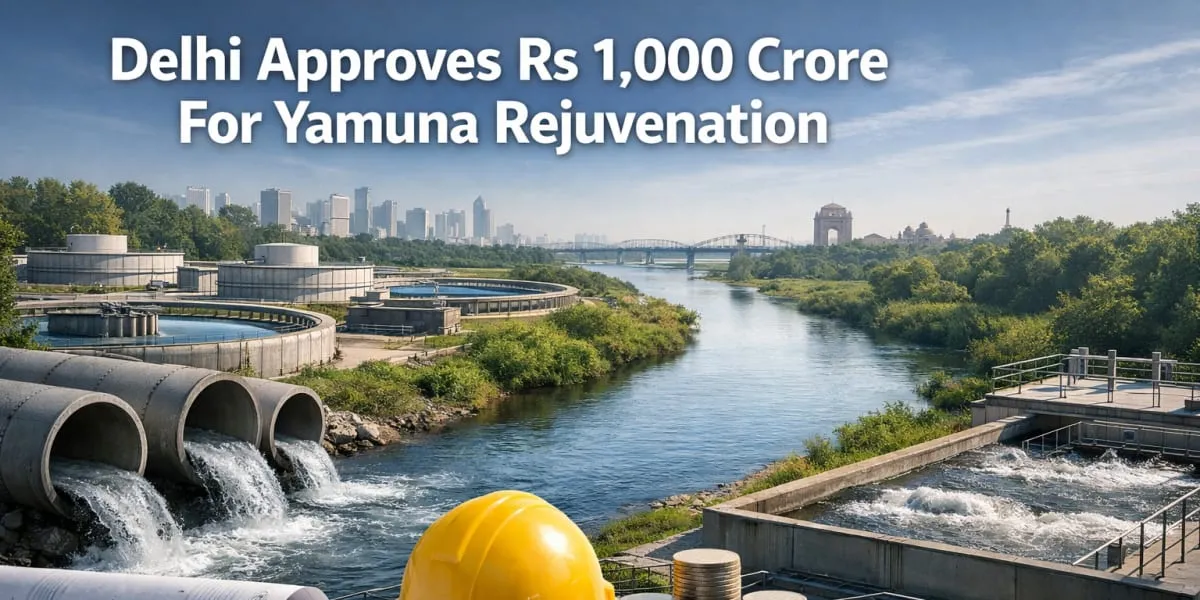
The Delhi government has approved a series of projects worth more than Rs 10 billion, aimed at rejuvenating the Yamuna River, cleaning the Najafgarh drain and strengthening the capital’s water and sewage infrastructure. The Chief Minister’s Office issued a statement on Sunday describing the measures as part of a sustained push to transform Delhi into a clean, green and water?secure capital while improving civic services for residents. The programme blends new construction, upgrades and operational arrangements to reduce pollution and expand coverage. Officials linked the approvals to broader urban environmental goals.

Approval was granted for 12 new Decentralised Sewage Treatment Plants under the Centre’s AMRUT scheme in the Najafgarh region, with a projected cost of about Rs 860 crore, roughly Rs 8.6 billion. The combined treatment capacity will be 46.5 million (mn) gallons per day (MGD), including a 17 MGD plant at Mitraon, and the installations are designed to intercept sewage flows close to source points. The decentralised approach is intended to ease load on central sewers and speed up restoration of polluted waterways.

Remaining DSTPs will be located at Kair, Kanganheri, Kakrola, Dichaon Kalan, Galibpur, Sarangpur, Shikarpur, Hasanpur, Jaffarpur, Kazipur and Khera Dabar and will serve areas that previously lacked adequate treatment infrastructure. The projects are expected to benefit more than 121 unauthorised colonies, 35 villages and nearly 0.7 million (mn) residents by preventing untreated sewage from entering the Najafgarh Drain and by improving sanitation standards. Implementation plans emphasise localised operations and maintenance to ensure sustained performance.

The government also approved upgradation of Phase I of the Keshopur Sewage Treatment Plant at an estimated cost of about Rs 122 crore, around Rs 1.22 billion, which will raise capacity from 12 MGD to 18 MGD and include an 11?year operation and maintenance component. To improve groundwater recharge, the Delhi Jal Board will construct new rainwater?harvesting structures, restore existing ones and appoint groundwater experts along with rainwater?harvesting social mobilisers to support community engagement and technical delivery.

The Delhi government has approved a series of projects worth more than Rs 10 billion, aimed at rejuvenating the Yamuna River, cleaning the Najafgarh drain and strengthening the capital’s water and sewage infrastructure. The Chief Minister’s Office issued a statement on Sunday describing the measures as part of a sustained push to transform Delhi into a clean, green and water?secure capital while improving civic services for residents. The programme blends new construction, upgrades and operational arrangements to reduce pollution and expand coverage. Officials linked the approvals to broader urban environmental goals. Approval was granted for 12 new Decentralised Sewage Treatment Plants under the Centre’s AMRUT scheme in the Najafgarh region, with a projected cost of about Rs 860 crore, roughly Rs 8.6 billion. The combined treatment capacity will be 46.5 million (mn) gallons per day (MGD), including a 17 MGD plant at Mitraon, and the installations are designed to intercept sewage flows close to source points. The decentralised approach is intended to ease load on central sewers and speed up restoration of polluted waterways. Remaining DSTPs will be located at Kair, Kanganheri, Kakrola, Dichaon Kalan, Galibpur, Sarangpur, Shikarpur, Hasanpur, Jaffarpur, Kazipur and Khera Dabar and will serve areas that previously lacked adequate treatment infrastructure. The projects are expected to benefit more than 121 unauthorised colonies, 35 villages and nearly 0.7 million (mn) residents by preventing untreated sewage from entering the Najafgarh Drain and by improving sanitation standards. Implementation plans emphasise localised operations and maintenance to ensure sustained performance. The government also approved upgradation of Phase I of the Keshopur Sewage Treatment Plant at an estimated cost of about Rs 122 crore, around Rs 1.22 billion, which will raise capacity from 12 MGD to 18 MGD and include an 11?year operation and maintenance component. To improve groundwater recharge, the Delhi Jal Board will construct new rainwater?harvesting structures, restore existing ones and appoint groundwater experts along with rainwater?harvesting social mobilisers to support community engagement and technical delivery.

Next Story
Products

Fynd Launches AI Platform to Accelerate Fashion Creation

Fynd, an AI-native retail technology company backed by Reliance Retail Ventures, has launched Fynd Create, a platform designed to bring design intelligence, sourcing and manufacturing onto a single connected ecosystem. The platform aims to help brands respond faster to changing consumer preferences and shorten product development cycles.As social media trends continue to compress traditional fashion seasons, brands are under increasing pressure to move from seasonal planning to demand-driven production. Conventional supply chains, often characterised by long lead times and fragmented operation..

Next Story
Resources

Modis Navnirman Appointed For Neel Kiran CHSL Redevelopment

Modis Navnirman (MNL) has been appointed as the developer for the redevelopment of Neel Kiran Co-operative Housing Society Ltd in Khar West, Mumbai, following a selection process in which members chose MNL as their preferred partner. The appointment will add approximately Rs two point five billion (Rs two point five bn) to the company's Gross Development Value pipeline and strengthen its focus on redevelopment and urban renewal projects across the Mumbai Metropolitan Region. The project site is a landmark residential society in Khar West, and the selection reflects members' preference for a pa..

Next Story
Infrastructure Energy

Diamond Power Commissions Eighth MV and EHV Cable Line

Diamond Power Infrastructure (DPIL) has commissioned its eighth Medium Voltage (MV) and Extra High Voltage (EHV) power cable production line at its manufacturing facility in Vadodara, Gujarat. The new line enhances the company's manufacturing capacity in the technologically advanced MV and EHV underground power cable segment. This segment supplies cables for power transmission networks, power generation projects and renewable energy evacuation systems. The development is presented as a step to meet evolving infrastructure needs. The MV and EHV cables produced at the Vadodara facility serve urb..

Advertisement

Subscribe to Our Newsletter

Get daily newsletters around different themes from Construction world.

STAY CONNECTED

Advertisement

Advertisement

Advertisement