NGT Amicus Flags 530-Tonne Waste Treatment Gap in Jammu and Kashmir
WATER & WASTE

NGT Amicus Flags 530-Tonne Waste Treatment Gap in Jammu and Kashmir

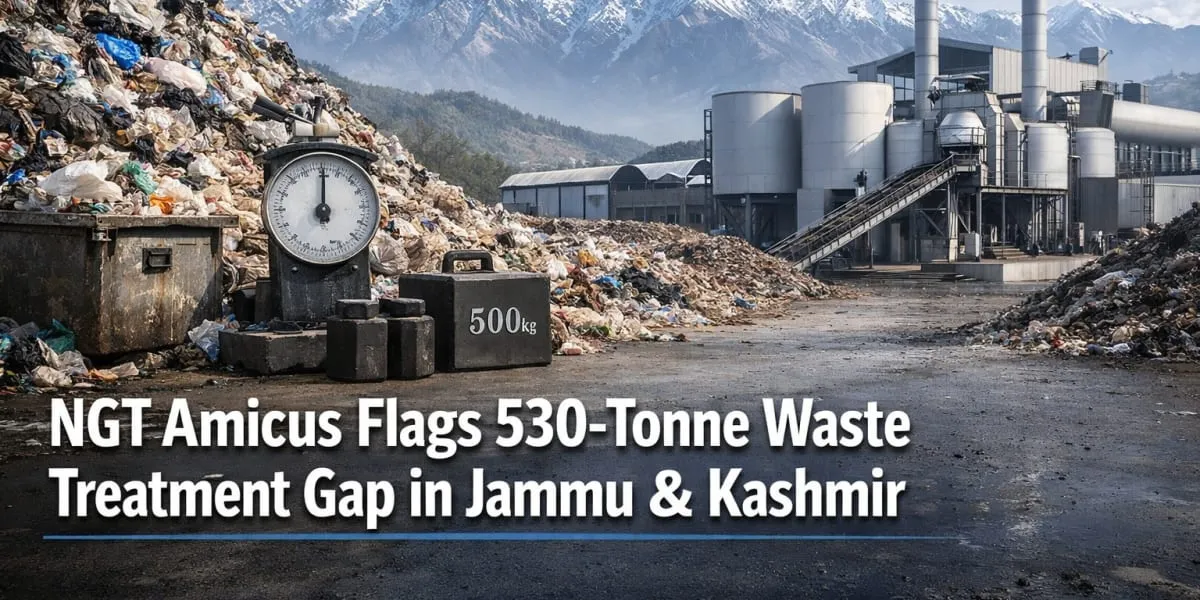
An amicus curiae appointed by the National Green Tribunal submitted a note to the Principal Bench in connection with Original Application No. 606 of 2018 after reviewing a compliance affidavit from the Union Territory. The note observed that Jammu and Kashmir generates 1,557 tonnes (t) of municipal solid waste every day. It assessed that nearly 1,027 t are processed daily, leaving a treatment shortfall of about 530 t per day and that around 26 t remain uncollected each day.

The note further stated that nearly 352 t are currently being deposited in landfills and that a proposal to use Refuse Derived Fuel (RDF) in cement plants is under consideration. It recorded that a 300-tonne-per-day Compressed Bio-Gas (CBG) plant has been sanctioned and is expected to be completed by March 2027, and that two Construction and Demolition waste processing facilities are likely to be commissioned this year. Concerns were raised about the scale of legacy waste and the pace of planned interventions. The submission set out timelines and proposed projects but noted gaps in operational detail.

The amicus noted that around 1.816 million (mn) t of old waste lie at 101 identified dump sites across 49 urban local bodies. It highlighted that information on leachate treatment, land reclamation, site restoration and the future use of reclaimed land has not been adequately provided by the authorities. The lack of such details was described as an obstacle to effective remediation.

The note also flagged environmental risks from waste processing units located close to sensitive water bodies, citing the Bandipora facility near the Wular Ramsar Wetland as an example where leachate could pollute freshwater sources. It pointed to flood-related damage to processing installations at RS Pura and Arnia, indicating insufficient disaster-resilient planning. The amicus suggested measures to safeguard environmentally sensitive water bodies and urged more comprehensive technical plans.

"Join industry leaders at RAHSTA Expo, India's premier platform for roads, highways and traffic infrastructure. Register now to explore innovations, network with experts and shape the future of mobility."

An amicus curiae appointed by the National Green Tribunal submitted a note to the Principal Bench in connection with Original Application No. 606 of 2018 after reviewing a compliance affidavit from the Union Territory. The note observed that Jammu and Kashmir generates 1,557 tonnes (t) of municipal solid waste every day. It assessed that nearly 1,027 t are processed daily, leaving a treatment shortfall of about 530 t per day and that around 26 t remain uncollected each day. The note further stated that nearly 352 t are currently being deposited in landfills and that a proposal to use Refuse Derived Fuel (RDF) in cement plants is under consideration. It recorded that a 300-tonne-per-day Compressed Bio-Gas (CBG) plant has been sanctioned and is expected to be completed by March 2027, and that two Construction and Demolition waste processing facilities are likely to be commissioned this year. Concerns were raised about the scale of legacy waste and the pace of planned interventions. The submission set out timelines and proposed projects but noted gaps in operational detail. The amicus noted that around 1.816 million (mn) t of old waste lie at 101 identified dump sites across 49 urban local bodies. It highlighted that information on leachate treatment, land reclamation, site restoration and the future use of reclaimed land has not been adequately provided by the authorities. The lack of such details was described as an obstacle to effective remediation. The note also flagged environmental risks from waste processing units located close to sensitive water bodies, citing the Bandipora facility near the Wular Ramsar Wetland as an example where leachate could pollute freshwater sources. It pointed to flood-related damage to processing installations at RS Pura and Arnia, indicating insufficient disaster-resilient planning. The amicus suggested measures to safeguard environmentally sensitive water bodies and urged more comprehensive technical plans.

Next Story
Infrastructure Transport

Uttar Pradesh Accelerates National Highway Projects

Uttar Pradesh Chief Minister Yogi Adityanath met Union Road Transport and Highways Minister Nitin Gadkari to review National Highway and road infrastructure projects. Officials from the National Highways Authority of India presented progress updates and proposals. Ministers directed acceleration of land acquisition, forest clearances, utility shifting and other formalities to expedite delivery. Officials said that since 2014 about 10,204 kilometres of National Highway projects have been awarded and nearly 9,329 kilometres completed, with 606 kilometres approved and 1,010 kilometres completed b..

Next Story
Infrastructure Transport

NHAI Completes Repairs at 33 of 40 Spots Along Gurugram NH-48

The National Highways Authority of India has rectified 33 of 40 deficient locations along an 11km stretch of the Delhi–Gurugram NH-48 corridor, following a joint inspection by the authority, the Municipal Corporation of Gurugram and the Gurugram Metropolitan Development Authority. The audit identified damaged footpaths, crash barriers, inadequate lane markings and poor sanitation at multiple points between Rajiv Chowk and Signature Towers. Repairs and maintenance works have been carried out over May and June as part of the exercise. The report noted broken crash barriers and roadside litteri..

Next Story
Infrastructure Urban

Mankhurd Maharashtra Nagar Flyover To Open By August 2027

The Brihanmumbai Municipal Corporation has said the Mankhurd-Maharashtra Nagar flyover will be operational by August 2027, as part of measures to ease congestion in the eastern suburbs. The structure will provide a direct link from the T Junction on the Sion-Panvel highway to the existing Ghatkopar-Mankhurd Link Road. The T Junction is one of the major traffic choke points in the eastern suburbs and records heavy flows of vehicles travelling to and from Navi Mumbai and Pune. Motorists currently spend more than 15 minutes at the signal during peak periods, according to civic data, prompting the..

Advertisement

Subscribe to Our Newsletter

Get daily newsletters around different themes from Construction world.

STAY CONNECTED

Advertisement

Advertisement

Advertisement