

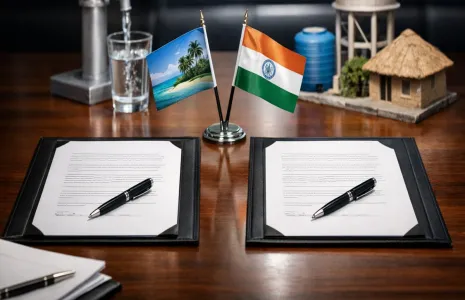


Reform Linked MoUs Signed Under Jal Jeevan Mission 2.0
WATER & WASTE

Reform Linked MoUs Signed Under Jal Jeevan Mission 2.0

Reform?linked Memoranda of Understanding under the Jal Jeevan Mission (JJM) 2.0 were signed with Uttarakhand, Karnataka and Tripura following cabinet approval on 10 March 2026. The agreements mandate a Gram Panchayat?led, service?based and community?centred model of rural water governance to ensure sustainable operation and maintenance. The MoUs emphasise accountable systems and enhanced community participation to advance long?term water security.

Signing ceremonies were conducted during separate scheduled meetings with Union Minister of Jal Shakti C. R. Patil and Minister of State V. Somanna in attendance, while the three chief ministers joined virtually. The MoUs were exchanged by Smt. Swati Meena Naik, Joint Secretary (Water), Department of Drinking Water and Sanitation and respective state secretaries. Senior DDWS officials including the Secretary and the National Mission Director were present to oversee implementation arrangements.

The agreements seek to secure regular, adequate and prescribed quality drinking water for every rural household through strengthened Jan Bhagidari and structural reforms for operation and maintenance. The text requires creation of Sujal Gaon identification, establishment of district technical units and routine district?level water and sanitation meetings with documented reporting on the JJM Dashboard. Uttarakhand was noted to have achieved 98 per cent coverage, providing tap water connections to 1.42 million (mn) out of 1.448 million (mn) rural households.

Karnataka was recorded at 87 per cent progress under the mission and noted for early adoption of a comprehensive operations and maintenance policy and village water and sanitation committees with gender?balanced membership. Tripura was noted at 86 per cent coverage, up from three per cent at the commencement of JJM in 2019, with Jal Seva Aankalan completed in 151 Gram Panchayats and district technical units constituted across all eight districts. Tripura signalled that O&M policy implementation would commence by May 2026.

Reform?linked Memoranda of Understanding under the Jal Jeevan Mission (JJM) 2.0 were signed with Uttarakhand, Karnataka and Tripura following cabinet approval on 10 March 2026. The agreements mandate a Gram Panchayat?led, service?based and community?centred model of rural water governance to ensure sustainable operation and maintenance. The MoUs emphasise accountable systems and enhanced community participation to advance long?term water security. Signing ceremonies were conducted during separate scheduled meetings with Union Minister of Jal Shakti C. R. Patil and Minister of State V. Somanna in attendance, while the three chief ministers joined virtually. The MoUs were exchanged by Smt. Swati Meena Naik, Joint Secretary (Water), Department of Drinking Water and Sanitation and respective state secretaries. Senior DDWS officials including the Secretary and the National Mission Director were present to oversee implementation arrangements. The agreements seek to secure regular, adequate and prescribed quality drinking water for every rural household through strengthened Jan Bhagidari and structural reforms for operation and maintenance. The text requires creation of Sujal Gaon identification, establishment of district technical units and routine district?level water and sanitation meetings with documented reporting on the JJM Dashboard. Uttarakhand was noted to have achieved 98 per cent coverage, providing tap water connections to 1.42 million (mn) out of 1.448 million (mn) rural households. Karnataka was recorded at 87 per cent progress under the mission and noted for early adoption of a comprehensive operations and maintenance policy and village water and sanitation committees with gender?balanced membership. Tripura was noted at 86 per cent coverage, up from three per cent at the commencement of JJM in 2019, with Jal Seva Aankalan completed in 151 Gram Panchayats and district technical units constituted across all eight districts. Tripura signalled that O&M policy implementation would commence by May 2026.

Related Stories

Gold Stories
Next Story
Infrastructure Urban

KONE Opens India's First Digital Experience Centre in Pune

KONE, a global elevator and escalator manufacturer, has inaugurated its first Digital Experience Centre (DEC) in India, located in Pune. The facility aims to showcase how artificial intelligence (AI), connectivity and data-driven technologies can enhance customer experiences and improve building operations.The centre was inaugurated by Jussi Herlin, Executive Vice Chair, KONE Corporation; Philippe Delorme, President and CEO, KONE; and Nandan Nilekani, Co-founder and Chairman of the Board, Infosys.Designed as an interactive customer environment, the facility demonstrates digital solutions cover..

Next Story
Infrastructure Urban

CII GreenCo Launches Circularity Guidelines for Indian Industry

The Confederation of Indian Industry (CII) GreenCo Council has launched the CII GreenCo Circularity Guidelines – Pilot Version at the 17th CII GreenCo Waste & Resource Management Summit 2026 in Chennai. The initiative aims to strengthen resource efficiency, waste reduction and circular economy practices across Indian manufacturing and process industries.The guidelines introduce a structured framework with circularity indices covering raw materials, consumables, packaging and other resource inputs. These indicators will help industries assess existing practices, identify opportunities to ..

Next Story
Infrastructure Energy

Global Electronics Association Launches IPC-1783-CO2E Standard

The Global Electronics Association has introduced IPC-1783-CO2E, a new international standard aimed at improving consistency, transparency and comparability in product carbon footprint reporting across the electronics manufacturing industry.The standard, titled International Standard for Data Collection and Reporting of CO2 Equivalent (CO2e) Emissions for the Electronics Manufacturing Supply Chain, provides industry-specific guidance for collecting, estimating and reporting carbon emissions data.With increasing regulatory requirements and customer expectations, electronics manufacturers face c..

Advertisement

Subscribe to Our Newsletter

Get daily newsletters around different themes from Construction world.

STAY CONNECTED

Advertisement

SPECIAL OFFER
QR Code