



High Crude Oil Prices Could Pressure India's Finances
OIL & GAS

High Crude Oil Prices Could Pressure India's Finances

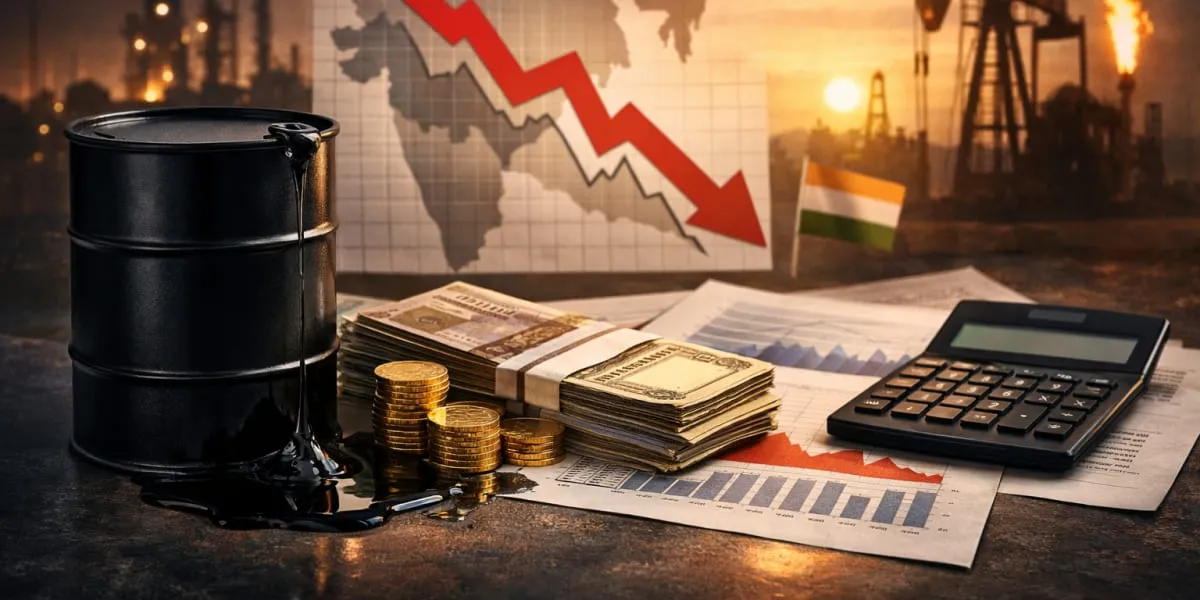
The finance ministry warned that sustained high crude oil prices could place renewed pressure on India’s fiscal deficit and current account balance after conflict in the Middle East pushed up global oil prices. The July monthly economic review said higher crude costs had increased the import bill and were adding to inflationary pressures and strains on external balances.

Despite geopolitical uncertainty, the ministry said the Indian economy sustained growth momentum in the first quarter of the current financial year even as some high-frequency indicators softened. The review noted that indicators such as e-way bills and the manufacturing purchasing managers index (PMI) recorded moderation while the services sector strengthened in the first quarter of the current financial year, supported by domestic and external demand, underlining the economy’s resilience.

The report flagged that tensions in the Gulf could pose risks through higher commodity prices, disruptions to trade flows and volatile capital movements, and it identified a potential El Niño transition as a downside risk to agricultural output. It cautioned that adverse weather could reduce farm output, stoke food inflation and dampen rural demand, while adding that food-grain stocks, reservoir levels and government contingency measures offered some protection though weather and energy developments required close monitoring.

The review said large government initiatives across semiconductors, critical minerals, shipbuilding and coal gasification were expected to strengthen domestic manufacturing capabilities and improve supply-chain resilience, supporting medium-term prospects. It added that the interaction of ongoing reforms, prudent macroeconomic management and timely policy responses, backed by consistent implementation, would be important in shaping India’s economic trajectory. The report also noted that the International Monetary Fund (IMF) projected global growth to moderate from 3.2 per cent in 2025 to 3.0 per cent in 2026 and warned that downside risks to that outlook persisted.

The finance ministry warned that sustained high crude oil prices could place renewed pressure on India’s fiscal deficit and current account balance after conflict in the Middle East pushed up global oil prices. The July monthly economic review said higher crude costs had increased the import bill and were adding to inflationary pressures and strains on external balances. Despite geopolitical uncertainty, the ministry said the Indian economy sustained growth momentum in the first quarter of the current financial year even as some high-frequency indicators softened. The review noted that indicators such as e-way bills and the manufacturing purchasing managers index (PMI) recorded moderation while the services sector strengthened in the first quarter of the current financial year, supported by domestic and external demand, underlining the economy’s resilience. The report flagged that tensions in the Gulf could pose risks through higher commodity prices, disruptions to trade flows and volatile capital movements, and it identified a potential El Niño transition as a downside risk to agricultural output. It cautioned that adverse weather could reduce farm output, stoke food inflation and dampen rural demand, while adding that food-grain stocks, reservoir levels and government contingency measures offered some protection though weather and energy developments required close monitoring. The review said large government initiatives across semiconductors, critical minerals, shipbuilding and coal gasification were expected to strengthen domestic manufacturing capabilities and improve supply-chain resilience, supporting medium-term prospects. It added that the interaction of ongoing reforms, prudent macroeconomic management and timely policy responses, backed by consistent implementation, would be important in shaping India’s economic trajectory. The report also noted that the International Monetary Fund (IMF) projected global growth to moderate from 3.2 per cent in 2025 to 3.0 per cent in 2026 and warned that downside risks to that outlook persisted.

Related Stories

Gold Stories

Next Story
Infrastructure Urban

PMC Approves Rs 5.78 bn Waste Processing Contract

The Pune Municipal Corporation approved a Rs 5.7796 billion (bn) fifteen-year contract to process 500 metric tonnes (t) of waste daily at the Devachi Uruli depot and allowed unauthorised overhead cables to remain temporarily for one year subject to a fee. The decision was taken by the civic body to appoint a private operator for an integrated waste facility covering about 12 acres. The approval frames the contract as an operational arrangement with a fixed base rate and annual adjustments. The contract was awarded to Bhoomi Green Energy Envirocare LLP, which quoted Rs 772 per t, compared with ..

Next Story
Infrastructure Urban

Kerala High Court to Inspect Brahmapuram Waste Plant

Two judges of the Kerala High Court, Justice Bechu Kurian Thomas and Justice Gopinath P, will inspect the Brahmapuram waste management plant on 11 September as part of the suo motu proceeding on the plant's maintenance. The inspection was scheduled to allow the bench to assess conditions on site and to verify representations made by municipal and state authorities. The court listed the site visit during a hearing and directed officials to prepare for an on-site review. The bench instructed authorities to file a detailed report on the plant's present functioning ahead of the visit. It said the ..

Next Story
Infrastructure Transport

Ahmedabad Geetamandir Bus Port Terminal Two Ready with Airport Facilities

Ahmedabad’s Geetamandir Bus Port has completed a separate Terminal Two, which is ready to serve passengers travelling to Saurashtra-Kutch and North Gujarat. The facility has been developed with airport like facilities to improve passenger comfort and ease of travel. Deputy Chief Minister Harsh Sanghvi is scheduled to inaugurate the new terminal today. Authorities say the design focuses on smoother boarding and reduced congestion. Terminal Two will become operational from 13 August and is expected to handle 1,091 buses daily servicing routes to Saurashtra-Kutch and North Gujarat. The new arra..

Advertisement

Subscribe to Our Newsletter

Get daily newsletters around different themes from Construction world.

STAY CONNECTED

Advertisement












