Clean Energy Meets Over Half Of India Peak Power Demand
POWER & RENEWABLE ENERGY

Clean Energy Meets Over Half Of India Peak Power Demand

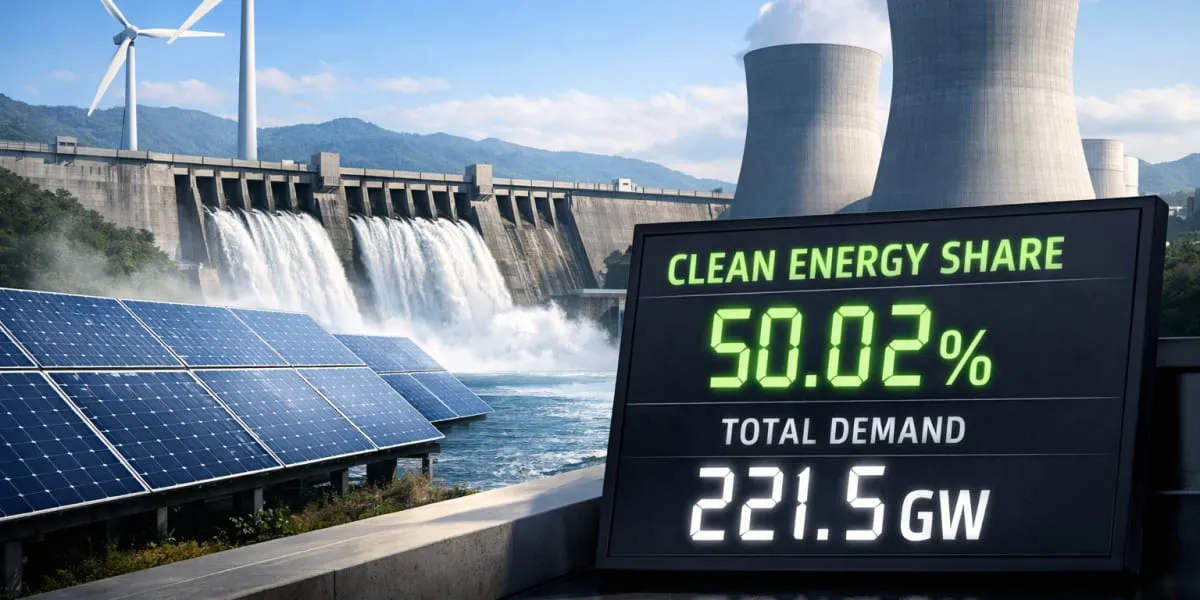
India's electricity grid recorded a milestone on July six when clean energy sources accounted for 50.02 per cent of national demand at 11:46 am, according to data from the power ministry's Merit Order Despatch of Electricity for Rejuvenation of Income and Transparency (MERIT). At that instant total demand stood at 221.5 gigawatt (GW). The figure marks the second consecutive year that non-fossil sources including renewable energy, hydropower and nuclear have met more than half of peak demand and reflects shifting supply dynamics.

Clean sources have supplied over 45 per cent of total electricity demand for 50 days since May, the Council on Energy, Environment and Water (CEEW) noted via fellow Disha Aggarwal, who said this signals a lasting change in the supply mix. CEEW research points to the need to scale flexible energy storage along with large-scale and distributed renewable systems to meet rising evening demand with low-cost renewables.

Peak power demand eased to 222.5 GW as of July six as rainfall across the country cooled temperatures, state-run Grid Controller of India data show. On July seven peak demand rose to 230 GW. Demand remains below the all-time high of 270.8 GW recorded in May, and the government has estimated peak demand could touch 271 GW in 2026.

India's total installed capacity was 542.3 GW as of May 31, with thermal capacity at 250.8 GW and renewable capacity at 282.7 GW. Analysts say shortfalls become most challenging in evening hours due to the non-availability of solar power and that increasing storage and flexibility will be vital. Experts also warned that an El Nino phase, characterised by warmer-than-normal Pacific sea temperatures, may bring harsher summer conditions and lift power demand.

India's electricity grid recorded a milestone on July six when clean energy sources accounted for 50.02 per cent of national demand at 11:46 am, according to data from the power ministry's Merit Order Despatch of Electricity for Rejuvenation of Income and Transparency (MERIT). At that instant total demand stood at 221.5 gigawatt (GW). The figure marks the second consecutive year that non-fossil sources including renewable energy, hydropower and nuclear have met more than half of peak demand and reflects shifting supply dynamics. Clean sources have supplied over 45 per cent of total electricity demand for 50 days since May, the Council on Energy, Environment and Water (CEEW) noted via fellow Disha Aggarwal, who said this signals a lasting change in the supply mix. CEEW research points to the need to scale flexible energy storage along with large-scale and distributed renewable systems to meet rising evening demand with low-cost renewables. Peak power demand eased to 222.5 GW as of July six as rainfall across the country cooled temperatures, state-run Grid Controller of India data show. On July seven peak demand rose to 230 GW. Demand remains below the all-time high of 270.8 GW recorded in May, and the government has estimated peak demand could touch 271 GW in 2026. India's total installed capacity was 542.3 GW as of May 31, with thermal capacity at 250.8 GW and renewable capacity at 282.7 GW. Analysts say shortfalls become most challenging in evening hours due to the non-availability of solar power and that increasing storage and flexibility will be vital. Experts also warned that an El Nino phase, characterised by warmer-than-normal Pacific sea temperatures, may bring harsher summer conditions and lift power demand.

Next Story
Infrastructure Transport

Surya Roshni delivers customised lighting for NCRTC RRTS stations

Surya Roshni has supplied customised indoor lighting solutions for 18 elevated stations on the National Capital Region Transport Corporation's (NCRTC) Rapid Rail Transit System (RRTS), strengthening its presence in India's infrastructure lighting segment.The project involved the design and deployment of lighting systems for platforms, concourses, foot overbridges (FOBs) and back-of-house (BOH) areas. According to the company, the luminaires were developed specifically to meet NCRTC's design, operational and performance requirements rather than using standard products.Surya introduced two custo..

Next Story
Real Estate

Hilton debuts Tapestry Collection brand in Vietnam

Hilton has opened NHAAN Resort & Spa Hoi An, Tapestry Collection by Hilton, marking the debut of the Tapestry Collection brand in Vietnam and expanding its lifestyle hospitality portfolio in Southeast Asia.Located along the Co Co River in Cam Thanh village, the 174-key resort provides access to Hoi An Ancient Town, Cua Dai Beach and the Cam Thanh Nipa Forest. The property has been designed by Vietnamese architect Vo Trong Nghia, incorporating biophilic architecture, locally sourced materials and riverfront landscapes.The resort offers a mix of guest rooms and suites, including family-frien..

Next Story
Building Material

Electrent expands lithium energy storage system portfolio

Electrent Energy has expanded its lithium-based energy storage portfolio with the launch of the ESS 850 and ESS 1050, targeting compact and maintenance-free power backup solutions for Indian homes.The new systems integrate a Home UPS and a LiFePO4 lithium battery into a single unit, extending the company's product range following the launch of its ESS 1350 and ESS 2500 models.Designed for apartments and smaller homes, the ESS 850 provides up to 1 hour 15 minutes of backup, while the ESS 1050 offers up to 1 hour 45 minutes on a typical 400 W household load. The systems can power essential appli..

Advertisement

Subscribe to Our Newsletter

Get daily newsletters around different themes from Construction world.

STAY CONNECTED

Advertisement

Advertisement

Advertisement