Southern Railway Chennai Division Adds Solar Across Stations
ECONOMY & POLICY

Southern Railway Chennai Division Adds Solar Across Stations

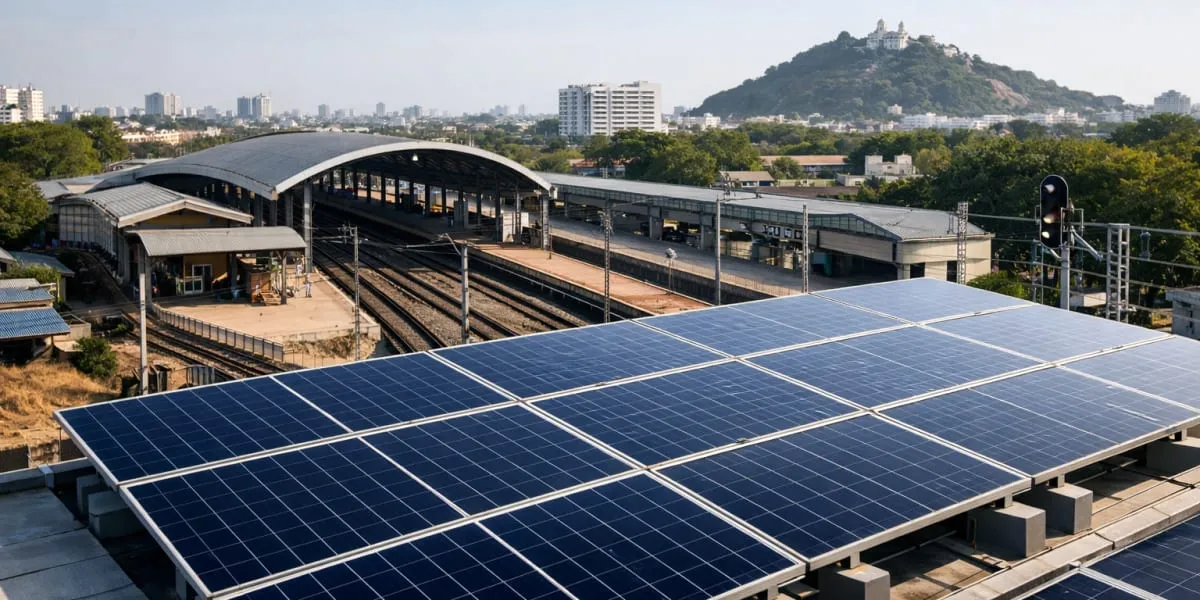
The Chennai Division of Southern Railway added 140 kilowatt (kW) of solar capacity during 2025–26 at St Thomas Mount station, Guindy station and training facilities in Avadi. The new installations raised the division's capacity by 140 kW and brought the total installed solar capacity to 2,494.5 kW. The division stated the additions form part of an ongoing push to expand renewable energy at stations and support facilities.

The new arrays are expected to generate around 0.204 million (mn) units of electricity annually, which the division estimated would reduce its grid draw and yield savings of about Rs 1.921 million (mn) a year. During 2025–26 the Chennai Division generated 2.315 million (mn) units of solar power from its installations, leading to estimated savings of about Rs 14.3 million (mn).

Solar systems have been deployed across stations, office buildings, sheds, platform shelters and training centres, including Chennai Central New Concourse Hall, Moore Market Complex, Tambaram, Chengalpattu, Kancheepuram, Katpadi, Arakkonam, Royapuram, Jolarpettai and Tiruvallur. The division reported that hybrid renewable systems combining windmills and solar units have also been trialled at selected sites to improve reliability and overall output.

Railways has set a target of adding another 2,600 kW of solar capacity across the network during 2026–27, and the Chennai Division said it would contribute its allotment as part of that national push. Officials indicated that continued deployment would focus on high-consumption locations to maximise financial and environmental benefits while reducing operational carbon intensity.

Division officials said the cumulative output and resulting cost savings would help lower operational expenses and support the upkeep of passenger amenities, lighting and signalling systems across busy stations. The measures were described as aligning with the wider rail energy strategy to reduce dependence on fossil fuels and to advance the network's sustainability and resilience goals.

The Chennai Division of Southern Railway added 140 kilowatt (kW) of solar capacity during 2025–26 at St Thomas Mount station, Guindy station and training facilities in Avadi. The new installations raised the division's capacity by 140 kW and brought the total installed solar capacity to 2,494.5 kW. The division stated the additions form part of an ongoing push to expand renewable energy at stations and support facilities. The new arrays are expected to generate around 0.204 million (mn) units of electricity annually, which the division estimated would reduce its grid draw and yield savings of about Rs 1.921 million (mn) a year. During 2025–26 the Chennai Division generated 2.315 million (mn) units of solar power from its installations, leading to estimated savings of about Rs 14.3 million (mn). Solar systems have been deployed across stations, office buildings, sheds, platform shelters and training centres, including Chennai Central New Concourse Hall, Moore Market Complex, Tambaram, Chengalpattu, Kancheepuram, Katpadi, Arakkonam, Royapuram, Jolarpettai and Tiruvallur. The division reported that hybrid renewable systems combining windmills and solar units have also been trialled at selected sites to improve reliability and overall output. Railways has set a target of adding another 2,600 kW of solar capacity across the network during 2026–27, and the Chennai Division said it would contribute its allotment as part of that national push. Officials indicated that continued deployment would focus on high-consumption locations to maximise financial and environmental benefits while reducing operational carbon intensity. Division officials said the cumulative output and resulting cost savings would help lower operational expenses and support the upkeep of passenger amenities, lighting and signalling systems across busy stations. The measures were described as aligning with the wider rail energy strategy to reduce dependence on fossil fuels and to advance the network's sustainability and resilience goals.

Next Story
Infrastructure Transport

Pune Division to Remove All Diamond Crossings by Year-End

The Pune railway division has announced plans to remove all 16 diamond crossings by the end of 2026 as part of a major yard remodelling project following the derailment of a Vande Bharat Express at Pune Junction on April 27. Railway authorities said the replacements aim to improve safety and streamline train operations across the busy station. The decision followed a Central Railway finding that the accident involved a non-standard diamond crossing and highlighted the need for replacement. Regular maintenance of existing crossings will continue until the replacement work is completed. Official..

Next Story
Infrastructure Urban

Goa Declares 80 Million Square Metres No Development Zone

The Goa state government has declared 80 million square metres (mn) of land a no development zone, designating the area as protected from new construction. The notification reclassifies tracts across the state under a no development category for planning and regulatory purposes. The declaration signals a formal halt to new building permits within the defined zone. Authorities indicated that maps will be issued to show broad boundaries while detailed surveys will refine precise limits. The move transfers responsibility for enforcement to local planning authorities and relevant departments, whic..

Next Story
Infrastructure Urban

Micro Mitti To Invest Rs Three Billion In Indore Project

Micro Mitti has announced an investment of Rs three billion (Rs 3 bn) to develop a commercial project in Indore. The company said the allocation marks a significant commitment to the city's real estate sector and will target commercial space demand. The announcement follows the firm's stated strategy to expand its asset base outside its existing markets. Company executives outlined the plan in a corporate release and provided limited additional details. The commercial project is intended to serve office, retail and related uses in response to demand from businesses and consumers in the region...

Advertisement

Subscribe to Our Newsletter

Get daily newsletters around different themes from Construction world.

STAY CONNECTED

Advertisement

Advertisement

Advertisement