IGL Opens India’s First Forecourt Rooftop Solar Plant
POWER & RENEWABLE ENERGY

IGL Opens India’s First Forecourt Rooftop Solar Plant

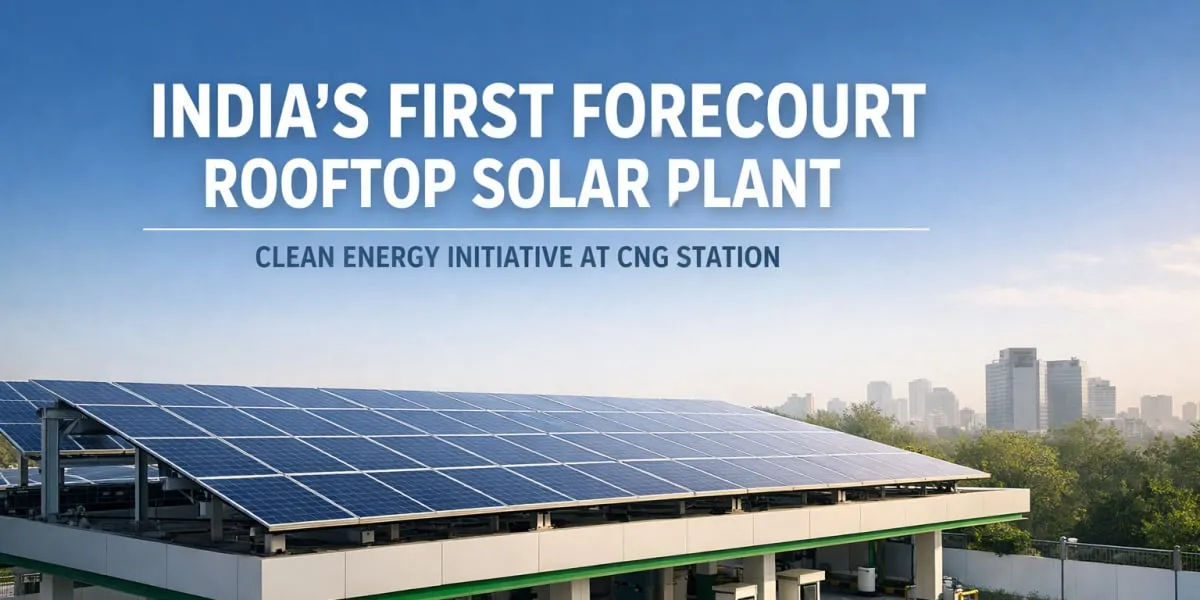
Indraprastha Gas Limited has commissioned India’s first forecourt area rooftop solar plant at the IFC-five compressed natural gas station in New Delhi. The company said the installation was inaugurated by Kamal Kishore Chatiwal, managing director, together with Mohit Bhatia, director (commercial). The initiative represents a milestone in IGL’s drive towards cleaner energy within its urban fuelling infrastructure.

The newly installed rooftop solar plant has an installed capacity of 32 kilowatt-peak (kW) direct current and is expected to generate around 44,000 units of electricity annually, the company said. The system will feed renewable power into station operations and reduce reliance on the local grid, enhancing energy resilience at the forecourt. The hardware was selected to suit constrained forecourt geometry while maintaining minimal visual impact and unobtrusive operation. The deployment demonstrates a compact renewable solution compatible with constrained urban rooftop spaces.

IGL indicated that integrating solar power into compressed natural gas infrastructure can contribute to lowering lifecycle carbon emissions associated with urban mobility and station operations. The project signals how city gas distribution companies can adapt renewable technologies to everyday facilities, offering a template for network-level replication. Such installations may enable operators to present clearer sustainability reporting and support green procurement criteria when upgrading assets. Operational benefits include potential reductions in operating costs and improved sustainability credentials for public facing assets.

Industry observers described the initiative as aligned with national objectives to accelerate renewable energy adoption, and the company presented it as support for climate-friendly energy practices. IGL said the pilot will inform roll-out strategies for similar forecourt installations across its network. IGL indicated that learnings from the pilot will inform technical standards and site selection for future roll-outs. The project is expected to encourage wider uptake of distributed solar among fuel retailers and urban infrastructure managers.

"Join industry leaders at RAHSTA Expo, India's premier platform for roads, highways and traffic infrastructure. Register now to explore innovations, network with experts and shape the future of mobility."

Indraprastha Gas Limited has commissioned India’s first forecourt area rooftop solar plant at the IFC-five compressed natural gas station in New Delhi. The company said the installation was inaugurated by Kamal Kishore Chatiwal, managing director, together with Mohit Bhatia, director (commercial). The initiative represents a milestone in IGL’s drive towards cleaner energy within its urban fuelling infrastructure. The newly installed rooftop solar plant has an installed capacity of 32 kilowatt-peak (kW) direct current and is expected to generate around 44,000 units of electricity annually, the company said. The system will feed renewable power into station operations and reduce reliance on the local grid, enhancing energy resilience at the forecourt. The hardware was selected to suit constrained forecourt geometry while maintaining minimal visual impact and unobtrusive operation. The deployment demonstrates a compact renewable solution compatible with constrained urban rooftop spaces. IGL indicated that integrating solar power into compressed natural gas infrastructure can contribute to lowering lifecycle carbon emissions associated with urban mobility and station operations. The project signals how city gas distribution companies can adapt renewable technologies to everyday facilities, offering a template for network-level replication. Such installations may enable operators to present clearer sustainability reporting and support green procurement criteria when upgrading assets. Operational benefits include potential reductions in operating costs and improved sustainability credentials for public facing assets. Industry observers described the initiative as aligned with national objectives to accelerate renewable energy adoption, and the company presented it as support for climate-friendly energy practices. IGL said the pilot will inform roll-out strategies for similar forecourt installations across its network. IGL indicated that learnings from the pilot will inform technical standards and site selection for future roll-outs. The project is expected to encourage wider uptake of distributed solar among fuel retailers and urban infrastructure managers.

Next Story
Infrastructure Energy

Beyond Backup Power

For decades, diesel gensets occupied a largely functional role in buildings: a mandatory backup system specified to meet statutory requirements and activated only during grid outages. Today, however, this perception is undergoing a profound shift. Across residential, commercial and mission-critical developments, developers, consultants and operators are increasingly viewing gensets as integral to a broader energy resilience strategy. Rising occupant expectations, growing dependence on digital systems and the proliferation of smart technologies mean that uninterrupted power has become essential..

Next Story
Infrastructure Transport

Mumbai-Pune Connecting Link is designed to ensure reliable all-weather, high-speed transport.

Infrastructure connectivity will be one of the keys to achieve Viksit Bharat. And the Mumbai-Pune Connecting Link has been developed as a long-term infrastructure solution for Western India. Dr Anilkumar Gaikwad, Vice Chairman & Managing Director, Maharashtra State Road Development Corporation (MSRDC), a speaker at the RAHSTA Expo 2026, elaborates upon the project and its significance.The Mumbai-Pune Connecting Link has largely been discussed as a travel-time reduction project. From MSRDC’s perspective, what larger infrastructure and mobility problem was this project actually designed to..

Next Story
Infrastructure Transport

Noida International Airport

Noida International Airport (NIA) is not just another capacity addition to India’s aviation map. It is a test case in whether India can build airport infrastructure that is scalable from Day 1, operationally efficient at launch, and resilient enough to grow without the familiar pain points of brownfield expansion.Its significance lies not merely in the first phase but in the way the airport has been planned for its fourth. Scheduled to begin commercial operations on 15 June 2026, NIA’s first phase comprises one runway and one passenger terminal designed to handle 12 million passengers annu..

Advertisement

Subscribe to Our Newsletter

Get daily newsletters around different themes from Construction world.

STAY CONNECTED

Advertisement

Advertisement

Advertisement