+
Karnataka Plans 26 GW Renewable Expansion With Rs Three tn Cost
POWER & RENEWABLE ENERGY

Karnataka Plans 26 GW Renewable Expansion With Rs Three tn Cost

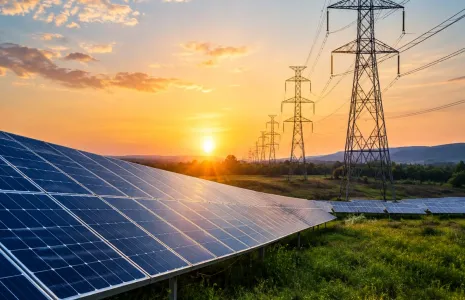
Karnataka could need around Rs three trillion (tn) by 2030 to add 26 gigawatt (GW) of renewable-energy capacity, MNRE Secretary Santosh Kumar Sarangi said. The investment requirement spans solar, wind, battery storage and clean-energy manufacturing, while transmission and grid integration were identified as critical to absorb the new capacity. The state currently has about 27 GW and is targeting another 10 GW by 2027 to reach roughly 37 GW.

Sarangi urged that Karnataka use the Bharat Renewable Energy Summit and Expo 2026 in New Delhi to showcase investment opportunities to multilateral institutions, pension funds, private equity investors and renewable-energy manufacturers. He said the state should highlight prospects across green hydrogen, renewable-energy manufacturing and hybrid projects while outlining transmission and storage needs. The summit, scheduled from November two to five, was presented as an opportunity for states to put forward project pipelines to domestic and international participants.

Gaurav Gupta, Additional Chief Secretary in the energy department, said grid connectivity and transmission often took two to three years and posed a bottleneck for developers. He noted delays on land acquisition and connectivity and said Karnataka was working with district administrations to expedite transmission projects. Among schemes under execution is a 765-kV transmission line linking Bijapur and Pune to facilitate flow into the national network.

Storage is being prioritised as renewable generation grows, with the state reported to have ordered or assigned around two point one gigawatt-hour (GWh) of battery energy storage and another zero point nine GWh under implementation. The projects include initiatives supported by the Centre’s viability-gap funding mechanism to integrate variable solar and wind output. Karnataka’s industrial policy targets Rs seven point five trillion (tn) and two million (mn) jobs between 2025 and 2030, linking clean-energy expansion to manufacturing and employment ambitions.

Karnataka could need around Rs three trillion (tn) by 2030 to add 26 gigawatt (GW) of renewable-energy capacity, MNRE Secretary Santosh Kumar Sarangi said. The investment requirement spans solar, wind, battery storage and clean-energy manufacturing, while transmission and grid integration were identified as critical to absorb the new capacity. The state currently has about 27 GW and is targeting another 10 GW by 2027 to reach roughly 37 GW. Sarangi urged that Karnataka use the Bharat Renewable Energy Summit and Expo 2026 in New Delhi to showcase investment opportunities to multilateral institutions, pension funds, private equity investors and renewable-energy manufacturers. He said the state should highlight prospects across green hydrogen, renewable-energy manufacturing and hybrid projects while outlining transmission and storage needs. The summit, scheduled from November two to five, was presented as an opportunity for states to put forward project pipelines to domestic and international participants. Gaurav Gupta, Additional Chief Secretary in the energy department, said grid connectivity and transmission often took two to three years and posed a bottleneck for developers. He noted delays on land acquisition and connectivity and said Karnataka was working with district administrations to expedite transmission projects. Among schemes under execution is a 765-kV transmission line linking Bijapur and Pune to facilitate flow into the national network. Storage is being prioritised as renewable generation grows, with the state reported to have ordered or assigned around two point one gigawatt-hour (GWh) of battery energy storage and another zero point nine GWh under implementation. The projects include initiatives supported by the Centre’s viability-gap funding mechanism to integrate variable solar and wind output. Karnataka’s industrial policy targets Rs seven point five trillion (tn) and two million (mn) jobs between 2025 and 2030, linking clean-energy expansion to manufacturing and employment ambitions.

Related Stories

Gold Stories

Next Story
Infrastructure Urban

Emiza Expands Bhiwandi Fulfilment Capacity by 2.32 Lakh Sq Ft

Emiza, a leading third-party logistics (3PL) provider, has expanded its Mumbai operations with the launch of two new fulfilment facilities in Bhiwandi, adding a combined capacity of 2.32 lakh sq ft to its network.The new facilities, spread across 75,000 sq ft and 1,57,000 sq ft, mark Emiza’s fifth and sixth warehouses in the Mumbai region. The expansion strengthens the company’s fulfilment infrastructure in Western India amid the rapid growth of India’s digital commerce ecosystem.With increasing online consumption, wider product categories and rising customer expectations for faster deli..

Next Story
Infrastructure Urban

Ingersoll Rand Showcases Air Solutions for Semiconductor Sector

Ingersoll Rand will showcase its advanced compressed air solutions for India’s growing semiconductor ecosystem at SEMICON India 2026, scheduled from September 17–19 at Yashobhoomi, New Delhi.The company will display its portfolio of oil-free compressors, centrifugal compression technologies and advanced air treatment systems at Stall No. 1156, Hall No. 1. The solutions are designed to address the stringent air quality, reliability and efficiency requirements of semiconductor manufacturing applications.With India accelerating investments across semiconductor manufacturing, packaging, equipm..

Next Story
Infrastructure Energy

RECPDCL Transfers Musalgaon Transmission SPV to MSETCL

REC Power Development and Consultancy Limited (RECPDCL), a wholly owned subsidiary of REC Limited, has handed over Musalgaon Power Transmission Limited, a project-specific Special Purpose Vehicle (SPV), to Maharashtra State Electricity Transmission Company Limited (MSETCL).MSETCL emerged as the successful bidder through the Tariff-Based Competitive Bidding (TBCB) process conducted by RECPDCL, the Bid Process Coordinator, for developing Maharashtra’s intra-state transmission project on a Build, Own, Operate and Transfer (BOOT) basis.The SPV was handed over by Shri Ratnesh Kumar, General Manag..

Advertisement

Subscribe to Our Newsletter

Get daily newsletters around different themes from Construction world.

STAY CONNECTED

Advertisement

SPECIAL OFFER
QR Code