Kashi Ranks 10th In Country For Rooftop Solar Installations
POWER & RENEWABLE ENERGY

Kashi Ranks 10th In Country For Rooftop Solar Installations

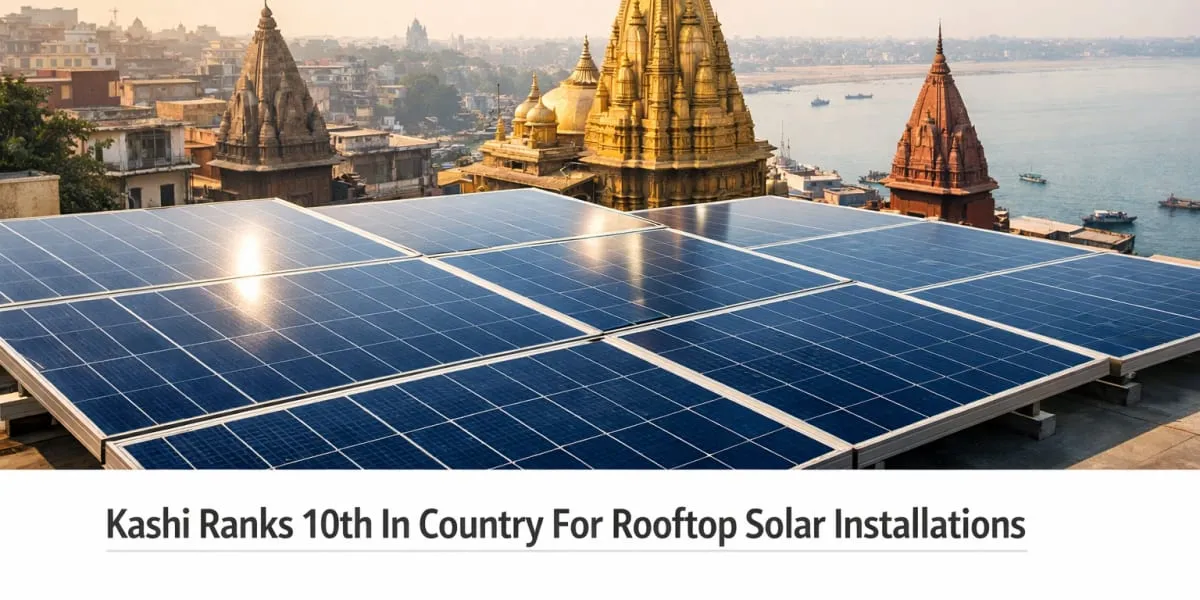
The religious city of Kashi is establishing a new identity in green energy as it rapidly adopts rooftop solar under the Pradhan Mantri Surya Ghar Free Electricity Scheme across households, temples and small businesses. The ancient city, a blend of tradition and modernity, has surpassed several major urban centres and secured the 10th position nationally for rooftop solar panel installations. Local authorities attribute the progress to active enrolment, targeted outreach, subsidy facilitation and installation camps that have encouraged residents to opt for solar systems. The municipal administration and state agencies have coordinated to simplify application, approvals and grid interface assistance to support rollout.

To date, 39,018 rooftop solar plants have been installed in Varanasi across rooftops of varying sizes and system capacities. The Chief Development Officer, Prakhar Kumar Singh, said that the district has received 62,964 applications under the scheme and that about 39,018 installations have been completed across the various related programmes, representing a strong conversion rate from applications to commissioned systems. The installations include residential, institutional and small commercial systems, ranging from basic household systems to larger arrays on public buildings. Municipal facilitation has helped address permitting, subsidy disbursal and grid connection issues to speed commissioning.

The district has an installed capacity of approximately 132.10 megawatt (MW), equivalent to a substantial distributed generation resource that contributes to local daytime demand, making Varanasi one of the leading districts in the state for green energy deployment. Varanasi has consistently ranked second in the state after Lucknow for several months and the installed capacity underscores steady uptake of rooftop systems and narrowing gaps with peers. Officials noted that local training, certification measures and service provision for installation and maintenance have supported the technical backbone required for rapid expansion.

Continued expansion of rooftop systems is projected to enhance energy security, reduce pressure on the central distribution network and lower household electricity bills while supporting livelihoods through installation and upkeep services. The published figures encompass all related schemes under the programme and demonstrate that a heritage city can advance contemporary sustainability goals alongside cultural priorities, offering a model for similar districts. Authorities plan to sustain momentum through sustained awareness campaigns, simplified procedures, targeted support and capacity building to encourage further uptake and ensure system performance.

The religious city of Kashi is establishing a new identity in green energy as it rapidly adopts rooftop solar under the Pradhan Mantri Surya Ghar Free Electricity Scheme across households, temples and small businesses. The ancient city, a blend of tradition and modernity, has surpassed several major urban centres and secured the 10th position nationally for rooftop solar panel installations. Local authorities attribute the progress to active enrolment, targeted outreach, subsidy facilitation and installation camps that have encouraged residents to opt for solar systems. The municipal administration and state agencies have coordinated to simplify application, approvals and grid interface assistance to support rollout. To date, 39,018 rooftop solar plants have been installed in Varanasi across rooftops of varying sizes and system capacities. The Chief Development Officer, Prakhar Kumar Singh, said that the district has received 62,964 applications under the scheme and that about 39,018 installations have been completed across the various related programmes, representing a strong conversion rate from applications to commissioned systems. The installations include residential, institutional and small commercial systems, ranging from basic household systems to larger arrays on public buildings. Municipal facilitation has helped address permitting, subsidy disbursal and grid connection issues to speed commissioning. The district has an installed capacity of approximately 132.10 megawatt (MW), equivalent to a substantial distributed generation resource that contributes to local daytime demand, making Varanasi one of the leading districts in the state for green energy deployment. Varanasi has consistently ranked second in the state after Lucknow for several months and the installed capacity underscores steady uptake of rooftop systems and narrowing gaps with peers. Officials noted that local training, certification measures and service provision for installation and maintenance have supported the technical backbone required for rapid expansion. Continued expansion of rooftop systems is projected to enhance energy security, reduce pressure on the central distribution network and lower household electricity bills while supporting livelihoods through installation and upkeep services. The published figures encompass all related schemes under the programme and demonstrate that a heritage city can advance contemporary sustainability goals alongside cultural priorities, offering a model for similar districts. Authorities plan to sustain momentum through sustained awareness campaigns, simplified procedures, targeted support and capacity building to encourage further uptake and ensure system performance.

Next Story
Building Material

Enlight Metals to Expand Raipur Plant Capacity

Enlight Metals has announced plans to expand the production capacity of its Raipur manufacturing facility from around 1,200 tonnes to nearly 4,000 tonnes.The expansion is aimed at strengthening the company’s ability to serve rising demand across industrial, infrastructure and contract manufacturing requirements.Located in Raipur, Chhattisgarh, the facility serves as a key manufacturing hub for Enlight Metals. The planned capacity enhancement is expected to improve supply capabilities, operational efficiency and the company’s ability to handle larger project requirements.The facility includ..

Next Story
Infrastructure Urban

Hindustan Zinc Partners Sulfozyme for Zinc Park Project

Hindustan Zinc has signed a Memorandum of Understanding with Sulfozyme Agro India under its Zinc Industrial Park initiative at Khankhala in Bhilwara district, Rajasthan. The partnership aims to strengthen India’s downstream zinc sector through sustainable metal recovery, resource efficiency and industrial development.Under the agreement, Sulfozyme Agro will establish proposed operations at the Zinc Industrial Park to process zinc-based materials into value-added products for industrial and downstream applications.Hindustan Zinc will support the venture through assured raw material linkage an..

Next Story
Infrastructure Urban

Cortec MCI Technology Restores Croatia Monuments

Cortec’s Migrating Corrosion Inhibitor technology has been used in restoration works for historic monuments in Croatia, including the Church of St Donatus in Zadar and the medieval city walls of Ilok.The Church of St Donatus, one of the most significant pre-Romanesque churches in Europe, is listed in the Register of Cultural Goods of the Republic of Croatia and is under UNESCO protection. The monument required urgent rehabilitation after 3D scanning analysis identified critical issues in the church walls, main structure and roof.The reinforced concrete support structure beneath the roof, ins..

Advertisement

Subscribe to Our Newsletter

Get daily newsletters around different themes from Construction world.

STAY CONNECTED

Advertisement

Advertisement

Advertisement