+
PM Launches Rs 56 Billion Projects In Tiruchirappalli
POWER & RENEWABLE ENERGY

PM Launches Rs 56 Billion Projects In Tiruchirappalli

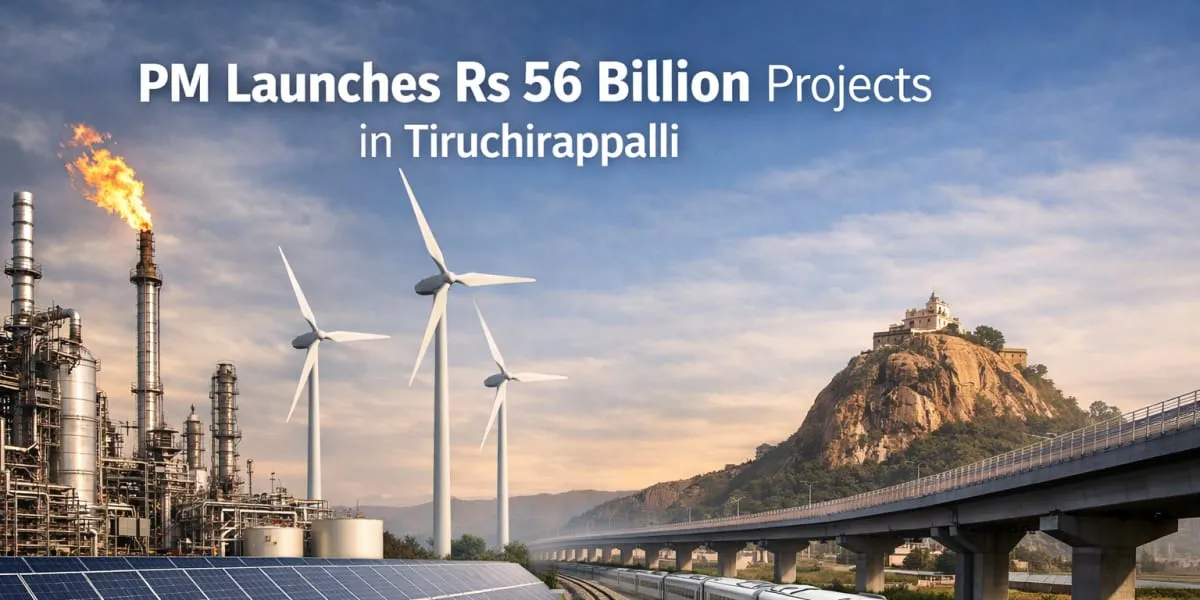
Prime Minister Narendra Modi visited Tiruchirappalli to inaugurate and dedicate multiple development projects covering infrastructure for clean energy, petroleum-related manufacturing, highways, railways and rural roads. The initiatives represent a combined investment of Rs 56 billion (Rs 56 bn) and are intended to expand energy access, improve connectivity and generate thousands of jobs for the youth of Tamil Nadu. Officials said the programme seeks to integrate regional growth with national development priorities.

He laid the foundation stone for Bharat Petroleum's city gas distribution network, a Rs 37 billion (Rs 37 bn) project that will extend piped natural gas to nearly 0.9 million (0.9 mn) families and numerous commercial establishments across Nilgiris and Erode districts. Authorities projected that reduced emissions and fuel substitution from the network over eight years would yield environmental benefits comparable to planting 40 million (40 mn) trees. The project was presented as a major step towards cleaner urban and peri-urban energy supply.

The Prime Minister dedicated Indian Oil Corporation's new lube blending plant in Chennai to the nation, describing it as one of the largest facilities of its kind worldwide and a reinforcement of the Make in India initiative. The plant is expected to increase domestic production of lubricants, reduce import dependence and improve supply chains for multiple industries. Officials indicated that local manufacturing capacity will support regional industry and contribute to export potential.

He inaugurated 370 kilometres of rural roads constructed under the Pradhan Mantri Gram Sadak Yojana, which are expected to enhance villagers' access to healthcare, education and markets and to strengthen the rural economy. A proposed highway bypass at Gangaikonda Cholapuram aims to protect the UNESCO recognised temple by diverting heavy traffic. The Prime Minister also noted the modernisation of eight stations under the Amrit Bharat programme and flagged off new train services to boost tourism and trade, reiterating the goal of a developed Tamil Nadu for a developed India.

Prime Minister Narendra Modi visited Tiruchirappalli to inaugurate and dedicate multiple development projects covering infrastructure for clean energy, petroleum-related manufacturing, highways, railways and rural roads. The initiatives represent a combined investment of Rs 56 billion (Rs 56 bn) and are intended to expand energy access, improve connectivity and generate thousands of jobs for the youth of Tamil Nadu. Officials said the programme seeks to integrate regional growth with national development priorities. He laid the foundation stone for Bharat Petroleum's city gas distribution network, a Rs 37 billion (Rs 37 bn) project that will extend piped natural gas to nearly 0.9 million (0.9 mn) families and numerous commercial establishments across Nilgiris and Erode districts. Authorities projected that reduced emissions and fuel substitution from the network over eight years would yield environmental benefits comparable to planting 40 million (40 mn) trees. The project was presented as a major step towards cleaner urban and peri-urban energy supply. The Prime Minister dedicated Indian Oil Corporation's new lube blending plant in Chennai to the nation, describing it as one of the largest facilities of its kind worldwide and a reinforcement of the Make in India initiative. The plant is expected to increase domestic production of lubricants, reduce import dependence and improve supply chains for multiple industries. Officials indicated that local manufacturing capacity will support regional industry and contribute to export potential. He inaugurated 370 kilometres of rural roads constructed under the Pradhan Mantri Gram Sadak Yojana, which are expected to enhance villagers' access to healthcare, education and markets and to strengthen the rural economy. A proposed highway bypass at Gangaikonda Cholapuram aims to protect the UNESCO recognised temple by diverting heavy traffic. The Prime Minister also noted the modernisation of eight stations under the Amrit Bharat programme and flagged off new train services to boost tourism and trade, reiterating the goal of a developed Tamil Nadu for a developed India.

Next Story
Infrastructure Urban

Implementation Status of Jal Jeevan Mission

Since August 2019 the Government has implemented Jal Jeevan Mission to provide assured potable water through household tap connections in rural India. At the start of the mission only 32.3 million (mn) rural households, representing 16.7 per cent, were reported to have tap water connections. States and union territories have reported that 125.8 mn additional rural households have since been provided with tap connections. As a result, of about 193.6 mn rural households roughly 158.2 mn, or 81.71 per cent, are reported to have tap water supply at home.\n\nThe State, district and village level st..

Next Story
Infrastructure Urban

Jal Jeevan Mission Reaches Eighty One Per Cent Rural Coverage

The Government reported substantial progress under the Jal Jeevan Mission, launched in August 2019 to provide tap water to every rural household. At launch only 32.3 million (mn) rural households had tap connections and states and Union territories reported provision of 125.8 mn additional households by March 2026. Consequently, out of about 193.6 mn rural households around 158.2 mn, or 81.71 per cent, are reported to have tap water at home. The Finance Minister announced extension of the mission until 2028 in the 2025-26 budget speech. The Swachh Bharat Mission Grameen, launched in October 20..

Next Story
Infrastructure Urban

Empowering Local Governance for Sustainable Rural Water Supply

The Ministry of Jal Shakti has aligned the Jal Jeevan Mission (JJM) with the 73rd Amendment to strengthen village level planning and community ownership of water supply. Gram Panchayats, village water and sanitation committees and Pani Samitis are to plan, implement, manage and maintain piped water systems, with gram sabha processes formalising handover and oversight. Implementation support agencies including non government organisations, community based organisations and self help groups have been empanelled to train local committees and promote women participation. Under JJM, the department ..

Advertisement

Subscribe to Our Newsletter

Get daily newsletters around different themes from Construction world.

STAY CONNECTED

Advertisement

Advertisement

Advertisement