Amagi Launches AdFlow Orchestrator To Maximise FAST Revenue
ECONOMY & POLICY

Amagi Launches AdFlow Orchestrator To Maximise FAST Revenue

Amagi has launched AdFlow Orchestrator, a Placement Opportunity Information Service (POIS)-based tool to improve monetisation for Free Ad-supported Streaming TV (FAST) channels. Amagi, an industry cloud platform for unified broadcast, streaming and monetisation, designed the product to bridge structural gaps between linear broadcast and streaming ad ecosystems. The POIS framework applies business logic to ad placement signals.

Broadcasters face a mismatch because linear TV feeds routinely carry four to eight minute ad pods that many FAST platforms reject, causing ad server timeouts and steep falls in fill rates. This prevents broadcasters from realising their monetisation potential on FAST platforms. AdFlow Orchestrator automatically conditions and restructures SCTE?35 ad markers to make each opportunity compliant.

The tool sits adjacent to the video supply chain and aligns broadcast signals with the specific requirements of distribution partners, ensuring every ad opportunity is valid, reachable and optimised for yield. Built on the SCTE 130-5 POIS standard, AdFlow Orchestrator applies business logic at scale to adapt break structures without altering core playout workflows. Company executives said automation reduces ad server timeouts, improves fill rates and preserves the viewer experience demanded by streaming services.

It offers automated pod splitting to restructure broadcast?length breaks into shorter, platform?compliant pods to prevent feed rejections. Dynamic slate replacement substitutes static slates and channel promos with curated interstitial video to maintain engagement and prevent drop?offs. Metadata enrichment adds electronic programme guide data to ad signals, which the company associates with CPM uplifts of 20 per cent. Advanced stream event control provides input switching for blackout scenarios and alternate content playback triggered by stream events.

AdFlow Orchestrator is deployed across 50+ channels and is reported to deliver material improvements in monetisation within weeks, giving content partners flexibility to meet strict platform standards cost effectively. The solution can be used standalone or integrated into existing Amagi workflows and is designed for interoperability with leading transcoding, packaging and CDN infrastructure. It is available now and will be demonstrated at the NAB Show 2026, Booth W2331.

Amagi has launched AdFlow Orchestrator, a Placement Opportunity Information Service (POIS)-based tool to improve monetisation for Free Ad-supported Streaming TV (FAST) channels. Amagi, an industry cloud platform for unified broadcast, streaming and monetisation, designed the product to bridge structural gaps between linear broadcast and streaming ad ecosystems. The POIS framework applies business logic to ad placement signals. Broadcasters face a mismatch because linear TV feeds routinely carry four to eight minute ad pods that many FAST platforms reject, causing ad server timeouts and steep falls in fill rates. This prevents broadcasters from realising their monetisation potential on FAST platforms. AdFlow Orchestrator automatically conditions and restructures SCTE?35 ad markers to make each opportunity compliant. The tool sits adjacent to the video supply chain and aligns broadcast signals with the specific requirements of distribution partners, ensuring every ad opportunity is valid, reachable and optimised for yield. Built on the SCTE 130-5 POIS standard, AdFlow Orchestrator applies business logic at scale to adapt break structures without altering core playout workflows. Company executives said automation reduces ad server timeouts, improves fill rates and preserves the viewer experience demanded by streaming services. It offers automated pod splitting to restructure broadcast?length breaks into shorter, platform?compliant pods to prevent feed rejections. Dynamic slate replacement substitutes static slates and channel promos with curated interstitial video to maintain engagement and prevent drop?offs. Metadata enrichment adds electronic programme guide data to ad signals, which the company associates with CPM uplifts of 20 per cent. Advanced stream event control provides input switching for blackout scenarios and alternate content playback triggered by stream events. AdFlow Orchestrator is deployed across 50+ channels and is reported to deliver material improvements in monetisation within weeks, giving content partners flexibility to meet strict platform standards cost effectively. The solution can be used standalone or integrated into existing Amagi workflows and is designed for interoperability with leading transcoding, packaging and CDN infrastructure. It is available now and will be demonstrated at the NAB Show 2026, Booth W2331.

Related Stories

Gold Stories

Next Story
Infrastructure Urban

KONE Opens India's First Digital Experience Centre in Pune

KONE, a global elevator and escalator manufacturer, has inaugurated its first Digital Experience Centre (DEC) in India, located in Pune. The facility aims to showcase how artificial intelligence (AI), connectivity and data-driven technologies can enhance customer experiences and improve building operations.The centre was inaugurated by Jussi Herlin, Executive Vice Chair, KONE Corporation; Philippe Delorme, President and CEO, KONE; and Nandan Nilekani, Co-founder and Chairman of the Board, Infosys.Designed as an interactive customer environment, the facility demonstrates digital solutions cover..

Next Story
Infrastructure Urban

CII GreenCo Launches Circularity Guidelines for Indian Industry

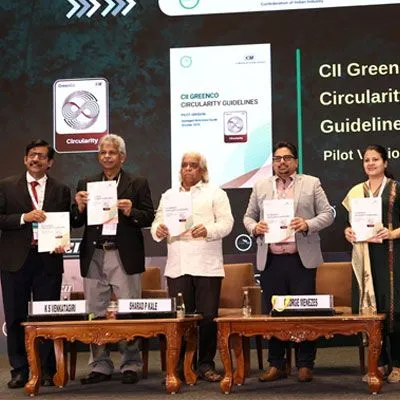
The Confederation of Indian Industry (CII) GreenCo Council has launched the CII GreenCo Circularity Guidelines – Pilot Version at the 17th CII GreenCo Waste & Resource Management Summit 2026 in Chennai. The initiative aims to strengthen resource efficiency, waste reduction and circular economy practices across Indian manufacturing and process industries.The guidelines introduce a structured framework with circularity indices covering raw materials, consumables, packaging and other resource inputs. These indicators will help industries assess existing practices, identify opportunities to ..

Next Story
Infrastructure Energy

Global Electronics Association Launches IPC-1783-CO2E Standard

The Global Electronics Association has introduced IPC-1783-CO2E, a new international standard aimed at improving consistency, transparency and comparability in product carbon footprint reporting across the electronics manufacturing industry.The standard, titled International Standard for Data Collection and Reporting of CO2 Equivalent (CO2e) Emissions for the Electronics Manufacturing Supply Chain, provides industry-specific guidance for collecting, estimating and reporting carbon emissions data.With increasing regulatory requirements and customer expectations, electronics manufacturers face c..

Advertisement

Subscribe to Our Newsletter

Get daily newsletters around different themes from Construction world.

STAY CONNECTED

Advertisement

SPECIAL OFFER
QR Code