



+
Belagavi Completes 98 Per Cent Of Smart City Works
ECONOMY & POLICY

Belagavi Completes 98 Per Cent Of Smart City Works

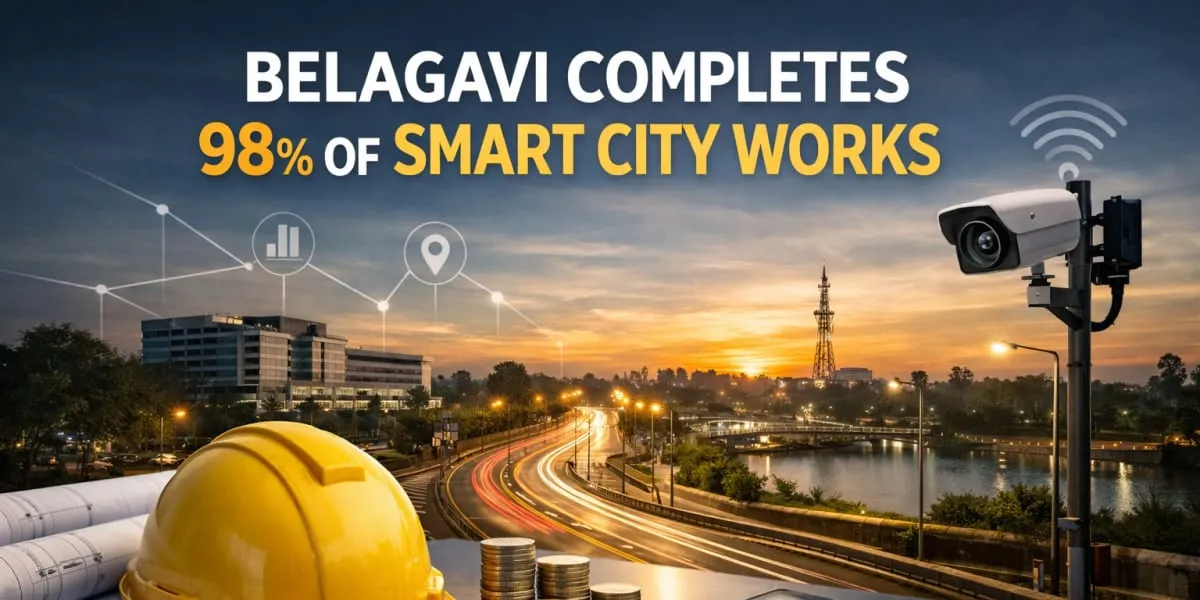
Belagavi has completed 98 per cent of projects sanctioned under the Smart Cities Mission, with the Union Ministry of Housing and Urban Affairs informing the Rajya Sabha that most works are finished and the remainder are under implementation. Belagavi Smart City Limited (BSCL) has received central financial assistance of Rs 4,900 million (mn), representing 100 per cent of the total central share allocated to the city, and the ministry stated that the entire amount has been utilised. The update was provided in response to a question from a Rajya Sabha member and set out the overall progress of the programme.

Out of a total of 217 projects with an aggregate value of Rs 27,800 mn, 212 projects valued at Rs 27,220 mn have been completed and five projects worth Rs 580 mn are currently under implementation. The figures indicate substantial completion across infrastructure, civic amenities and heritage works that formed part of the sanctioned interventions. The ministry supplied a project-wise breakdown to clarify the status of major components.

Among the key initiatives, the Integrated Command and Control Centre (ICCC) and the first and third phases of the Heritage Park have been completed, while work on Heritage Park Phase two remains underway. The ministry also clarified that the Tilakwadi Master Plan, the vacuum sewer network and the round the clock water supply pilot project do not form part of the Smart Cities Mission portfolio. Project completions were cited as contributing to urban service delivery and public amenities in the municipal area.

The Karnataka Urban Infrastructure Development and Finance Corporation Ltd. (KUIDFC) first appointed the Karnataka Monitoring and Evaluation Authority (KMEA) to assess the impact of completed projects on quality of life and to monitor outcomes. The monitoring authority is expected to evaluate how interventions have affected service provision and urban livability across neighbourhoods. The ministry said Belagavi is nearing completion of its Smart Cities programme, with only a handful of projects remaining to be finished.

Belagavi has completed 98 per cent of projects sanctioned under the Smart Cities Mission, with the Union Ministry of Housing and Urban Affairs informing the Rajya Sabha that most works are finished and the remainder are under implementation. Belagavi Smart City Limited (BSCL) has received central financial assistance of Rs 4,900 million (mn), representing 100 per cent of the total central share allocated to the city, and the ministry stated that the entire amount has been utilised. The update was provided in response to a question from a Rajya Sabha member and set out the overall progress of the programme. Out of a total of 217 projects with an aggregate value of Rs 27,800 mn, 212 projects valued at Rs 27,220 mn have been completed and five projects worth Rs 580 mn are currently under implementation. The figures indicate substantial completion across infrastructure, civic amenities and heritage works that formed part of the sanctioned interventions. The ministry supplied a project-wise breakdown to clarify the status of major components. Among the key initiatives, the Integrated Command and Control Centre (ICCC) and the first and third phases of the Heritage Park have been completed, while work on Heritage Park Phase two remains underway. The ministry also clarified that the Tilakwadi Master Plan, the vacuum sewer network and the round the clock water supply pilot project do not form part of the Smart Cities Mission portfolio. Project completions were cited as contributing to urban service delivery and public amenities in the municipal area. The Karnataka Urban Infrastructure Development and Finance Corporation Ltd. (KUIDFC) first appointed the Karnataka Monitoring and Evaluation Authority (KMEA) to assess the impact of completed projects on quality of life and to monitor outcomes. The monitoring authority is expected to evaluate how interventions have affected service provision and urban livability across neighbourhoods. The ministry said Belagavi is nearing completion of its Smart Cities programme, with only a handful of projects remaining to be finished.

Next Story
Infrastructure Urban

Implementation Status of Jal Jeevan Mission

Since August 2019 the Government has implemented Jal Jeevan Mission to provide assured potable water through household tap connections in rural India. At the start of the mission only 32.3 million (mn) rural households, representing 16.7 per cent, were reported to have tap water connections. States and union territories have reported that 125.8 mn additional rural households have since been provided with tap connections. As a result, of about 193.6 mn rural households roughly 158.2 mn, or 81.71 per cent, are reported to have tap water supply at home.\n\nThe State, district and village level st..

Next Story
Infrastructure Urban

Jal Jeevan Mission Reaches Eighty One Per Cent Rural Coverage

The Government reported substantial progress under the Jal Jeevan Mission, launched in August 2019 to provide tap water to every rural household. At launch only 32.3 million (mn) rural households had tap connections and states and Union territories reported provision of 125.8 mn additional households by March 2026. Consequently, out of about 193.6 mn rural households around 158.2 mn, or 81.71 per cent, are reported to have tap water at home. The Finance Minister announced extension of the mission until 2028 in the 2025-26 budget speech. The Swachh Bharat Mission Grameen, launched in October 20..

Next Story
Infrastructure Urban

Empowering Local Governance for Sustainable Rural Water Supply

The Ministry of Jal Shakti has aligned the Jal Jeevan Mission (JJM) with the 73rd Amendment to strengthen village level planning and community ownership of water supply. Gram Panchayats, village water and sanitation committees and Pani Samitis are to plan, implement, manage and maintain piped water systems, with gram sabha processes formalising handover and oversight. Implementation support agencies including non government organisations, community based organisations and self help groups have been empanelled to train local committees and promote women participation. Under JJM, the department ..

Advertisement

Subscribe to Our Newsletter

Get daily newsletters around different themes from Construction world.

STAY CONNECTED

Advertisement

Advertisement

Advertisement