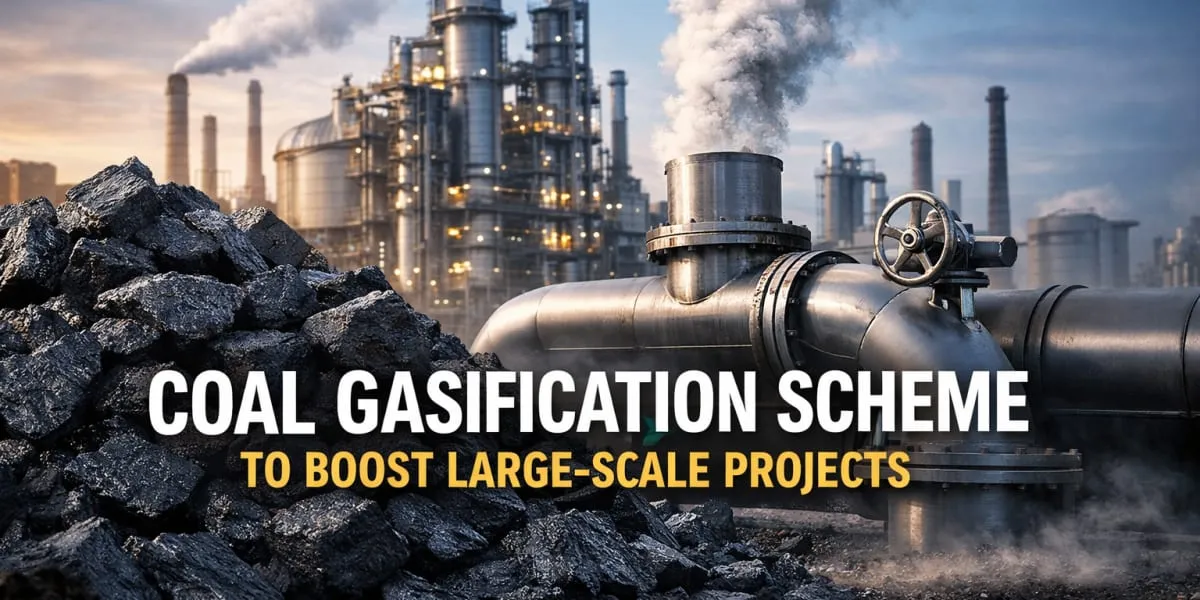
Coal Gasification Scheme To Boost Large-Scale Projects
ECONOMY & POLICY

Coal Gasification Scheme To Boost Large-Scale Projects

Union Minister Kishan Reddy said the Coal Gasification Scheme will provide momentum to large scale projects and accelerate the development of domestic feedstock for chemicals and fertilisers. The scheme is designed to convert coal into synthesis gas that can be used as a clean industrial feedstock, supporting substitution for imported intermediates. The minister indicated that greater scale will improve project economics and attract private investment.

The government plans to implement the scheme through a mix of policy support and targeted incentives to reduce initial capital risk and spur clustered development. Officials will encourage ports and logistics providers to synchronise with project timelines to cut transport costs and ensure timely feedstock supply. The approach is expected to shorten gestation periods and enable faster commissioning of plants.

The scheme is anticipated to catalyse activity in the petrochemical and fertiliser sectors and create manufacturing hubs in coal bearing regions. Construction and operational phases are likely to generate employment and stimulate ancillary industries such as equipment fabrication and storage services. Industry bodies have been asked to prepare frameworks for technology adoption and skill development.

Ministry officials will work with state governments to secure land, clearances and infrastructure while maintaining environmental safeguards and emission management. The programme will promote modern gasification technologies and provisions for carbon management to align with national sustainability goals. The minister said the initiative will strengthen energy security and lay the groundwork for larger investments in downstream manufacturing.

Authorities will engage domestic research institutions and technical partners to adapt gasification designs to local coal characteristics and to improve efficiency and emissions performance. Financing mechanisms will include facilitation for project developers and exploration of public private partnership models to mobilise long term capital. The phased roll out will be monitored through performance metrics to inform subsequent scaling and policy adjustments.

Union Minister Kishan Reddy said the Coal Gasification Scheme will provide momentum to large scale projects and accelerate the development of domestic feedstock for chemicals and fertilisers. The scheme is designed to convert coal into synthesis gas that can be used as a clean industrial feedstock, supporting substitution for imported intermediates. The minister indicated that greater scale will improve project economics and attract private investment. The government plans to implement the scheme through a mix of policy support and targeted incentives to reduce initial capital risk and spur clustered development. Officials will encourage ports and logistics providers to synchronise with project timelines to cut transport costs and ensure timely feedstock supply. The approach is expected to shorten gestation periods and enable faster commissioning of plants. The scheme is anticipated to catalyse activity in the petrochemical and fertiliser sectors and create manufacturing hubs in coal bearing regions. Construction and operational phases are likely to generate employment and stimulate ancillary industries such as equipment fabrication and storage services. Industry bodies have been asked to prepare frameworks for technology adoption and skill development. Ministry officials will work with state governments to secure land, clearances and infrastructure while maintaining environmental safeguards and emission management. The programme will promote modern gasification technologies and provisions for carbon management to align with national sustainability goals. The minister said the initiative will strengthen energy security and lay the groundwork for larger investments in downstream manufacturing. Authorities will engage domestic research institutions and technical partners to adapt gasification designs to local coal characteristics and to improve efficiency and emissions performance. Financing mechanisms will include facilitation for project developers and exploration of public private partnership models to mobilise long term capital. The phased roll out will be monitored through performance metrics to inform subsequent scaling and policy adjustments.

Related Stories

Gold Stories

Next Story
Infrastructure Urban

KONE Opens India's First Digital Experience Centre in Pune

KONE, a global elevator and escalator manufacturer, has inaugurated its first Digital Experience Centre (DEC) in India, located in Pune. The facility aims to showcase how artificial intelligence (AI), connectivity and data-driven technologies can enhance customer experiences and improve building operations.The centre was inaugurated by Jussi Herlin, Executive Vice Chair, KONE Corporation; Philippe Delorme, President and CEO, KONE; and Nandan Nilekani, Co-founder and Chairman of the Board, Infosys.Designed as an interactive customer environment, the facility demonstrates digital solutions cover..

Next Story
Infrastructure Urban

CII GreenCo Launches Circularity Guidelines for Indian Industry

The Confederation of Indian Industry (CII) GreenCo Council has launched the CII GreenCo Circularity Guidelines – Pilot Version at the 17th CII GreenCo Waste & Resource Management Summit 2026 in Chennai. The initiative aims to strengthen resource efficiency, waste reduction and circular economy practices across Indian manufacturing and process industries.The guidelines introduce a structured framework with circularity indices covering raw materials, consumables, packaging and other resource inputs. These indicators will help industries assess existing practices, identify opportunities to ..

Next Story
Infrastructure Energy

Global Electronics Association Launches IPC-1783-CO2E Standard

The Global Electronics Association has introduced IPC-1783-CO2E, a new international standard aimed at improving consistency, transparency and comparability in product carbon footprint reporting across the electronics manufacturing industry.The standard, titled International Standard for Data Collection and Reporting of CO2 Equivalent (CO2e) Emissions for the Electronics Manufacturing Supply Chain, provides industry-specific guidance for collecting, estimating and reporting carbon emissions data.With increasing regulatory requirements and customer expectations, electronics manufacturers face c..

Advertisement

Subscribe to Our Newsletter

Get daily newsletters around different themes from Construction world.

STAY CONNECTED

Advertisement

SPECIAL OFFER
QR Code