Delhi Approves PARIVARTAN Scheme To Replace Old Trucks And Buses
ECONOMY & POLICY

Delhi Approves PARIVARTAN Scheme To Replace Old Trucks And Buses

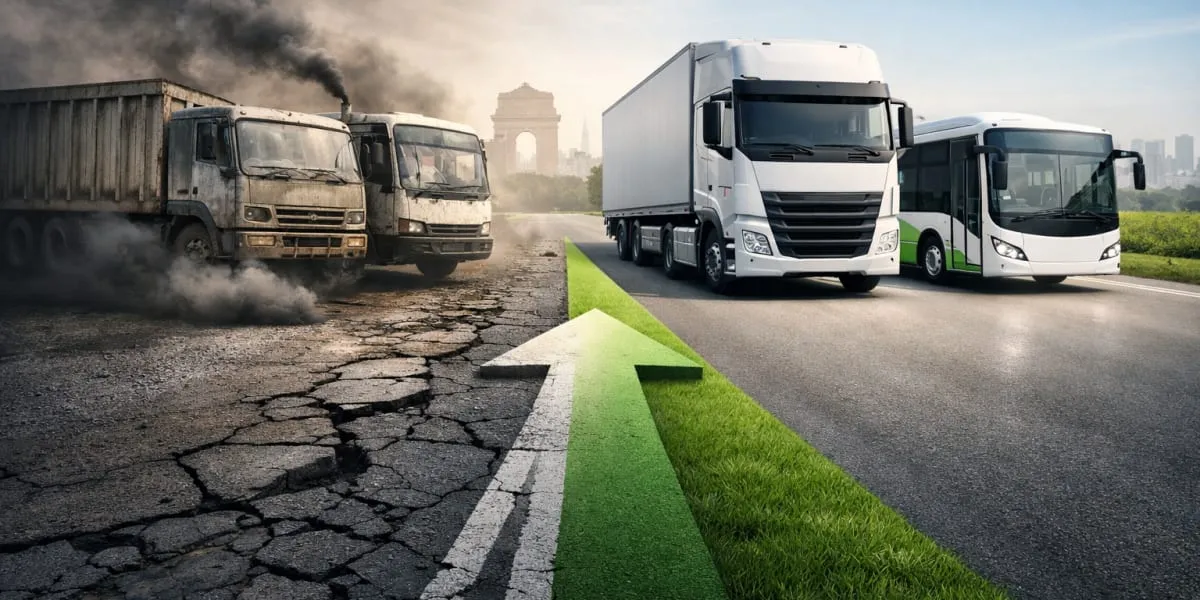
The Delhi government has approved the Programme for Accelerated Renewal and Incentivisation of Vehicle Assets for Reducing Transport Air Pollution and Network Emissions (PARIVARTAN) to cut transport-related emissions in the national capital. The scheme, supported by the Ministry of Road Transport and Highways (MoRTH), will phase out old, polluting trucks and buses and replace them with BS-VI, higher-emission-standard or electric vehicles. The initiative is intended to modernise the commercial vehicle fleet and strengthen the capital's clean transport system.

Owners of Light Goods Vehicles that are BS-IV or older who scrap those vehicles and buy new electric vehicles will receive a 100 per cent exemption on motor vehicle tax and registration fees for 10 years and a five per cent interest subvention from the Delhi government. They will also be eligible for an eight per cent manufacturer discount and fuel vouchers or a one-time equivalent benefit, while buyers of used electric light goods vehicles will obtain a 50 per cent motor vehicle tax exemption for 10 years and the five per cent subvention.

Medium and heavy goods vehicles that are BS-IV or older may qualify for comparable incentives when scrapped and replaced with new BS-VI, higher-emission-standard or electric goods vehicles, including a 100 per cent motor vehicle tax exemption for 10 years and a 100 per cent waiver of registration fees. Additional measures include a five per cent interest subvention, an eight per cent manufacturer discount and fuel vouchers or a one-time equivalent payment; acquisition of used BS-VI or electric goods vehicles will attract a 50 per cent motor vehicle tax exemption for 10 years and the five per cent subvention.

The government estimated the scheme will benefit around 0.207 mn truck and bus owners in the Delhi-NCR and replace many old commercial vehicles with cleaner models, reducing air pollution. The programme requires that all light goods vehicles purchased in Delhi under PARIVARTAN must be electric and allows only BS-VI CNG or electric buses, aligning with the Delhi EV Policy-2026.

The Delhi government has approved the Programme for Accelerated Renewal and Incentivisation of Vehicle Assets for Reducing Transport Air Pollution and Network Emissions (PARIVARTAN) to cut transport-related emissions in the national capital. The scheme, supported by the Ministry of Road Transport and Highways (MoRTH), will phase out old, polluting trucks and buses and replace them with BS-VI, higher-emission-standard or electric vehicles. The initiative is intended to modernise the commercial vehicle fleet and strengthen the capital's clean transport system. Owners of Light Goods Vehicles that are BS-IV or older who scrap those vehicles and buy new electric vehicles will receive a 100 per cent exemption on motor vehicle tax and registration fees for 10 years and a five per cent interest subvention from the Delhi government. They will also be eligible for an eight per cent manufacturer discount and fuel vouchers or a one-time equivalent benefit, while buyers of used electric light goods vehicles will obtain a 50 per cent motor vehicle tax exemption for 10 years and the five per cent subvention. Medium and heavy goods vehicles that are BS-IV or older may qualify for comparable incentives when scrapped and replaced with new BS-VI, higher-emission-standard or electric goods vehicles, including a 100 per cent motor vehicle tax exemption for 10 years and a 100 per cent waiver of registration fees. Additional measures include a five per cent interest subvention, an eight per cent manufacturer discount and fuel vouchers or a one-time equivalent payment; acquisition of used BS-VI or electric goods vehicles will attract a 50 per cent motor vehicle tax exemption for 10 years and the five per cent subvention. The government estimated the scheme will benefit around 0.207 mn truck and bus owners in the Delhi-NCR and replace many old commercial vehicles with cleaner models, reducing air pollution. The programme requires that all light goods vehicles purchased in Delhi under PARIVARTAN must be electric and allows only BS-VI CNG or electric buses, aligning with the Delhi EV Policy-2026.

Related Stories

Gold Stories

Next Story
Real Estate

L&T Wins Mega Order for India’s Largest NVIDIA B300 AI Factory

Larsen & Toubro (L&T), through Vyoma.AI’s AI infrastructure subsidiary LTN Compute, has secured a mega order to develop what the company describes as India’s largest single-cluster AI infrastructure facility. The NVIDIA B300 AI Factory will support US-based AI cloud company Together AI’s platform for large-scale inference, fine-tuning and training workloads.The integrated AI Factory will be hosted at Vyoma.AI’s Chennai data centre campus and will have a capacity of 10,000 NVIDIA B300 GPUs. The platform will combine hyperscale data centre infrastructure, accelerated computing, h..

Next Story
Infrastructure Urban

Autodesk Elevates Nikhil Bagalkotkar to Lead AEC in India, SAARC

Autodesk has elevated Nikhil Bagalkotkar as Head – Architecture, Engineering and Construction (AEC), India and SAARC, with immediate effect.In his new role, Bagalkotkar will lead Autodesk's AEC business strategy across the region and drive adoption of the company's Design and Make platform. He will also focus on promoting digital design and construction technologies to help customers accelerate innovation and deliver more sustainable and resilient infrastructure.Bagalkotkar will be responsible for expanding Autodesk's AEC business, strengthening customer and partner engagement, and accelerat..

Next Story
Real Estate

Listed Developers' Pre-Sales Seen Rising 22.3 Per Cent in FY27

India's leading listed residential developers are expected to sustain strong sales momentum in FY27, with combined pre-sales of 11 major players projected to rise 22.3 per cent year-on-year, according to an analysis by ANAROCK Research & Advisory.Combined pre-sales of the developers are estimated to increase from Rs 1.49 trillion in FY26 to Rs 1.82 lakh crore in FY27. ANAROCK attributed the growth to sustained end-user demand, new project launches and strong execution despite higher property prices, construction costs and global uncertainties.Dr Prashant Thakur, Executive Director and Head..

Advertisement

Subscribe to Our Newsletter

Get daily newsletters around different themes from Construction world.

STAY CONNECTED

Advertisement

Advertisement

Advertisement