Delhi PWD Reviews Projects To Improve Connectivity And Ease Traffic
ECONOMY & POLICY

Delhi PWD Reviews Projects To Improve Connectivity And Ease Traffic

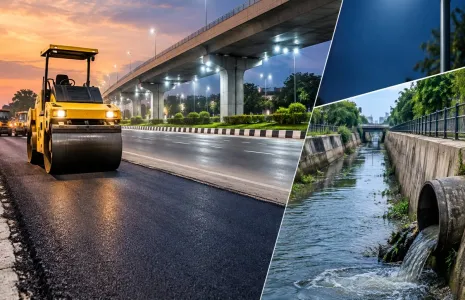
A high-level meeting at the Delhi Secretariat reviewed major infrastructure projects aimed at enhancing road connectivity and easing traffic congestion in Outer and rural Delhi. The session involved members of the Legislative Assembly and officials of the Public Works Department (PWD), with local representatives presenting constituency requirements and planning inputs. The meeting concentrated on proposals intended to address chronic bottlenecks on principal routes across West and North-West Delhi. Officials emphasised aligning project design with local travel patterns and village access needs.

Bawana MLA and Delhi Minister Ravinder Indraj Singh set out two key proposals, including an elevated corridor over the auxiliary drainage channel in Bawana and the 11.70-kilometre Kanjhawala-Mangolpuri Elevated Corridor. The latter is designed to relieve severe congestion on arterial roads and to facilitate smoother daily travel for commuters. The minister recommended dedicated entry and exit points for surrounding villages within the elevated corridor and improved pedestrian facilities and traffic safety measures. He also urged seamless local connectivity so that the corridor serves main traffic as well as village residents.

To minimise disruption to daily travel, the minister advocated a phased construction strategy that would allow segments to remain operational while works progress. Officials were asked to undertake a comprehensive capacity and future-traffic assessment to accommodate expected vehicular growth in the coming years. The request underlined that rural areas including Bawana and Kanjhawala have long awaited road network upgrades and that the projects are important for balanced regional development. Attention was drawn to tailoring the Detailed Project Report to reflect ground realities and suggestions from elected representatives.

The PWD was instructed to incorporate the planning inputs and to ensure that design choices protect local access and pedestrian safety while delivering corridor-level benefits. Officials were reminded to factor in village linkages and to provide robust traffic management during construction and operation phases. The meeting concluded with a call for timely finalisation of project reports so that implementation can proceed with minimal disruption. Stakeholders were urged to keep residents central to planning to secure long-term benefits for Outer Delhi communities.

A high-level meeting at the Delhi Secretariat reviewed major infrastructure projects aimed at enhancing road connectivity and easing traffic congestion in Outer and rural Delhi. The session involved members of the Legislative Assembly and officials of the Public Works Department (PWD), with local representatives presenting constituency requirements and planning inputs. The meeting concentrated on proposals intended to address chronic bottlenecks on principal routes across West and North-West Delhi. Officials emphasised aligning project design with local travel patterns and village access needs. Bawana MLA and Delhi Minister Ravinder Indraj Singh set out two key proposals, including an elevated corridor over the auxiliary drainage channel in Bawana and the 11.70-kilometre Kanjhawala-Mangolpuri Elevated Corridor. The latter is designed to relieve severe congestion on arterial roads and to facilitate smoother daily travel for commuters. The minister recommended dedicated entry and exit points for surrounding villages within the elevated corridor and improved pedestrian facilities and traffic safety measures. He also urged seamless local connectivity so that the corridor serves main traffic as well as village residents. To minimise disruption to daily travel, the minister advocated a phased construction strategy that would allow segments to remain operational while works progress. Officials were asked to undertake a comprehensive capacity and future-traffic assessment to accommodate expected vehicular growth in the coming years. The request underlined that rural areas including Bawana and Kanjhawala have long awaited road network upgrades and that the projects are important for balanced regional development. Attention was drawn to tailoring the Detailed Project Report to reflect ground realities and suggestions from elected representatives. The PWD was instructed to incorporate the planning inputs and to ensure that design choices protect local access and pedestrian safety while delivering corridor-level benefits. Officials were reminded to factor in village linkages and to provide robust traffic management during construction and operation phases. The meeting concluded with a call for timely finalisation of project reports so that implementation can proceed with minimal disruption. Stakeholders were urged to keep residents central to planning to secure long-term benefits for Outer Delhi communities.

Related Stories

Gold Stories

Next Story
Infrastructure Urban

Modi Urges End-to-End Reforms for Infrastructure Projects

Prime Minister Narendra Modi on Tuesday called for continuous reforms across all stages of infrastructure project execution during the 53rd PRAGATI meeting. He asked ministries and state governments to adopt an end-to-end approach and a proactive work culture to ensure timely delivery. The meeting reviewed six key infrastructure projects in the railway, road and power sectors across nine states with a cumulative investment of Rs 300 billion (Rs 300 bn). Officials assessed projects on timelines, inter-agency coordination and resolution of pending issues. He said infrastructure projects should b..

Next Story
Infrastructure Transport

GMR Airports Plans US$2 bn Expansion In Delhi And Hyderabad

GMR Airports plans a US$2 billion (bn) expansion of facilities at New Delhi and Hyderabad as part of a major modernisation drive. Hyderabad’s upgraded airport will be able to accommodate about 80 million (mn) passengers a year, more than double its current annual volume of 34 mn fliers. The company is India’s largest airport operator by number of fliers annually, while rival Adani Airport Holdings Ltd is the biggest by number of airports and is reported to be looking to invest US$15 bn to boost passenger capacity over the next five years. Executives indicated the build-outs in New Delhi an..

Next Story
Infrastructure Transport

Mumbai Airport to Demolish Part of Terminal One From 15 January

Adani Group-operated Mumbai International Airport (MIAL) will begin partial demolition of the north section of Terminal one-B at Chatrapati Shivaji Maharaj International Airport from 15 January 2027, according to a letter to the civil aviation ministry. The operator has begun redistributing air traffic to Terminal two and to Navi Mumbai International Airport to facilitate the work. The airport, managed by Mumbai International Airport, currently has a capacity of over 50 million (mn) passengers and handles over 950 flight movements daily. Terminal one is nearly 80 years old and parts of it have..

Advertisement

Subscribe to Our Newsletter

Get daily newsletters around different themes from Construction world.

STAY CONNECTED

Advertisement