DMRC Begins Studies For Elevated Corridors In South Delhi
ECONOMY & POLICY

DMRC Begins Studies For Elevated Corridors In South Delhi

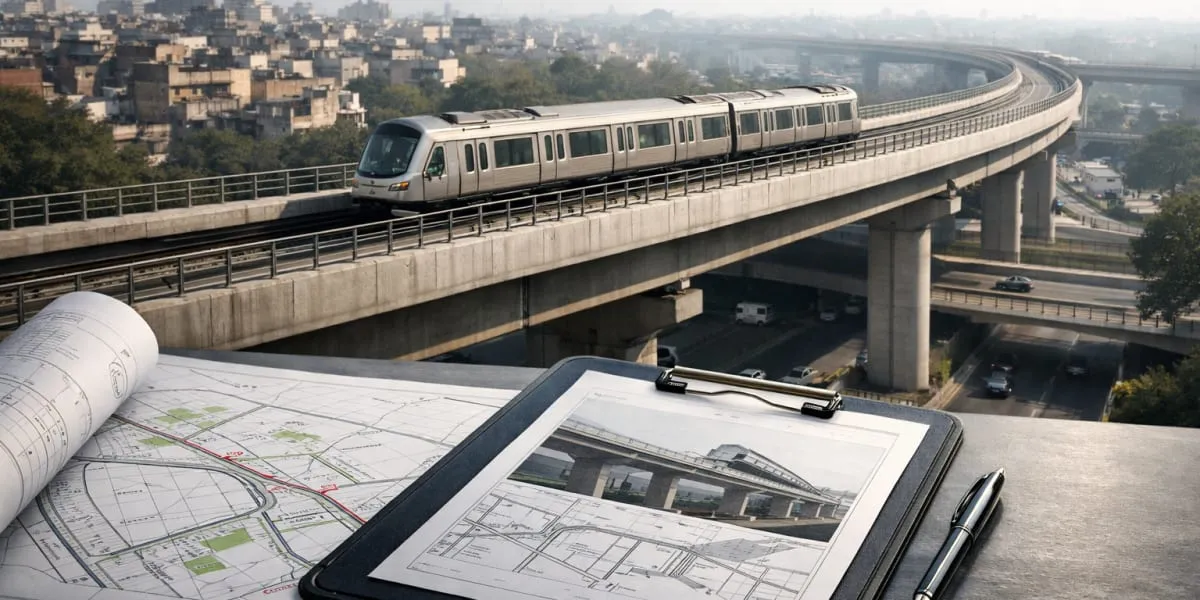
The Delhi Metro Rail Corporation has initiated feasibility studies and prepared a detailed project report for a network of elevated corridors, underpasses and road redesigns connecting Saket, Sangam Vihar, Khanpur, Pul Prahladpur and Badarpur. The project aims to improve connectivity between Sangam Vihar, Saket, Khanpur, Maa Anandmayee Marg, Pul Prahladpur and Badarpur, stretches that experience heavy congestion daily because of dense residential clusters, roadside parking and increasing vehicular pressure. The work is intended to ease movement along South Delhi arterial routes over time.

Officials indicated that the DPR and feasibility exercise for the proposed traffic overhaul comprising elevated roads, underpasses, subways and redesigned stretches is expected to be completed within four months and that consultancy work for preparing the DPR has been estimated at around Rs 14.7 million (mn). The larger six-lane elevated corridor and underpass project has been planned at an estimated cost of Rs 14.71 billion (bn). The measures are designed to improve daily commute on Mehrauli-Badarpur (MB) Road in the coming years.

The proposal envisages a nearly five-km elevated corridor from Sangam Vihar to Maa Anandmayee Marg, along with another one point one-km elevated stretch starting from Pul Prahladpur towards Badarpur. An additional one point nine-km section between Maa Anandmayee Marg and Pul Prahladpur will be redesigned under the Unified Traffic and Transportation Infrastructure (Planning and Engineering) Centre (UTTIPEC) compliant street planning norms. The scheme aims to address pinch points caused by on-street parking and junction congestion.

The DMRC said the appointed consultant will conduct traffic volume surveys, origin-destination studies, parking assessments and road safety audits before finalising the proposal and that outcomes will guide detailed design and prioritisation of interventions. Officials noted that the planning phase will seek to integrate multimodal movement and reduce travel times for residents in the corridor. Further approvals and funding decisions will determine the construction schedule.

The Delhi Metro Rail Corporation has initiated feasibility studies and prepared a detailed project report for a network of elevated corridors, underpasses and road redesigns connecting Saket, Sangam Vihar, Khanpur, Pul Prahladpur and Badarpur. The project aims to improve connectivity between Sangam Vihar, Saket, Khanpur, Maa Anandmayee Marg, Pul Prahladpur and Badarpur, stretches that experience heavy congestion daily because of dense residential clusters, roadside parking and increasing vehicular pressure. The work is intended to ease movement along South Delhi arterial routes over time. Officials indicated that the DPR and feasibility exercise for the proposed traffic overhaul comprising elevated roads, underpasses, subways and redesigned stretches is expected to be completed within four months and that consultancy work for preparing the DPR has been estimated at around Rs 14.7 million (mn). The larger six-lane elevated corridor and underpass project has been planned at an estimated cost of Rs 14.71 billion (bn). The measures are designed to improve daily commute on Mehrauli-Badarpur (MB) Road in the coming years. The proposal envisages a nearly five-km elevated corridor from Sangam Vihar to Maa Anandmayee Marg, along with another one point one-km elevated stretch starting from Pul Prahladpur towards Badarpur. An additional one point nine-km section between Maa Anandmayee Marg and Pul Prahladpur will be redesigned under the Unified Traffic and Transportation Infrastructure (Planning and Engineering) Centre (UTTIPEC) compliant street planning norms. The scheme aims to address pinch points caused by on-street parking and junction congestion. The DMRC said the appointed consultant will conduct traffic volume surveys, origin-destination studies, parking assessments and road safety audits before finalising the proposal and that outcomes will guide detailed design and prioritisation of interventions. Officials noted that the planning phase will seek to integrate multimodal movement and reduce travel times for residents in the corridor. Further approvals and funding decisions will determine the construction schedule.

Related Stories

Gold Stories

Next Story
Infrastructure Urban

KONE Opens India's First Digital Experience Centre in Pune

KONE, a global elevator and escalator manufacturer, has inaugurated its first Digital Experience Centre (DEC) in India, located in Pune. The facility aims to showcase how artificial intelligence (AI), connectivity and data-driven technologies can enhance customer experiences and improve building operations.The centre was inaugurated by Jussi Herlin, Executive Vice Chair, KONE Corporation; Philippe Delorme, President and CEO, KONE; and Nandan Nilekani, Co-founder and Chairman of the Board, Infosys.Designed as an interactive customer environment, the facility demonstrates digital solutions cover..

Next Story
Infrastructure Urban

CII GreenCo Launches Circularity Guidelines for Indian Industry

The Confederation of Indian Industry (CII) GreenCo Council has launched the CII GreenCo Circularity Guidelines – Pilot Version at the 17th CII GreenCo Waste & Resource Management Summit 2026 in Chennai. The initiative aims to strengthen resource efficiency, waste reduction and circular economy practices across Indian manufacturing and process industries.The guidelines introduce a structured framework with circularity indices covering raw materials, consumables, packaging and other resource inputs. These indicators will help industries assess existing practices, identify opportunities to ..

Next Story
Infrastructure Energy

Global Electronics Association Launches IPC-1783-CO2E Standard

The Global Electronics Association has introduced IPC-1783-CO2E, a new international standard aimed at improving consistency, transparency and comparability in product carbon footprint reporting across the electronics manufacturing industry.The standard, titled International Standard for Data Collection and Reporting of CO2 Equivalent (CO2e) Emissions for the Electronics Manufacturing Supply Chain, provides industry-specific guidance for collecting, estimating and reporting carbon emissions data.With increasing regulatory requirements and customer expectations, electronics manufacturers face c..

Advertisement

Subscribe to Our Newsletter

Get daily newsletters around different themes from Construction world.

STAY CONNECTED

Advertisement

SPECIAL OFFER
QR Code