Hindustan Zinc And Group Nirmal To Set Up Zinc Wire Facility
ECONOMY & POLICY

Hindustan Zinc And Group Nirmal To Set Up Zinc Wire Facility

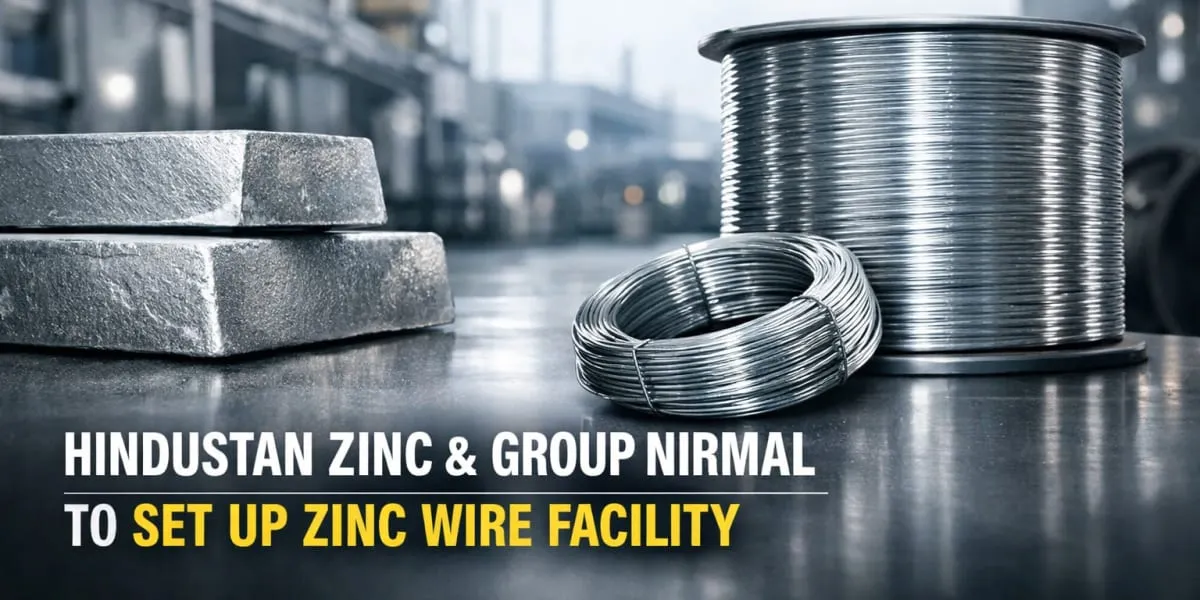
Hindustan Zinc Limited has signed a memorandum of understanding with Group Nirmal to establish a zinc wire manufacturing facility at its Zinc Industrial Park at Khankhala in Bhilwara district of Rajasthan. The agreement, announced in Udaipur on 12 May 2026, advances the company’s strategy to build a downstream zinc manufacturing ecosystem focused on high?value industrial applications. The facility will use the company’s Special High Grade (SHG) zinc as feedstock for wire production.

Group Nirmal will produce zinc wire for sectors including infrastructure, renewable energy, automotive and industrial engineering, supporting thermal spray coating and metallising processes. In these processes zinc is melted and sprayed onto steel to form a protective coating that enhances corrosion resistance for bridges, transmission towers, railways, ports, pipelines and industrial installations. The release said such coatings extend structural longevity, improve operational reliability and reduce life?cycle maintenance requirements.

The Zinc Industrial Park, developed with the Rajasthan State Industrial Development and Investment Corporation, aims to integrate raw material availability with value?added zinc production and renewable energy adoption. The initiative, first announced at the Rising Rajasthan Global Investment Summit in December 2024, is progressing through phased investor partnerships and strategic collaborations. Hindustan Zinc will provide assured raw material linkage and ecosystem support to Group Nirmal’s proposed operations at the park.

Hindustan Zinc supplies to more than 40 countries and holds about 74 per cent of the primary zinc market in India, and the company describes itself as the world’s largest integrated zinc producer and a top 10 global silver producer. The company highlighted recognition as the most sustainable metals and mining company by S&P Global for 2025, the launch of EcoZen green zinc and commitments on water?positive performance and net zero by 2050. The chief executive indicated the partnership will drive domestic manufacturing, strengthen supply chains and create long?term industrial value while supporting regional economic development.

Hindustan Zinc Limited has signed a memorandum of understanding with Group Nirmal to establish a zinc wire manufacturing facility at its Zinc Industrial Park at Khankhala in Bhilwara district of Rajasthan. The agreement, announced in Udaipur on 12 May 2026, advances the company’s strategy to build a downstream zinc manufacturing ecosystem focused on high?value industrial applications. The facility will use the company’s Special High Grade (SHG) zinc as feedstock for wire production. Group Nirmal will produce zinc wire for sectors including infrastructure, renewable energy, automotive and industrial engineering, supporting thermal spray coating and metallising processes. In these processes zinc is melted and sprayed onto steel to form a protective coating that enhances corrosion resistance for bridges, transmission towers, railways, ports, pipelines and industrial installations. The release said such coatings extend structural longevity, improve operational reliability and reduce life?cycle maintenance requirements. The Zinc Industrial Park, developed with the Rajasthan State Industrial Development and Investment Corporation, aims to integrate raw material availability with value?added zinc production and renewable energy adoption. The initiative, first announced at the Rising Rajasthan Global Investment Summit in December 2024, is progressing through phased investor partnerships and strategic collaborations. Hindustan Zinc will provide assured raw material linkage and ecosystem support to Group Nirmal’s proposed operations at the park. Hindustan Zinc supplies to more than 40 countries and holds about 74 per cent of the primary zinc market in India, and the company describes itself as the world’s largest integrated zinc producer and a top 10 global silver producer. The company highlighted recognition as the most sustainable metals and mining company by S&P Global for 2025, the launch of EcoZen green zinc and commitments on water?positive performance and net zero by 2050. The chief executive indicated the partnership will drive domestic manufacturing, strengthen supply chains and create long?term industrial value while supporting regional economic development.

Next Story
Infrastructure Urban

Centre Clears Power Distribution Upgrade for Uttar Pradesh

The Central Government has approved power distribution projects worth Rs 407.39 billion for Uttar Pradesh under the Revamped Distribution Sector Scheme (RDSS). The investment will be used to modernise the state's electricity distribution infrastructure and strengthen network capacity across urban and rural areas. The package targets one of the country's largest distribution networks as the state experiences rapid urbanisation and rising electricity consumption. Planned interventions include the strengthening of distribution lines, modernisation of substations, replacement of ageing electrical ..

Next Story
Infrastructure Energy

India Data Centres To Consume 191 TWh By 2040 Driving Renewables

A Wood Mackenzie report says India's operational data centre capacity is projected to increase more than fivefold to 12 gigawatt (GW) by 2030 from 2.2 GW in 2025 as artificial intelligence (AI) and cloud computing drive demand. It projects electricity consumption to rise from 10 terawatt-hour (TWh) in 2025 to 191 TWh by 2040. The study forecasts a compound annual growth rate of around 40 per cent and notes AI-dedicated capacity will surge nearly 24-fold from 275 megawatt (MW) in 2025 to 6,546 MW by 2030. The report places India's digital economy at Rs 32 trillion (tn) in 2025 and says it contr..

Next Story
Infrastructure Transport

Hydrogen Train Completes 1,200 Kilometres Of Trials

India's first hydrogen train was flagged off between Jind and Sonipat on July 17 and has travelled over 1,200 kilometres in trials, saving diesel consumption of more than 3,200 litres, a Railway Ministry press release said. The deployment marks the introduction of a zero-emission fuel cell train into route testing and represents a milestone in domestic rail innovation. The train generates electricity onboard through a chemical reaction between hydrogen and oxygen, producing electricity to propel the vehicle while emitting only water vapour as a by-product. There is no smoke and no tailpipe car..

Advertisement

Subscribe to Our Newsletter

Get daily newsletters around different themes from Construction world.

STAY CONNECTED

Advertisement

Advertisement

Advertisement