+
India Adds Six Point Six GW Of Rooftop Solar In First Half
ECONOMY & POLICY

India Adds Six Point Six GW Of Rooftop Solar In First Half

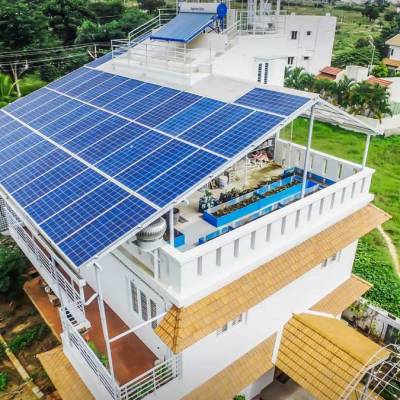
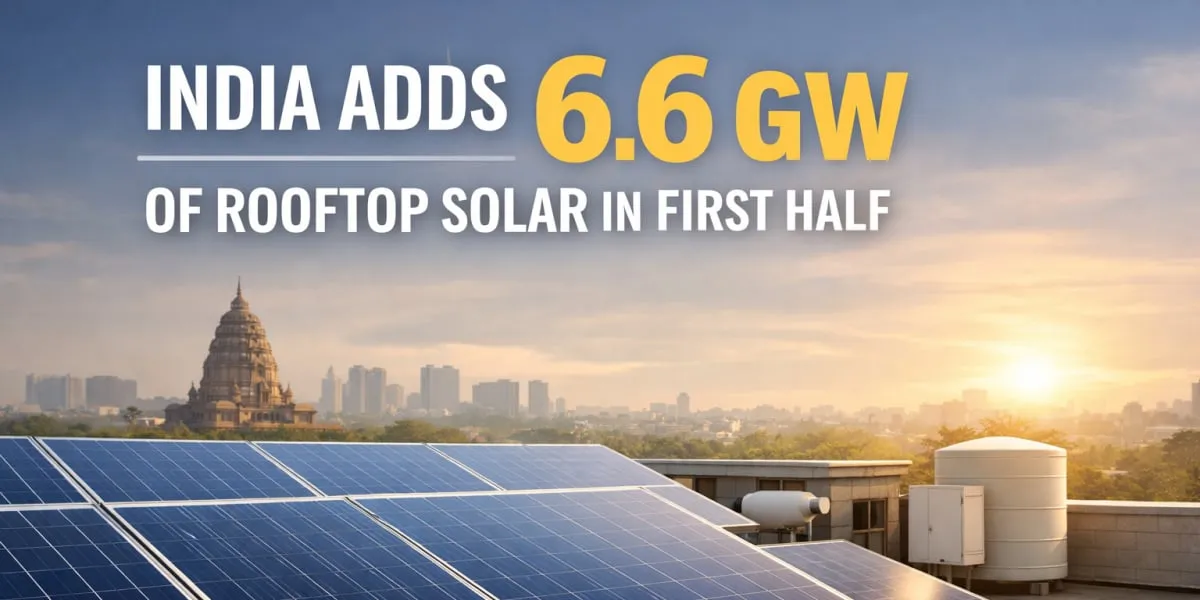
India installed six point six gigawatt (GW) of rooftop solar capacity in the first half of calendar year 2026, up 136 per cent from two point eight GW in the same period of 2025, Mercom India reported. The second quarter added three point eight GW, a 41 per cent quarter on quarter rise, and was 136 per cent higher year on year from one point six GW in Q2 2025.

Rooftop systems accounted for 33 per cent of the country’s solar installations during the quarter, with residential installations dominating the market and contributing 84 per cent of total additions. Industrial installations made up 10 per cent, commercial installations accounted for five per cent and government projects represented one per cent. Installations under the capex model comprised the majority of quarterly additions in Q2 2026.

Mercom said the Pradhan Mantri Surya Ghar programme drove growth, reaching nearly four point five million (mn) households by June 2026, about 45 per cent of the ten million (mn) goal. The Approved List of Models and Manufacturers (ALMM) List II, effective one June 2026, increased pressure on domestic cell availability and domestic content requirement module prices, although transition measures eased some near term strain. Eligible net metering and open access projects received a transition window to 31 December 2026 and some residential consumers could forgo the subsidy and use non DCR modules until March 2027.

Raj Prabhu, chief executive of Mercom Capital Group, said India had a strong residential rooftop pipeline but converting it into installations would require faster approvals, better financing and quicker delivery. He added that higher grid tariffs should bolster commercial demand while rising system costs and regulatory constraints could limit industrial growth, and that the ALMM transition window could aid projects but might prompt a rush, increase price volatility and leave future growth dependent on rapid domestic cell capacity ramping and states removing approval, metering and connectivity bottlenecks.

India installed six point six gigawatt (GW) of rooftop solar capacity in the first half of calendar year 2026, up 136 per cent from two point eight GW in the same period of 2025, Mercom India reported. The second quarter added three point eight GW, a 41 per cent quarter on quarter rise, and was 136 per cent higher year on year from one point six GW in Q2 2025. Rooftop systems accounted for 33 per cent of the country’s solar installations during the quarter, with residential installations dominating the market and contributing 84 per cent of total additions. Industrial installations made up 10 per cent, commercial installations accounted for five per cent and government projects represented one per cent. Installations under the capex model comprised the majority of quarterly additions in Q2 2026. Mercom said the Pradhan Mantri Surya Ghar programme drove growth, reaching nearly four point five million (mn) households by June 2026, about 45 per cent of the ten million (mn) goal. The Approved List of Models and Manufacturers (ALMM) List II, effective one June 2026, increased pressure on domestic cell availability and domestic content requirement module prices, although transition measures eased some near term strain. Eligible net metering and open access projects received a transition window to 31 December 2026 and some residential consumers could forgo the subsidy and use non DCR modules until March 2027. Raj Prabhu, chief executive of Mercom Capital Group, said India had a strong residential rooftop pipeline but converting it into installations would require faster approvals, better financing and quicker delivery. He added that higher grid tariffs should bolster commercial demand while rising system costs and regulatory constraints could limit industrial growth, and that the ALMM transition window could aid projects but might prompt a rush, increase price volatility and leave future growth dependent on rapid domestic cell capacity ramping and states removing approval, metering and connectivity bottlenecks.

Related Stories

Gold Stories

Next Story
Infrastructure Energy

Inside a Pumped Storage Project: How It Actually Balances the Grid

What happens when the sun sets just as electricity demand starts to rise? Solar generation falls, but homes, factories and businesses still need power. Pumped storage power plants help bridge this gap by storing surplus electricity as gravitational potential energy in elevated water and releasing it when demand increases. As India adds more solar and wind capacity, this ability to shift electricity across hours is becoming increasingly important for grid flexibility.What is a Pumped Storage Power Plant?A pumped storage power plant (PSP) is a long-duration energy storage facility with two reser..

Next Story
Technology

LTTS launches FARM to accelerate deep-tech startups

L&T Technology Services (LTTS) has launched LTTS FARM, a startup engagement platform aimed at accelerating the commercialisation of deep-tech innovations through Engineering Intelligence-led collaboration, co-innovation and market access.Built on the theme of “Collaboration First, Commercialisation Next”, the platform targets startups with Technology Readiness Level (TRL) 4+ solutions that have demonstrated technical feasibility and are ready for industry adoption. LTTS FARM will support startups aligned with LTTS’ key technology focus areas, including Software Defined Mobility, Plan..

Next Story
Infrastructure Energy

REC Wins Top Honour for Hindi Policy Implementation

EC Limited has received the First Prize for outstanding implementation of the Official Language Policy for 2025-26 at the meeting of the Hindi Salahkar Samiti of the Ministry of Power, Government of India.The award was presented to REC by Shri Manohar Lal, Union Minister of Power and Housing and Urban Affairs. Shri Shripad Yesso Naik, Minister of State for Power and New and Renewable Energy; Shri Dinesh Sharma, Rajya Sabha MP; Shri Suresh Kumar Kashyap, Lok Sabha MP; and Shri Pankaj Agrawal, Secretary, Ministry of Power, were also present. Shri Jitendra Shrivastava, IAS, CMD, REC, received the..

Advertisement

Subscribe to Our Newsletter

Get daily newsletters around different themes from Construction world.

STAY CONNECTED

Advertisement

SPECIAL OFFER
QR Code