



+
India Hosts AI Impact Summit 2026
ECONOMY & POLICY

India Hosts AI Impact Summit 2026

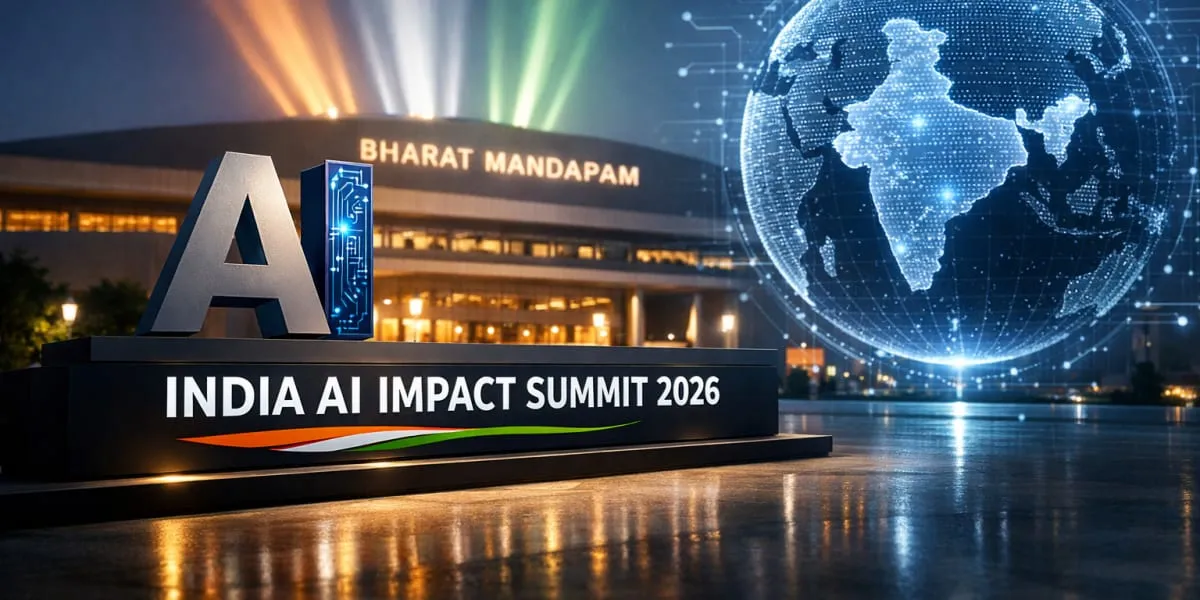
Prime Minister Narendra Modi inaugurated the India AI Impact Summit 2026 at Bharat Mandapam in New Delhi and said the event was the world’s largest AI Impact Summit hosted by a nation that represents one-sixth of humanity. He highlighted that India has the largest youth population, the biggest technology talent pool and a thriving tech-enabled ecosystem, and noted that 1.4 billion (bn) Indians are eager to embrace new technologies. He welcomed heads of government, global AI leaders and innovators and described hosting the summit as a matter of pride for India and the Global South.

He observed that the summit brought together representatives from over 100 countries and that the strong presence of young people instilled fresh confidence in the global AI enterprise. He noted rapid acceptance and ownership of AI by youth worldwide and highlighted the enthusiasm at the exhibition. He said solutions in agriculture, security, assistance for divyangjan and multilingual applications demonstrated the strength of Made in India innovations.

The Prime Minister characterised artificial intelligence as a historic turning point that multiplies human capability and alters the pace and paradigms of development, stressing its unprecedented speed and scale. He warned that the future of AI depends on present choices and called for a larger vision with greater responsibility so that technology serves humanity rather than becoming directionless. He argued that transparency, accountability and human oversight are essential to ensure AI remains a force for good.

He outlined M.A.N.A.V. vision for AI as moral and ethical systems, accountable governance, national sovereignty with data ownership, accessible and inclusive technologies, and validation and legitimacy so that AI is lawful and verifiable. He urged democratisation of AI to ensure inclusion and empowerment, especially for the Global South, and called for open code and shared development to improve safety. He advocated global standards such as watermarking and authenticity labels to counter deepfakes and stressed child safety and mass skilling. He concluded that India is building a resilient ecosystem from semiconductors to quantum computing and invited the world to design and develop in India.

Prime Minister Narendra Modi inaugurated the India AI Impact Summit 2026 at Bharat Mandapam in New Delhi and said the event was the world’s largest AI Impact Summit hosted by a nation that represents one-sixth of humanity. He highlighted that India has the largest youth population, the biggest technology talent pool and a thriving tech-enabled ecosystem, and noted that 1.4 billion (bn) Indians are eager to embrace new technologies. He welcomed heads of government, global AI leaders and innovators and described hosting the summit as a matter of pride for India and the Global South. He observed that the summit brought together representatives from over 100 countries and that the strong presence of young people instilled fresh confidence in the global AI enterprise. He noted rapid acceptance and ownership of AI by youth worldwide and highlighted the enthusiasm at the exhibition. He said solutions in agriculture, security, assistance for divyangjan and multilingual applications demonstrated the strength of Made in India innovations. The Prime Minister characterised artificial intelligence as a historic turning point that multiplies human capability and alters the pace and paradigms of development, stressing its unprecedented speed and scale. He warned that the future of AI depends on present choices and called for a larger vision with greater responsibility so that technology serves humanity rather than becoming directionless. He argued that transparency, accountability and human oversight are essential to ensure AI remains a force for good. He outlined M.A.N.A.V. vision for AI as moral and ethical systems, accountable governance, national sovereignty with data ownership, accessible and inclusive technologies, and validation and legitimacy so that AI is lawful and verifiable. He urged democratisation of AI to ensure inclusion and empowerment, especially for the Global South, and called for open code and shared development to improve safety. He advocated global standards such as watermarking and authenticity labels to counter deepfakes and stressed child safety and mass skilling. He concluded that India is building a resilient ecosystem from semiconductors to quantum computing and invited the world to design and develop in India.

Next Story
Equipment

Kabelschlepp India Installs Robotic VMC in Bengaluru

Kabelschlepp India, part of the Tsubaki Group, has installed a state-of-the-art Vertical Machining Center (VMC) integrated with robotic automation at its Bengaluru facility. The inauguration was held in the presence of Henning Preis, President & CEO, Kabelschlepp Group, Jörg Schulz, Vice President – Production, and Srinivas P. Kamisetty, Managing Director, Kabelschlepp India.The high-precision CNC VMC is designed for advanced milling, drilling, tapping and multi-axis machining. Equipped with a vertical spindle orientation, automatic tool changer and intelligent CNC control system, it en..

Next Story
Infrastructure Transport

Highway Delivery Reset!

Project delays and inefficiencies continue to bedevil the progress of India’s National Highways network. A multi-pronged reform agenda is needed to inject greater transparency and accountability at every stage – from planning and procurement to execution, maintenance and oversight. This article offers key recommendations and reform strategies that government stakeholders – from the Ministry of Road Transport & Highways (MoRTH) and the National Highways Authority of India (NHAI) to state agencies and oversight bodies – should pursue to put highway development on a better track.Decen..

Next Story
Infrastructure Transport

MSIDC Executes ₹37,000 Crore Road Programme

With Rs 37,000 crore worth of road projects under execution across Maharashtra, Maharashtra State Infrastructure Development Corporation (MSIDC) is driving one of the state’s largest infrastructure programmes. Dr Brijesh Dixit, Managing Director, discusses the institutional reforms, execution frameworks, financing strategies and technology adoption enabling timely, high-quality delivery, in conversation with PRATAP PADODE, Editor-in-Chief, CW.With over Rs 37,000 crore worth of road projects underway across districts – many under tight timelines – what institutional and executio..

Advertisement

Subscribe to Our Newsletter

Get daily newsletters around different themes from Construction world.

STAY CONNECTED

Advertisement

Advertisement

Advertisement

Open In App














