India Limited Fuel Price Rise to 7 Per Cent amid Global Surge
ECONOMY & POLICY

India Limited Fuel Price Rise to 7 Per Cent amid Global Surge

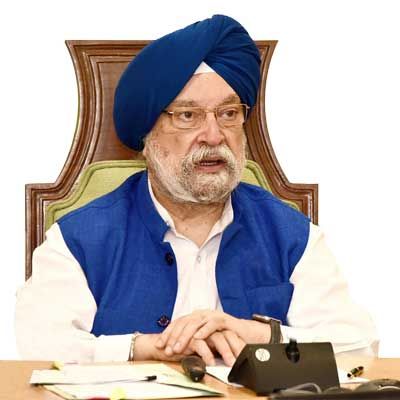
India's fuel prices rose by around 7 per cent despite an international increase of 50 to 70 per cent, Petroleum Minister Hardeep Singh Puri said during an inspection of petrol pumps in Indore. He attributed the relatively limited domestic movement to excise duty reductions and state-run oil marketing companies absorbing higher crude costs.

Puri said the Centre reduced excise duty three times, in November 2021, May 2022 and on March 10, 2026. The measures, he said, helped protect Indian consumers from sharp global price shocks during periods of international instability. He credited Prime Minister Narendra Modi's policies with insulating households from those movements.

The minister also praised Bharat Petroleum Corporation (BPCL), Indian Oil Corporation (IOCL) and Hindustan Petroleum Corporation (HPCL) for bearing substantial losses when crude prices increased from $60-65 to $120 per barrel. The companies' intervention, he said, helped prevent the full impact of higher international costs from reaching domestic retail customers.

The inspection took place amid the Iran conflict, during which opposition parties had raised concerns about possible shortages of petrol, diesel and cooking gas. Puri rejected those concerns as unfounded and said fuel supplies had continued without interruption across the country. He said none of the 107,000 retail outlets had run dry.

Puri said domestic liquefied petroleum gas (LPG) production had been increased to ensure availability. He added that the government had not seen a shortage of LPG cylinders despite claims of an impending crisis during the previous Parliament session. The minister's comments came as authorities continued to monitor energy supplies and prices amid volatility in international crude markets.

India's fuel prices rose by around 7 per cent despite an international increase of 50 to 70 per cent, Petroleum Minister Hardeep Singh Puri said during an inspection of petrol pumps in Indore. He attributed the relatively limited domestic movement to excise duty reductions and state-run oil marketing companies absorbing higher crude costs. Puri said the Centre reduced excise duty three times, in November 2021, May 2022 and on March 10, 2026. The measures, he said, helped protect Indian consumers from sharp global price shocks during periods of international instability. He credited Prime Minister Narendra Modi's policies with insulating households from those movements. The minister also praised Bharat Petroleum Corporation (BPCL), Indian Oil Corporation (IOCL) and Hindustan Petroleum Corporation (HPCL) for bearing substantial losses when crude prices increased from $60-65 to $120 per barrel. The companies' intervention, he said, helped prevent the full impact of higher international costs from reaching domestic retail customers. The inspection took place amid the Iran conflict, during which opposition parties had raised concerns about possible shortages of petrol, diesel and cooking gas. Puri rejected those concerns as unfounded and said fuel supplies had continued without interruption across the country. He said none of the 107,000 retail outlets had run dry. Puri said domestic liquefied petroleum gas (LPG) production had been increased to ensure availability. He added that the government had not seen a shortage of LPG cylinders despite claims of an impending crisis during the previous Parliament session. The minister's comments came as authorities continued to monitor energy supplies and prices amid volatility in international crude markets.

Related Stories

Gold Stories

Next Story
Infrastructure Energy

DMRC Invites Bids for Solar-Linked BESS Power Procurement

Delhi Metro Rail Corporation (DMRC) has invited bids for renewable energy from an Inter-State Transmission System (ISTS)-connected generating plant combining a solar photovoltaic (PV) system with a co-located Battery Energy Storage System (BESS). The procurement will be conducted through competitive bidding followed by an e-reverse auction. The last date for submitting online bids is December 10, 2026, at 3 PM. DMRC will open the technical bids on December 11, 2026, at 3 PM. The opening of financial bids and the e-reverse auction will be scheduled after completion of the technical evaluation. ..

Next Story
Infrastructure Energy

Solar Growth May Slow Beyond FY28 on Awards, Grid Constraints

India’s solar capacity growth could face headwinds beyond FY28 as slower renewable energy project awards, delays in signing power agreements and transmission constraints threaten expansion, according to a report by Yes Securities. Near-term additions remain supported by a construction pipeline exceeding 150 GW and rising rooftop installations, but weaker award activity could affect capacity additions and industry volumes in FY29 and FY30. Solar capacity additions nearly doubled to 44.61 GW in FY26 from 23.83 GW in FY25. Installations remained strong in the first half of FY27, when 21 GW of s..

Next Story
Infrastructure Transport

India’s First High-Speed Rail Service to Begin in 2027

India’s first high-speed rail service will commence in 2027, with the Surat-Vapi section of the Mumbai-Ahmedabad High-Speed Rail corridor scheduled to open first, Railway Minister Ashwini Vaishnaw said. The remaining sections to Mumbai will be opened in phases. Vaishnaw said 456 km of pier work and 371 km of viaduct construction had been completed by September. About 600,000 noise barriers had been installed along a 299 km stretch, while 9,300 overhead equipment masts had been erected across a 206 km viaduct. Four mountain tunnels have been excavated, and 5 km of the 21 km Maharashtra tunnel..

Advertisement

Subscribe to Our Newsletter

Get daily newsletters around different themes from Construction world.

STAY CONNECTED

Advertisement

SPECIAL OFFER
QR Code