
India Needs Rapid Battery Storage Expansion
ECONOMY & POLICY

India Needs Rapid Battery Storage Expansion

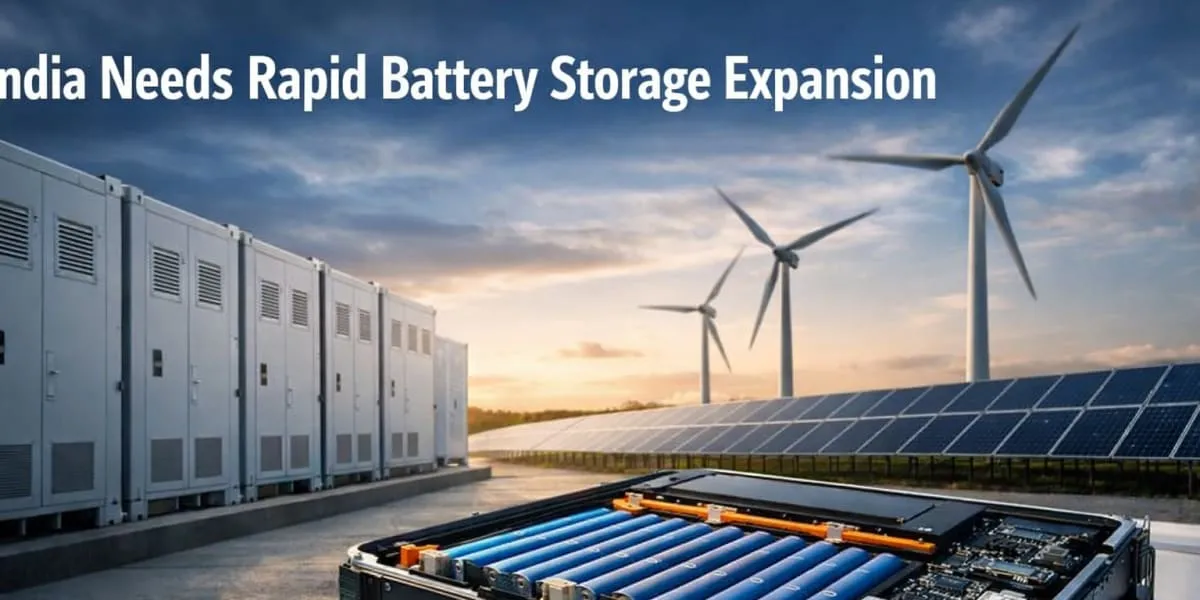
Industry stakeholders have warned that rising renewable capacity has created an immediate need to scale storage systems, highlighting a substantial gap between demand and domestic manufacturing capability. They noted that India's domestic cell manufacturing accounts for less than one per cent, or two GWh, of an approximately 260 GWh demand pipeline from competitive tenders in 2026. The shortfall, they said, threatens the ability to firm intermittent generation as capacity additions accelerate.

Battery energy storage systems (BESS) and pumped storage projects are increasingly important as the power system seeks to balance solar generation with peak demand and rising electricity consumption. Stakeholders argued that batteries and other storage technologies are central to addressing intermittency and unlocking further renewable growth. The need is driven by both system reliability and commercial optimisation.

Industry leaders cautioned against using import dependence as a reason to slow deployment, saying the grid needs storage now rather than waiting for fully indigenous cells. One executive warned that domestic supply is running well behind demand and that the gap will persist for years rather than a few quarters. Policymakers and project developers were urged to prioritise deployment while simultaneously expanding manufacturing.

National Thermal Power Corporation (NTPC) has been allocated five GWh of battery energy storage capacity under the Viability Gap Funding scheme to optimise existing thermal and transmission assets and to ensure reliable supply during non-solar hours. Research firm Wood Mackenzie estimated it would take more than a decade for India to achieve self-sufficiency in battery storage, citing a structural reliance on imports. The firm noted that India had two GWh of commissioned cell manufacturing capacity as of 2026 compared with 2,695 GWh in China. China was said to control between 85 per cent and 98 per cent of global capacity across major supply chain components, prolonging import dependence.

Industry stakeholders have warned that rising renewable capacity has created an immediate need to scale storage systems, highlighting a substantial gap between demand and domestic manufacturing capability. They noted that India's domestic cell manufacturing accounts for less than one per cent, or two GWh, of an approximately 260 GWh demand pipeline from competitive tenders in 2026. The shortfall, they said, threatens the ability to firm intermittent generation as capacity additions accelerate. Battery energy storage systems (BESS) and pumped storage projects are increasingly important as the power system seeks to balance solar generation with peak demand and rising electricity consumption. Stakeholders argued that batteries and other storage technologies are central to addressing intermittency and unlocking further renewable growth. The need is driven by both system reliability and commercial optimisation. Industry leaders cautioned against using import dependence as a reason to slow deployment, saying the grid needs storage now rather than waiting for fully indigenous cells. One executive warned that domestic supply is running well behind demand and that the gap will persist for years rather than a few quarters. Policymakers and project developers were urged to prioritise deployment while simultaneously expanding manufacturing. National Thermal Power Corporation (NTPC) has been allocated five GWh of battery energy storage capacity under the Viability Gap Funding scheme to optimise existing thermal and transmission assets and to ensure reliable supply during non-solar hours. Research firm Wood Mackenzie estimated it would take more than a decade for India to achieve self-sufficiency in battery storage, citing a structural reliance on imports. The firm noted that India had two GWh of commissioned cell manufacturing capacity as of 2026 compared with 2,695 GWh in China. China was said to control between 85 per cent and 98 per cent of global capacity across major supply chain components, prolonging import dependence.

Related Stories

Gold Stories

Next Story
Infrastructure Urban

Modi Urges End-to-End Reforms for Infrastructure Projects

Prime Minister Narendra Modi on Tuesday called for continuous reforms across all stages of infrastructure project execution during the 53rd PRAGATI meeting. He asked ministries and state governments to adopt an end-to-end approach and a proactive work culture to ensure timely delivery. The meeting reviewed six key infrastructure projects in the railway, road and power sectors across nine states with a cumulative investment of Rs 300 billion (Rs 300 bn). Officials assessed projects on timelines, inter-agency coordination and resolution of pending issues. He said infrastructure projects should b..

Next Story
Infrastructure Transport

GMR Airports Plans US$2 bn Expansion In Delhi And Hyderabad

GMR Airports plans a US$2 billion (bn) expansion of facilities at New Delhi and Hyderabad as part of a major modernisation drive. Hyderabad’s upgraded airport will be able to accommodate about 80 million (mn) passengers a year, more than double its current annual volume of 34 mn fliers. The company is India’s largest airport operator by number of fliers annually, while rival Adani Airport Holdings Ltd is the biggest by number of airports and is reported to be looking to invest US$15 bn to boost passenger capacity over the next five years. Executives indicated the build-outs in New Delhi an..

Next Story
Infrastructure Transport

Mumbai Airport to Demolish Part of Terminal One From 15 January

Adani Group-operated Mumbai International Airport (MIAL) will begin partial demolition of the north section of Terminal one-B at Chatrapati Shivaji Maharaj International Airport from 15 January 2027, according to a letter to the civil aviation ministry. The operator has begun redistributing air traffic to Terminal two and to Navi Mumbai International Airport to facilitate the work. The airport, managed by Mumbai International Airport, currently has a capacity of over 50 million (mn) passengers and handles over 950 flight movements daily. Terminal one is nearly 80 years old and parts of it have..

Advertisement

Subscribe to Our Newsletter

Get daily newsletters around different themes from Construction world.

STAY CONNECTED

Advertisement