India Targets 47.24 GW BESS And Rs 4.78 tn Investment
ECONOMY & POLICY

India Targets 47.24 GW BESS And Rs 4.78 tn Investment

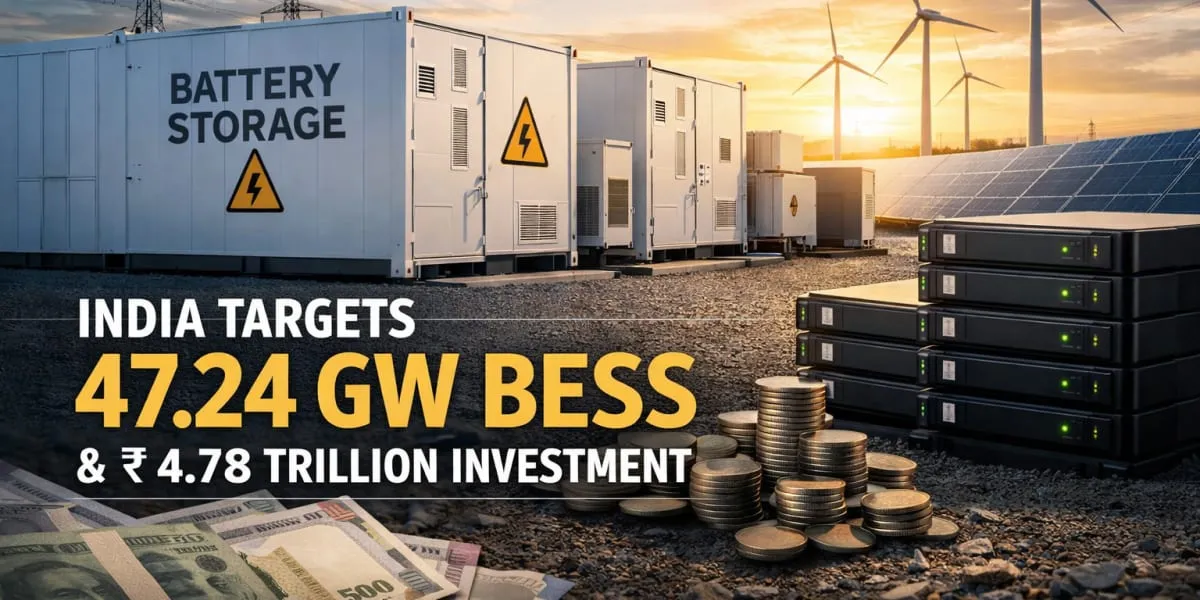
The government has set a target of 47.24 Gigawatt (GW) of battery energy storage system (BESS) capacity supported by a planned investment of Rs 4.78 trillion (tn) to enhance future grid stability. Battery energy storage system is defined as installations that store electrical energy for dispatch to the grid when required. The initiative is intended to strengthen the electricity system as renewable generation increases and variability grows. Officials indicated the scale is intended to balance supply and demand and to provide ancillary services and reserve capacity.

The investment total corresponds to Rs 4,780 billion (bn), reflecting major capital mobilisation for storage infrastructure across transmission and distribution networks. The capacity target is designed to complement variable renewable output and to reduce curtailment while improving system flexibility and grid responsiveness. Industry focus includes grid integration, enhanced dispatchability and the development of long duration storage options alongside short duration systems. The announcement underscores the importance of storage for frequency regulation, peak shaving and capacity firming.

Realising the ambition will require coordinated action by system operators, regulators, investors and equipment manufacturers at central and state levels. Financing structures will combine public support and private capital, and procurement frameworks will need to ensure commercial viability and timely delivery. Policy measures will address standards, safety, recycling and end of life management for battery systems. The plan aims to stimulate domestic production capabilities for cells, modules and balance of plant components.

Operational challenges include grid connection, network planning and the allocation of land and permitting for projects, together with the strengthening of transmission and distribution infrastructure. Robust grid codes and clear contracting mechanisms will be essential to translate capacity targets into operational assets and to allocate costs and responsibilities. The announcement signals a significant shift in system planning and investment strategy that will aid renewable integration and enhance energy security. Stakeholders across the supply chain will be required to align on technical standards, timelines and delivery milestones.

The government has set a target of 47.24 Gigawatt (GW) of battery energy storage system (BESS) capacity supported by a planned investment of Rs 4.78 trillion (tn) to enhance future grid stability. Battery energy storage system is defined as installations that store electrical energy for dispatch to the grid when required. The initiative is intended to strengthen the electricity system as renewable generation increases and variability grows. Officials indicated the scale is intended to balance supply and demand and to provide ancillary services and reserve capacity. The investment total corresponds to Rs 4,780 billion (bn), reflecting major capital mobilisation for storage infrastructure across transmission and distribution networks. The capacity target is designed to complement variable renewable output and to reduce curtailment while improving system flexibility and grid responsiveness. Industry focus includes grid integration, enhanced dispatchability and the development of long duration storage options alongside short duration systems. The announcement underscores the importance of storage for frequency regulation, peak shaving and capacity firming. Realising the ambition will require coordinated action by system operators, regulators, investors and equipment manufacturers at central and state levels. Financing structures will combine public support and private capital, and procurement frameworks will need to ensure commercial viability and timely delivery. Policy measures will address standards, safety, recycling and end of life management for battery systems. The plan aims to stimulate domestic production capabilities for cells, modules and balance of plant components. Operational challenges include grid connection, network planning and the allocation of land and permitting for projects, together with the strengthening of transmission and distribution infrastructure. Robust grid codes and clear contracting mechanisms will be essential to translate capacity targets into operational assets and to allocate costs and responsibilities. The announcement signals a significant shift in system planning and investment strategy that will aid renewable integration and enhance energy security. Stakeholders across the supply chain will be required to align on technical standards, timelines and delivery milestones.

Next Story
Infrastructure Urban

SCLR Extension Nears Completion Linking BKC With Signal-Free Route

The Santacruz-Chembur Link Road (SCLR) extension towards Bandra-Kurla Complex (BKC) via the Mumbai University campus has entered its final stage, bringing motorists closer to a direct, signal-free connection between the Western Express Highway and the city’s commercial district. The elevated connector is being built as an arm from the SCLR alignment and will link the western suburbs with BKC without surface signals. The link is designed to reduce journey times for commuters travelling from the western suburbs to BKC and to improve access to eastern Mumbai. By carrying through traffic above s..

Next Story
Infrastructure Transport

Raiganj MP Seeks Bengal Only Highway Link To Siliguri

Raiganj Member of Parliament Kartik Chandra Paul met Union Minister for Road Transport and Highways Nitin Gadkari in New Delhi to press for a new stretch of national highway in North Dinajpur district. He urged approval for a Bengal-to-Bengal link that would connect National Highways 12 and 27 to allow vehicles bound for Siliguri to avoid the current route through Kishanganj in neighbouring Bihar. He also submitted a proposed alignment of the new road to the ministry for consideration. At present vehicles from Raiganj travel along NH-12 and join NH-27 at Purnia More in Dalkhola, a route that p..

Next Story
Infrastructure Transport

Airport Kilambakkam Metro Line To Be Extended To Chengalpattu

Chennai Metro Rail (CMRL) has invited tenders for two detailed project reports that would extend its rail network to Chengalpattu in the south and extend Corridor-5 to Wimco Nagar in the north as part of a second wave of expansion beyond the operator's corridors under construction. The move signals an acceleration of planning for suburban links and interchange nodes. The larger of the two studies covers a roughly 27km extension from the planned Kilambakkam metro station to Chengalpattu under Corridor-1, Phase I. CMRL floated the tender at an estimated cost of Rs 21.6 mn. The proposed line woul..

Advertisement

Subscribe to Our Newsletter

Get daily newsletters around different themes from Construction world.

STAY CONNECTED

Advertisement

Advertisement

Advertisement