



KVIC Reports Record Sales And Employment In 2025-26
ECONOMY & POLICY

KVIC Reports Record Sales And Employment In 2025-26

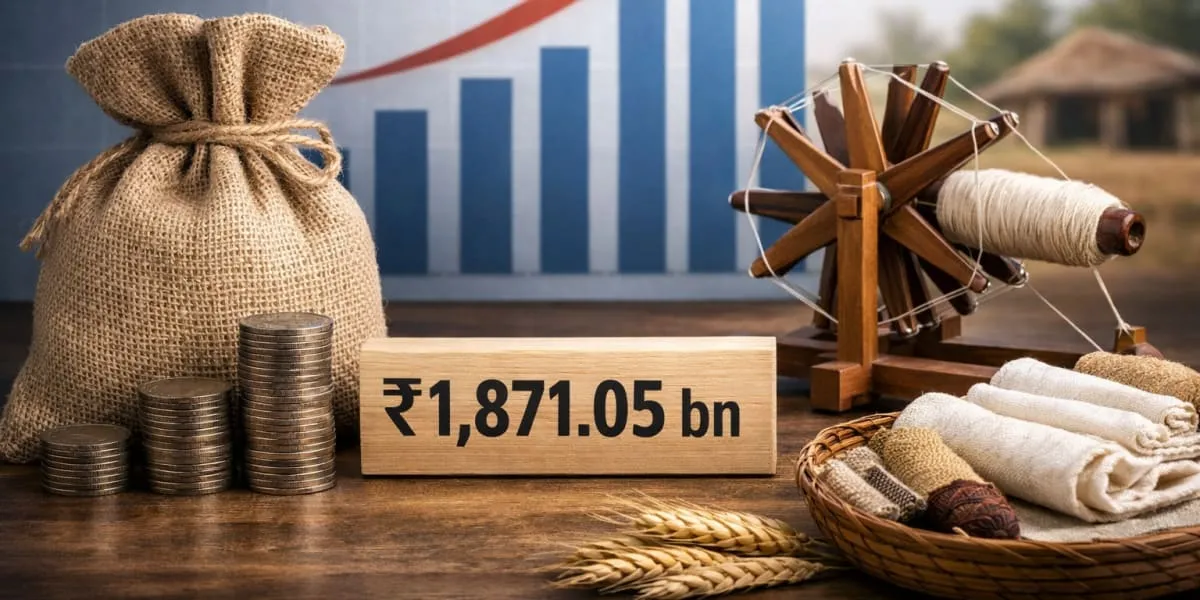
The Khadi and Village Industries Commission released provisional data for the financial year 2025-26, reporting record sales and rising rural employment. Sales of Khadi and village industry products reached Rs.1,871.05 billion (bn), which reflected sustained momentum from national campaigns promoting indigenous production. The commission attributed the performance to policy focus and expanded market access rather than to any single initiative. The data were presented as evidence of growing entrepreneurship and self-reliance across rural India.

Comparative figures show large gains since 2013-14, with sales up 501 per cent and production up 380 per cent over the 12-year period. Production rose from Rs.26,109 crore to Rs.1,25,296 crore, equivalent to Rs.261.09 billion and Rs.1,252.96 billion respectively. Employment associated with Khadi and village industries expanded from 1.30 crore to 2.04 crore, moving the total from 13 million (mn) to 20.4 mn. The commission framed these trends as central to achieving broader economic goals.

Khadi textiles recorded significant expansion, with production increasing from Rs.811 crore to Rs.3,974 crore and sales rising from Rs.1,081 crore to Rs.7,869 crore, reflecting widening consumer acceptance. Village industry production climbed from Rs.25,298 crore to Rs.1,21,322 crore while sales grew from Rs.30,073 crore to Rs.1,79,236 crore, underpinning rural manufacturing growth. The commission noted particularly strong gains in market access, institutional procurement and targeted training for artisans.

Under the Prime Minister's Employment Generation Programme, 66,494 new units were established in 2025-26 with a margin subsidy of Rs.2,457 crore and loans of Rs.7,375 crore, creating employment for 731,434 people. Since inception, 1,084,679 units have been supported with Rs.29,623 crore in subsidies and loans totalling Rs.80,705 crore, providing jobs to roughly 9.795 million (mn) individuals. The commission also highlighted distribution of 323,006 machines and toolkits and an increase in artisan pay from Rs.four to Rs.15 per hank, around 275 per cent.

The Khadi and Village Industries Commission released provisional data for the financial year 2025-26, reporting record sales and rising rural employment. Sales of Khadi and village industry products reached Rs.1,871.05 billion (bn), which reflected sustained momentum from national campaigns promoting indigenous production. The commission attributed the performance to policy focus and expanded market access rather than to any single initiative. The data were presented as evidence of growing entrepreneurship and self-reliance across rural India. Comparative figures show large gains since 2013-14, with sales up 501 per cent and production up 380 per cent over the 12-year period. Production rose from Rs.26,109 crore to Rs.1,25,296 crore, equivalent to Rs.261.09 billion and Rs.1,252.96 billion respectively. Employment associated with Khadi and village industries expanded from 1.30 crore to 2.04 crore, moving the total from 13 million (mn) to 20.4 mn. The commission framed these trends as central to achieving broader economic goals. Khadi textiles recorded significant expansion, with production increasing from Rs.811 crore to Rs.3,974 crore and sales rising from Rs.1,081 crore to Rs.7,869 crore, reflecting widening consumer acceptance. Village industry production climbed from Rs.25,298 crore to Rs.1,21,322 crore while sales grew from Rs.30,073 crore to Rs.1,79,236 crore, underpinning rural manufacturing growth. The commission noted particularly strong gains in market access, institutional procurement and targeted training for artisans. Under the Prime Minister's Employment Generation Programme, 66,494 new units were established in 2025-26 with a margin subsidy of Rs.2,457 crore and loans of Rs.7,375 crore, creating employment for 731,434 people. Since inception, 1,084,679 units have been supported with Rs.29,623 crore in subsidies and loans totalling Rs.80,705 crore, providing jobs to roughly 9.795 million (mn) individuals. The commission also highlighted distribution of 323,006 machines and toolkits and an increase in artisan pay from Rs.four to Rs.15 per hank, around 275 per cent.

Next Story
Infrastructure Energy

NSW Launches 2.5 GW Renewable Tender And 12 GWh Storage

New South Wales has opened a pair of record tenders seeking two point five gigawatts (GW) of new renewable generation and 12 gigawatt?hours (GWh) of long?duration storage to accelerate its clean energy transition. The generation auction, Tender 8, is the largest launched under the NSW Electricity Infrastructure Roadmap and is being managed by independent consumer trustee AusEnergy Services Limited (ASL). The storage contest, Tender 9, seeks up to 12 GWh of additional storage and follows a decision to unlock an extra 50 per cent of capacity above baseline planning targets. Officials indicated t..

Next Story
Infrastructure Energy

Jharkhand Researchers Develop Eco-Friendly Solar Cell

A team from the Department of Energy Engineering at the Central University of Jharkhand (CUJ) has developed an eco-friendly solar cell that uses a plant-based natural dye extracted from the petals of Mirabilis jalapa (commonly known as Gulabbas or Four O'Clock Flower). The researchers described the work as part of ongoing laboratory studies to explore sustainable alternatives to conventional photovoltaics. The device builds on dye-sensitised solar cell concepts adapted for locally available botanical materials. The lead researcher said the developed solar cell had achieved a highest power conv..

Next Story
Infrastructure Energy

Gwalior Floats Rs 99.8 mn Tender For Two MW Solar Plant

The Gwalior Municipal Corporation has issued a Notice Inviting Tender under a Request For Proposal to appoint an agency to develop a grid-connected solar power project at Manpur. The scheme calls for a two Megawatt AC on-grid ground-mounted solar photovoltaic plant, with a 20 per cent DC oversizing that raises the total DC capacity to two point four Megawatt (MW). The selected developer will be responsible for detailed design, construction and all associated infrastructure works required for grid integration. The original tender document was dated eight June 2024 and was digitally updated in M..

Advertisement

Subscribe to Our Newsletter

Get daily newsletters around different themes from Construction world.

STAY CONNECTED

Advertisement

Advertisement

Advertisement

-->














