Shah Launches SSB Projects Worth Rs 1.7 Billion (bn) in Bihar
ECONOMY & POLICY

Shah Launches SSB Projects Worth Rs 1.7 Billion (bn) in Bihar

Union home minister Amit Shah launched a package of projects for the Sashastra Seema Bal (SSB) in Bihar worth Rs 1.7 billion (bn). The initiatives are intended to strengthen border security infrastructure and enhance operational readiness along the state’s frontier regions. The announcement was made at a formal event attended by senior officials and state representatives. The allocation underscores central commitment to strengthen border management in eastern India and to modernise facilities used by personnel and communities in border districts.\n\nThe programme covers construction and upgrading of border outposts, accommodation for personnel, training facilities and communication systems to improve surveillance and response capabilities. Authorities indicated the measures will support rapid mobilisation and better protection of border communities. The projects form part of a wider national effort to modernise paramilitary forces and optimise deployment efficiency. The modernisation drive is expected to introduce improved communication networks and mobility assets to support sustained operations.\n\nFunding for the package will be disbursed through the ministry’s allotted infrastructure channels and is expected to be utilised over the coming months for planning, procurement and construction. Officials emphasised that the works will follow established procurement rules and aim to deliver durable infrastructure and logistical support for Sashastra Seema Bal personnel. Local administration will coordinate site selection and implementation with central agencies. Stakeholders will prioritise durable materials and climate resilient designs at construction sites.\n\nThe investment in Bihar is presented as strengthening internal security architecture and enabling improved cooperation between central forces and state authorities. Observers noted the potential benefits for local employment during construction and for long term operational capacity of the Sashastra Seema Bal. The ministry signalled ongoing monitoring to ensure timely completion and effective use of the allocated funds. Community liaison mechanisms will be established to address local concerns and facilitate timely project delivery effectively.

Union home minister Amit Shah launched a package of projects for the Sashastra Seema Bal (SSB) in Bihar worth Rs 1.7 billion (bn). The initiatives are intended to strengthen border security infrastructure and enhance operational readiness along the state’s frontier regions. The announcement was made at a formal event attended by senior officials and state representatives. The allocation underscores central commitment to strengthen border management in eastern India and to modernise facilities used by personnel and communities in border districts.\n\nThe programme covers construction and upgrading of border outposts, accommodation for personnel, training facilities and communication systems to improve surveillance and response capabilities. Authorities indicated the measures will support rapid mobilisation and better protection of border communities. The projects form part of a wider national effort to modernise paramilitary forces and optimise deployment efficiency. The modernisation drive is expected to introduce improved communication networks and mobility assets to support sustained operations.\n\nFunding for the package will be disbursed through the ministry’s allotted infrastructure channels and is expected to be utilised over the coming months for planning, procurement and construction. Officials emphasised that the works will follow established procurement rules and aim to deliver durable infrastructure and logistical support for Sashastra Seema Bal personnel. Local administration will coordinate site selection and implementation with central agencies. Stakeholders will prioritise durable materials and climate resilient designs at construction sites.\n\nThe investment in Bihar is presented as strengthening internal security architecture and enabling improved cooperation between central forces and state authorities. Observers noted the potential benefits for local employment during construction and for long term operational capacity of the Sashastra Seema Bal. The ministry signalled ongoing monitoring to ensure timely completion and effective use of the allocated funds. Community liaison mechanisms will be established to address local concerns and facilitate timely project delivery effectively.

Related Stories

Gold Stories

Next Story
Infrastructure Urban

KONE Opens India's First Digital Experience Centre in Pune

KONE, a global elevator and escalator manufacturer, has inaugurated its first Digital Experience Centre (DEC) in India, located in Pune. The facility aims to showcase how artificial intelligence (AI), connectivity and data-driven technologies can enhance customer experiences and improve building operations.The centre was inaugurated by Jussi Herlin, Executive Vice Chair, KONE Corporation; Philippe Delorme, President and CEO, KONE; and Nandan Nilekani, Co-founder and Chairman of the Board, Infosys.Designed as an interactive customer environment, the facility demonstrates digital solutions cover..

Next Story
Infrastructure Urban

CII GreenCo Launches Circularity Guidelines for Indian Industry

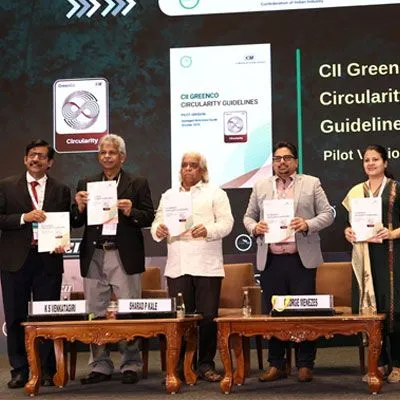
The Confederation of Indian Industry (CII) GreenCo Council has launched the CII GreenCo Circularity Guidelines – Pilot Version at the 17th CII GreenCo Waste & Resource Management Summit 2026 in Chennai. The initiative aims to strengthen resource efficiency, waste reduction and circular economy practices across Indian manufacturing and process industries.The guidelines introduce a structured framework with circularity indices covering raw materials, consumables, packaging and other resource inputs. These indicators will help industries assess existing practices, identify opportunities to ..

Next Story
Infrastructure Energy

Global Electronics Association Launches IPC-1783-CO2E Standard

The Global Electronics Association has introduced IPC-1783-CO2E, a new international standard aimed at improving consistency, transparency and comparability in product carbon footprint reporting across the electronics manufacturing industry.The standard, titled International Standard for Data Collection and Reporting of CO2 Equivalent (CO2e) Emissions for the Electronics Manufacturing Supply Chain, provides industry-specific guidance for collecting, estimating and reporting carbon emissions data.With increasing regulatory requirements and customer expectations, electronics manufacturers face c..

Advertisement

Subscribe to Our Newsletter

Get daily newsletters around different themes from Construction world.

STAY CONNECTED

Advertisement

SPECIAL OFFER
QR Code