TRAI Reviews Network Quality Across Bihar LSA Corridors
ECONOMY & POLICY

TRAI Reviews Network Quality Across Bihar LSA Corridors

Recently, Telecom Regulatory Authority of India (TRAI) released the findings of its Independent Drive Test (IDT) for the Bihar Licensed Service Area (LSA), covering city routes in Hazaribagh district and adjoining areas, national highway corridors from Ranchi to Patna along NH-19, NH-20 and NH-22, and the railway route between Patna and Ranchi. The assessment was conducted in November 2025 to capture real-world mobile network performance across diverse usage environments.

Between 20 and 28 November 2025, TRAI teams carried out extensive testing covering 220.9 km of city drive routes, 18 hotspot locations, 2.1 km of walk tests, 327.5 km of highway drive tests and 376.9 km of railway route testing. Technologies evaluated included 2G, 3G, 4G and 5G, reflecting user experience across multiple handset capabilities. The findings have been shared with all concerned telecom service providers.

Voice services were assessed on parameters such as Call Setup Success Rate (CSSR), Drop Call Rate (DCR), call setup time, speech quality and coverage, while data services were evaluated on download and upload throughput, latency, jitter, packet drop rate and video streaming delay.

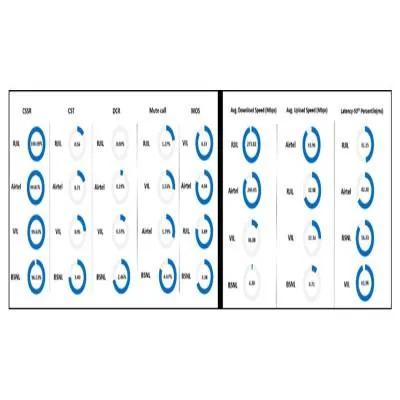
In auto-selection mode, Airtel and RJIL recorded overall call setup success rates of 96.63 per cent and 99.21 per cent respectively, while BSNL and VIL reported 57.80 per cent and 82.99 per cent. Overall drop call rates stood at 0.27 per cent for Airtel, 6.79 per cent for BSNL, 0.79 per cent for RJIL and 8.73 per cent for VIL across city, highway and railway routes.

For 5G services, the maximum average download speed recorded during the overall drive test was 199.26 Mbps, while the maximum average upload speed reached 24.47 Mbps. Poor signal strength in auto-selection mode was observed across varying portions of the city drive routes, with higher incidence reported for BSNL and VIL.

The assessment covered multiple urban and semi-urban locations across Jharkhand and Bihar, including institutional campuses, transport hubs, healthcare facilities and public spaces. TRAI stated that the tests were conducted using standardised protocols and recommended equipment to reflect real-time network conditions, with the detailed report available on its official website.

Recently, Telecom Regulatory Authority of India (TRAI) released the findings of its Independent Drive Test (IDT) for the Bihar Licensed Service Area (LSA), covering city routes in Hazaribagh district and adjoining areas, national highway corridors from Ranchi to Patna along NH-19, NH-20 and NH-22, and the railway route between Patna and Ranchi. The assessment was conducted in November 2025 to capture real-world mobile network performance across diverse usage environments. Between 20 and 28 November 2025, TRAI teams carried out extensive testing covering 220.9 km of city drive routes, 18 hotspot locations, 2.1 km of walk tests, 327.5 km of highway drive tests and 376.9 km of railway route testing. Technologies evaluated included 2G, 3G, 4G and 5G, reflecting user experience across multiple handset capabilities. The findings have been shared with all concerned telecom service providers. Voice services were assessed on parameters such as Call Setup Success Rate (CSSR), Drop Call Rate (DCR), call setup time, speech quality and coverage, while data services were evaluated on download and upload throughput, latency, jitter, packet drop rate and video streaming delay. In auto-selection mode, Airtel and RJIL recorded overall call setup success rates of 96.63 per cent and 99.21 per cent respectively, while BSNL and VIL reported 57.80 per cent and 82.99 per cent. Overall drop call rates stood at 0.27 per cent for Airtel, 6.79 per cent for BSNL, 0.79 per cent for RJIL and 8.73 per cent for VIL across city, highway and railway routes. For 5G services, the maximum average download speed recorded during the overall drive test was 199.26 Mbps, while the maximum average upload speed reached 24.47 Mbps. Poor signal strength in auto-selection mode was observed across varying portions of the city drive routes, with higher incidence reported for BSNL and VIL. The assessment covered multiple urban and semi-urban locations across Jharkhand and Bihar, including institutional campuses, transport hubs, healthcare facilities and public spaces. TRAI stated that the tests were conducted using standardised protocols and recommended equipment to reflect real-time network conditions, with the detailed report available on its official website.

Next Story
Infrastructure Urban

Rosatom Delivers Nuclear Fuel for Kudankulam Unit 3

Rosatom has recently supplied nuclear fuel for the initial loading of the VVER-1000 reactor core at Unit 3 of the Kudankulam Nuclear Power Plant, marking a key milestone in the second stage of the Russian-designed nuclear power project in southern India.The fuel was supplied by Rosatom’s Nuclear Fuel Division, managed by TVEL, and manufactured at the Novosibirsk Chemical Concentrates Plant. The delivery includes the initial reactor load along with reserve fuel assemblies and is part of a long-term contract covering the entire operational life of Units 3 and 4.Building on operational experien..

Next Story
Infrastructure Transport

CBL International Enables First LNG Bunkering at Xiaomo Port

CBL International recently completed the first-ever LNG bunkering operation at Xiaomo Port, supplying liquefied natural gas to vessels operated by BYD in support of its maritime decarbonisation strategy. The operation was facilitated through a physical supplier in collaboration with China National Offshore Oil Corporation (CNOOC), which supported the port’s inaugural LNG bunkering activity. The milestone represents a strategic expansion of CBL International's sustainable fuel offerings beyond biofuels, while also diversifying revenue streams. As global shipping intensifies efforts to cut em..

Next Story
Infrastructure Urban

Aimtron, Aurassure Partner for IoT Weather Systems

Aimtron Electronics has recently entered into an OEM manufacturing engagement with Aurassure to produce new-age, IoT-enabled weather and environmental monitoring systems in India. The collaboration supports the growing demand for real-time environmental intelligence across urban, industrial and infrastructure applications. The engagement comes as global focus on climate-risk management and data-driven planning accelerates. The global weather monitoring systems market, valued at around USD 2.1 billion in 2024, is projected to reach nearly USD 4.8 billion by 2034, driven by the rapid adoption o..

Advertisement

Subscribe to Our Newsletter

Get daily newsletters around different themes from Construction world.

STAY CONNECTED

Advertisement

Advertisement

Advertisement

Advertisement

Open In App