




VMRDA Region Gets New Development Blueprint
ECONOMY & POLICY

VMRDA Region Gets New Development Blueprint

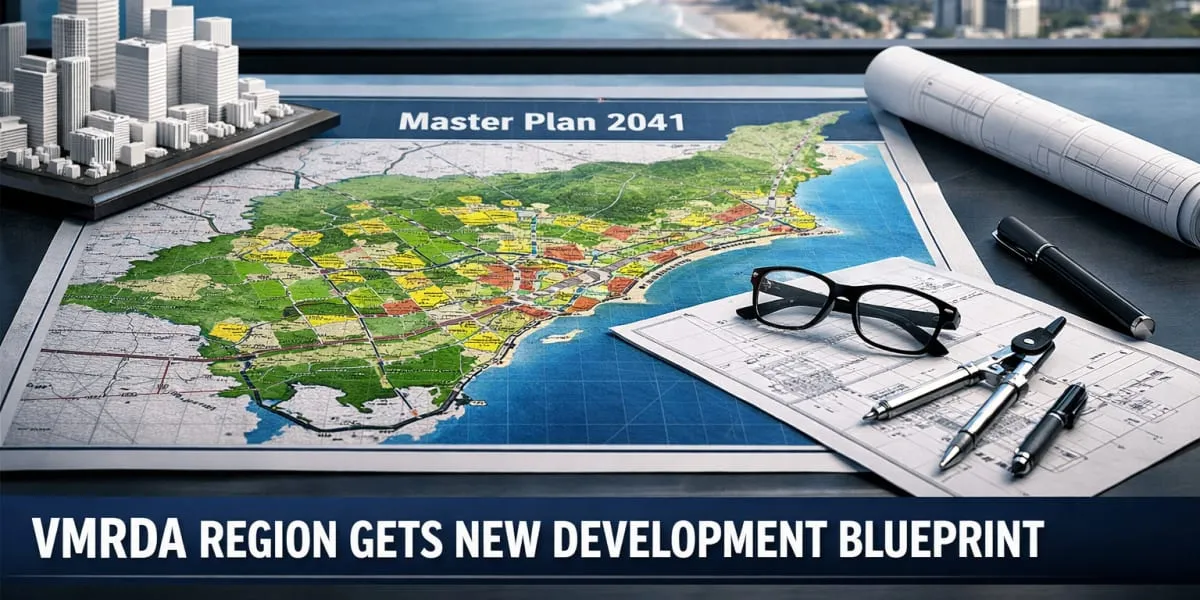
The state government approved the revised Master Plan-2041 for the Visakhapatnam Metropolitan Region Development Authority through government order GO-144 on July eight, granting statutory status under the AP Metropolitan Region and Urban Development Authorities Act of 2016. The updated plan replaces the 2021 plan after a detailed review of current needs and infrastructure requirements. It followed public consultations and assessments.

Public participation formed a key element of the revision process. Authorities initially received 3,722 objections and suggestions, which were consolidated into 717 distinct issues; 427 were incorporated and 290 were excluded for technical or legal reasons. A second round of consultations in early 2026 generated 1,241 responses primarily on roads, land use, water bodies and alignments.

The plan uses Geographic Information System (GIS) technology to integrate development data from 2021 to 2026 covering layouts, building plans, open spaces and land-use changes. Major projects included the Raipur Expressway, the Coastal Corridor, the Polavaram Canal, Metro Rail, the Bus Rapid Transit System and suburban railway corridors. The road network will be expanded to 4,098.6 km, with 676.5 km of new roads proposed and 15 priority links for connections to Bhogapuram international airport.

Planned initiatives encompass the Bhogapuram Aerocity, information technology (IT) and data hubs in Madhurawada, Anandapuram and Kapuluppada, the GMR Manasa Aviation Edunity and the Vizag Bay City project extending from Kailasagiri to Bheemili. Environmental conservation measures designate forests, hills, water bodies and ecologically sensitive zones as protected and provide for creation of Miyawaki forests across 9.17 hectares. The approach aims to balance development needs with ecological safeguards.

The land-use plan allocates agriculture 40.7 per cent, residential 17 per cent, mixed-use 9 per cent, transport 6 per cent, forests and green zones 25 per cent and industry 2 per cent, with other categories forming the remainder. The region’s population is projected to rise from four point seven nine four million (mn) in 2025 to six point six three zero million (mn) by 2041. Inputs from departments, representatives and citizens shaped the revised Master Plan-2041 to support planned urbanisation, integrated transport, environmental protection and investment.

The state government approved the revised Master Plan-2041 for the Visakhapatnam Metropolitan Region Development Authority through government order GO-144 on July eight, granting statutory status under the AP Metropolitan Region and Urban Development Authorities Act of 2016. The updated plan replaces the 2021 plan after a detailed review of current needs and infrastructure requirements. It followed public consultations and assessments. Public participation formed a key element of the revision process. Authorities initially received 3,722 objections and suggestions, which were consolidated into 717 distinct issues; 427 were incorporated and 290 were excluded for technical or legal reasons. A second round of consultations in early 2026 generated 1,241 responses primarily on roads, land use, water bodies and alignments. The plan uses Geographic Information System (GIS) technology to integrate development data from 2021 to 2026 covering layouts, building plans, open spaces and land-use changes. Major projects included the Raipur Expressway, the Coastal Corridor, the Polavaram Canal, Metro Rail, the Bus Rapid Transit System and suburban railway corridors. The road network will be expanded to 4,098.6 km, with 676.5 km of new roads proposed and 15 priority links for connections to Bhogapuram international airport. Planned initiatives encompass the Bhogapuram Aerocity, information technology (IT) and data hubs in Madhurawada, Anandapuram and Kapuluppada, the GMR Manasa Aviation Edunity and the Vizag Bay City project extending from Kailasagiri to Bheemili. Environmental conservation measures designate forests, hills, water bodies and ecologically sensitive zones as protected and provide for creation of Miyawaki forests across 9.17 hectares. The approach aims to balance development needs with ecological safeguards. The land-use plan allocates agriculture 40.7 per cent, residential 17 per cent, mixed-use 9 per cent, transport 6 per cent, forests and green zones 25 per cent and industry 2 per cent, with other categories forming the remainder. The region’s population is projected to rise from four point seven nine four million (mn) in 2025 to six point six three zero million (mn) by 2041. Inputs from departments, representatives and citizens shaped the revised Master Plan-2041 to support planned urbanisation, integrated transport, environmental protection and investment.

Related Stories

Gold Stories
Next Story
Infrastructure Urban

NABARD, NaBFID Partner to Fund Rural Infrastructure

The National Bank for Agriculture and Rural Development (NABARD) and the National Bank for Financing Infrastructure and Development (NaBFID) have signed a Memorandum of Understanding (MoU) to collaborate on financing infrastructure projects with significant rural impact.The partnership combines NABARD’s expertise in rural and agricultural infrastructure with NaBFID’s specialised infrastructure financing capabilities. It will focus on joint financing, knowledge sharing and developing financing solutions to improve access to long-term, competitively priced capital for rural infrastructure an..

Next Story
Infrastructure Energy

Advait Energy Wins Rs 1.34 Billion MPPTCL Order

Advait Energy Transitions (AETL) has secured a Rs 1.34 billion turnkey contract from Madhya Pradesh Power Transmission Co. Ltd. (MPPTCL) for the design, manufacturing and supply of Emergency Restoration Systems (ERS) for 400kV, 220kV and 132kV EHV transmission lines.The order, received against Tender No. TR-23/2025 on August 25, 2026, will be executed over 18 months. The contract value, inclusive of taxes, covers the complete ERS along with the required accessories.Emergency Restoration Systems are used to restore transmission infrastructure following disruptions, helping maintain continuity a..

Next Story
Real Estate

Gradiant expands Coimbatore engineering centre

Gradiant has expanded its Global Engineering Center (GEC) in Coimbatore, more than doubling its engineering workforce from approximately 100 to over 200 professionals as it strengthens its global project execution capabilities.The expanded centre will bring together multidisciplinary expertise across process engineering, detailed design and project engineering, enabling the India team to take on greater responsibility for the engineering and design of Gradiant’s international projects.According to Govind Alagappan, COO, Gradiant, Coimbatore’s engineering talent and industrial heritage make..

Advertisement

Subscribe to Our Newsletter

Get daily newsletters around different themes from Construction world.

STAY CONNECTED

Advertisement














