WABAG Signs Contract For Doha SWRO II Desalination Plant
ECONOMY & POLICY

WABAG Signs Contract For Doha SWRO II Desalination Plant

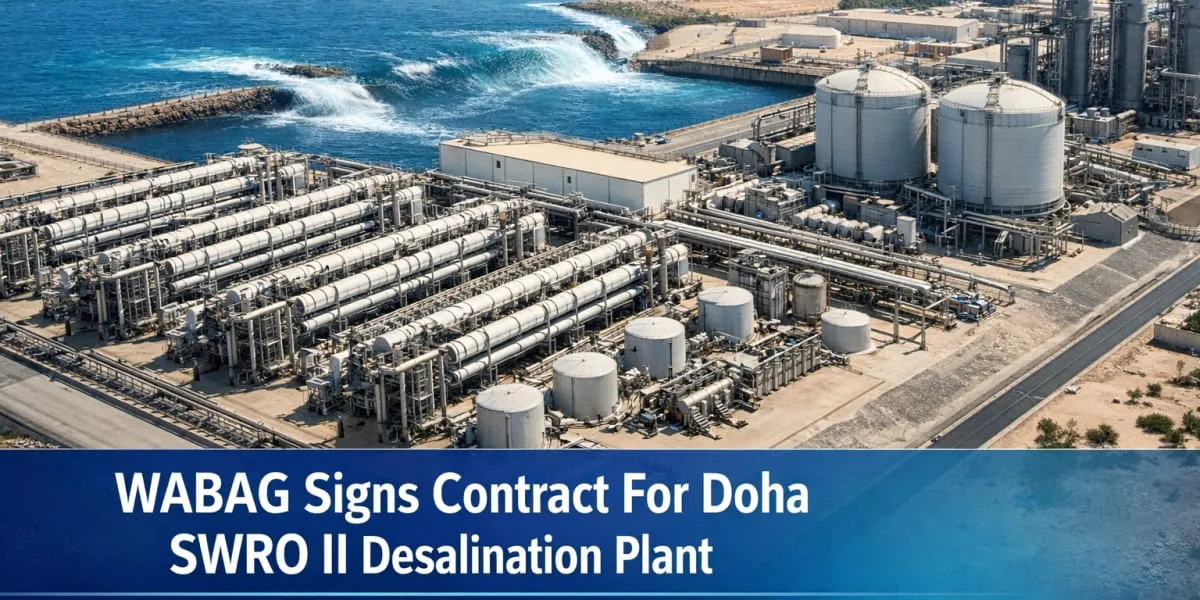
VA TECH WABAG has signed a contract to build the Doha SWRO Desalination Plant with Recarbonation System Stage II in Kuwait after the award by the Ministry of Electricity, Water & Renewable Energy in June 2026. The execution of the contract now formally paves the way for project commencement and represents the company's first project in Kuwait. The order has been classified as a mega project by the issuer and strengthens WABAG's footprint across the GCC region.

Undertaken on a Design, Build, Operate basis, the facility is sized at 60 MIGD, approximately 272 million (mn) litres per day, and will combine sea water reverse osmosis technology with a recarbonation system. Construction is scheduled over 36 months followed by a five-year operation and maintenance period under the contract. On-site solar photovoltaic systems will meet part of the plant's energy needs, supporting Kuwait's clean-energy objectives and lowering the facility's carbon footprint.

The project will be delivered by a WABAG-led unincorporated joint venture with Heavy Engineering Industries & Shipbuilding Company K.S.C., known as HEISCO. The arrangement is intended to leverage WABAG's desalination expertise and HEISCO's local engineering and construction capabilities to expedite delivery. The deployment aligns with regional priorities to enhance water security while integrating sustainable energy measures.

WABAG's head for strategy and business growth in the GCC said the signing marked an important step towards the commencement of operations in a strategically important market and reflected the company's continued focus on delivering technologically advanced and sustainable desalination solutions across the region. With over a century of experience and around 2,000 water professionals operating in more than 25 countries, WABAG has designed and built over 1,500 municipal and industrial water and wastewater treatment plants worldwide. The company positions itself as a lifecycle partner able to manage design, engineering, supply, construction and long-term operational management across diverse business models.

VA TECH WABAG has signed a contract to build the Doha SWRO Desalination Plant with Recarbonation System Stage II in Kuwait after the award by the Ministry of Electricity, Water & Renewable Energy in June 2026. The execution of the contract now formally paves the way for project commencement and represents the company's first project in Kuwait. The order has been classified as a mega project by the issuer and strengthens WABAG's footprint across the GCC region. Undertaken on a Design, Build, Operate basis, the facility is sized at 60 MIGD, approximately 272 million (mn) litres per day, and will combine sea water reverse osmosis technology with a recarbonation system. Construction is scheduled over 36 months followed by a five-year operation and maintenance period under the contract. On-site solar photovoltaic systems will meet part of the plant's energy needs, supporting Kuwait's clean-energy objectives and lowering the facility's carbon footprint. The project will be delivered by a WABAG-led unincorporated joint venture with Heavy Engineering Industries & Shipbuilding Company K.S.C., known as HEISCO. The arrangement is intended to leverage WABAG's desalination expertise and HEISCO's local engineering and construction capabilities to expedite delivery. The deployment aligns with regional priorities to enhance water security while integrating sustainable energy measures. WABAG's head for strategy and business growth in the GCC said the signing marked an important step towards the commencement of operations in a strategically important market and reflected the company's continued focus on delivering technologically advanced and sustainable desalination solutions across the region. With over a century of experience and around 2,000 water professionals operating in more than 25 countries, WABAG has designed and built over 1,500 municipal and industrial water and wastewater treatment plants worldwide. The company positions itself as a lifecycle partner able to manage design, engineering, supply, construction and long-term operational management across diverse business models.

Related Stories

Gold Stories

Next Story
Infrastructure Urban

Modi Urges End-to-End Reforms for Infrastructure Projects

Prime Minister Narendra Modi on Tuesday called for continuous reforms across all stages of infrastructure project execution during the 53rd PRAGATI meeting. He asked ministries and state governments to adopt an end-to-end approach and a proactive work culture to ensure timely delivery. The meeting reviewed six key infrastructure projects in the railway, road and power sectors across nine states with a cumulative investment of Rs 300 billion (Rs 300 bn). Officials assessed projects on timelines, inter-agency coordination and resolution of pending issues. He said infrastructure projects should b..

Next Story
Infrastructure Transport

GMR Airports Plans US$2 bn Expansion In Delhi And Hyderabad

GMR Airports plans a US$2 billion (bn) expansion of facilities at New Delhi and Hyderabad as part of a major modernisation drive. Hyderabad’s upgraded airport will be able to accommodate about 80 million (mn) passengers a year, more than double its current annual volume of 34 mn fliers. The company is India’s largest airport operator by number of fliers annually, while rival Adani Airport Holdings Ltd is the biggest by number of airports and is reported to be looking to invest US$15 bn to boost passenger capacity over the next five years. Executives indicated the build-outs in New Delhi an..

Next Story
Infrastructure Transport

Mumbai Airport to Demolish Part of Terminal One From 15 January

Adani Group-operated Mumbai International Airport (MIAL) will begin partial demolition of the north section of Terminal one-B at Chatrapati Shivaji Maharaj International Airport from 15 January 2027, according to a letter to the civil aviation ministry. The operator has begun redistributing air traffic to Terminal two and to Navi Mumbai International Airport to facilitate the work. The airport, managed by Mumbai International Airport, currently has a capacity of over 50 million (mn) passengers and handles over 950 flight movements daily. Terminal one is nearly 80 years old and parts of it have..

Advertisement

Subscribe to Our Newsletter

Get daily newsletters around different themes from Construction world.

STAY CONNECTED

Advertisement