Zetwerk Electronics Inaugurates Bengaluru Manufacturing Unit
ECONOMY & POLICY

Zetwerk Electronics Inaugurates Bengaluru Manufacturing Unit

Union Minister Ashwini Vaishnaw inaugurated Zetwerk Electronics' new manufacturing facility for defence, automotive and IT hardware electronics in Bengaluru, with Karnataka minister M.B. Patil present. The minister indicated that every product from the unit will meet high quality standards and that electronic component manufacturing is expanding rapidly. He noted that 46 approvals have been granted and that Karnataka is set to receive investments exceeding Rs 100 billion (bn). The event was presented as part of efforts to bolster domestic production.

The minister highlighted that the budget raised the allocation for the electronic component manufacturing scheme from Rs 220 bn to Rs 400 bn to accelerate the sector. He referred to a national production target of USD 500 bn by the 2030-2031 financial year and urged rapid progress towards that goal. He observed that Indian designers are developing complete two-nanometre chips and that equipment manufacturers have begun operations in the country, with Applied Materials and Lam Research present and a drive to attract ASML.

He said commercial production is expected to begin this year and that the first commercially produced chip from a semiconductor plant should become available soon. The minister outlined that Semicon 2.0 will focus on design, equipment manufacturing, chemicals, gases, validation and yield improvement to build a sustainable semiconductor ecosystem. Emphasis was placed on ecosystem development across design and fabrication support to drive long term competitiveness.

He stated a target to prepare 85,000 silicon engineers over ten years and noted that 67,000 have been trained in the first four years, signalling progress in building local skills. The minister added that with the arrival of the fab a mapped path exists from 28-nanometre to 7-nanometre as part of Silicon 2.0 and that chip design will increasingly be undertaken in India. He urged a cooperative approach among states and called for a broad vision to make India a Viksit Bharat by 2047 under the Prime Minister's guidance.

Union Minister Ashwini Vaishnaw inaugurated Zetwerk Electronics' new manufacturing facility for defence, automotive and IT hardware electronics in Bengaluru, with Karnataka minister M.B. Patil present. The minister indicated that every product from the unit will meet high quality standards and that electronic component manufacturing is expanding rapidly. He noted that 46 approvals have been granted and that Karnataka is set to receive investments exceeding Rs 100 billion (bn). The event was presented as part of efforts to bolster domestic production. The minister highlighted that the budget raised the allocation for the electronic component manufacturing scheme from Rs 220 bn to Rs 400 bn to accelerate the sector. He referred to a national production target of USD 500 bn by the 2030-2031 financial year and urged rapid progress towards that goal. He observed that Indian designers are developing complete two-nanometre chips and that equipment manufacturers have begun operations in the country, with Applied Materials and Lam Research present and a drive to attract ASML. He said commercial production is expected to begin this year and that the first commercially produced chip from a semiconductor plant should become available soon. The minister outlined that Semicon 2.0 will focus on design, equipment manufacturing, chemicals, gases, validation and yield improvement to build a sustainable semiconductor ecosystem. Emphasis was placed on ecosystem development across design and fabrication support to drive long term competitiveness. He stated a target to prepare 85,000 silicon engineers over ten years and noted that 67,000 have been trained in the first four years, signalling progress in building local skills. The minister added that with the arrival of the fab a mapped path exists from 28-nanometre to 7-nanometre as part of Silicon 2.0 and that chip design will increasingly be undertaken in India. He urged a cooperative approach among states and called for a broad vision to make India a Viksit Bharat by 2047 under the Prime Minister's guidance.

Related Stories

Gold Stories

Next Story
Infrastructure Urban

KONE Opens India's First Digital Experience Centre in Pune

KONE, a global elevator and escalator manufacturer, has inaugurated its first Digital Experience Centre (DEC) in India, located in Pune. The facility aims to showcase how artificial intelligence (AI), connectivity and data-driven technologies can enhance customer experiences and improve building operations.The centre was inaugurated by Jussi Herlin, Executive Vice Chair, KONE Corporation; Philippe Delorme, President and CEO, KONE; and Nandan Nilekani, Co-founder and Chairman of the Board, Infosys.Designed as an interactive customer environment, the facility demonstrates digital solutions cover..

Next Story
Infrastructure Urban

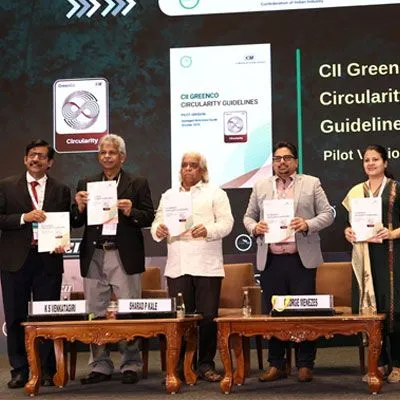
CII GreenCo Launches Circularity Guidelines for Indian Industry

The Confederation of Indian Industry (CII) GreenCo Council has launched the CII GreenCo Circularity Guidelines – Pilot Version at the 17th CII GreenCo Waste & Resource Management Summit 2026 in Chennai. The initiative aims to strengthen resource efficiency, waste reduction and circular economy practices across Indian manufacturing and process industries.The guidelines introduce a structured framework with circularity indices covering raw materials, consumables, packaging and other resource inputs. These indicators will help industries assess existing practices, identify opportunities to ..

Next Story
Infrastructure Energy

Global Electronics Association Launches IPC-1783-CO2E Standard

The Global Electronics Association has introduced IPC-1783-CO2E, a new international standard aimed at improving consistency, transparency and comparability in product carbon footprint reporting across the electronics manufacturing industry.The standard, titled International Standard for Data Collection and Reporting of CO2 Equivalent (CO2e) Emissions for the Electronics Manufacturing Supply Chain, provides industry-specific guidance for collecting, estimating and reporting carbon emissions data.With increasing regulatory requirements and customer expectations, electronics manufacturers face c..

Advertisement

Subscribe to Our Newsletter

Get daily newsletters around different themes from Construction world.

STAY CONNECTED

Advertisement

SPECIAL OFFER
QR Code