Green steel to drive India steel sector growth
Steel

Green steel to drive India steel sector growth

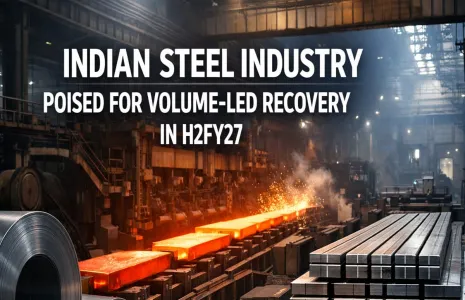
India’s iron and steel industry is expected to see long-term growth driven by capacity expansion, urbanisation, infrastructure development and manufacturing growth, according to a Rubix Industry Insights report by Rubix Data Sciences. The report said India has moved from being the fourth-largest producer to the second-largest producer and consumer of crude steel globally over the past decade.

India ranked second globally in crude steel production and finished steel consumption in 2024 and was also the world’s largest producer of sponge iron. The country’s share of global crude steel production increased from 5 per cent in 2014 to 8 per cent in 2024, while its share of finished steel consumption also rose from 5 per cent to 8 per cent during the same period.

The report said India aims to raise crude steel capacity from around 200 million tonnes per annum at present to 300 million tonnes per annum by 2030-31. Capacity is targeted to reach 400 million tonnes per annum by 2035-36 and 500 million tonnes per annum by 2047. To achieve the 400 million tonnes target, the sector is expected to require investments of nearly Rs 17 trillion.

Rubix noted that India’s steel demand will be supported by housing, transport networks, industrial infrastructure and smart cities as urbanisation rises. However, the report also highlighted key challenges, including India’s dependence on imported coking coal, which currently accounts for around 90 per cent of requirements, and high carbon emissions from steel production.

The report also pointed to the growing importance of green steel initiatives, including the Green Steel Mission, renewable energy adoption, scrap-based steelmaking and green hydrogen-based technologies. India introduced a formal Green Steel Taxonomy in 2024, classifying steel by carbon emission intensity and introducing a star-rating system to support decarbonisation.

Rubix said continued investment in capacity expansion, green technologies and raw material security could help India become a leading supplier of value-added, low-carbon steel. The report added that export prospects may improve following the India-UK Comprehensive Economic and Trade Agreement, under which 85 per cent of Indian steel exports to the UK will be exempt from UK steel safeguard measures.

"Join industry leaders at RAHSTA Expo, India's premier platform for roads, highways and traffic infrastructure. Register now to explore innovations, network with experts and shape the future of mobility."

India’s iron and steel industry is expected to see long-term growth driven by capacity expansion, urbanisation, infrastructure development and manufacturing growth, according to a Rubix Industry Insights report by Rubix Data Sciences. The report said India has moved from being the fourth-largest producer to the second-largest producer and consumer of crude steel globally over the past decade. India ranked second globally in crude steel production and finished steel consumption in 2024 and was also the world’s largest producer of sponge iron. The country’s share of global crude steel production increased from 5 per cent in 2014 to 8 per cent in 2024, while its share of finished steel consumption also rose from 5 per cent to 8 per cent during the same period. The report said India aims to raise crude steel capacity from around 200 million tonnes per annum at present to 300 million tonnes per annum by 2030-31. Capacity is targeted to reach 400 million tonnes per annum by 2035-36 and 500 million tonnes per annum by 2047. To achieve the 400 million tonnes target, the sector is expected to require investments of nearly Rs 17 trillion. Rubix noted that India’s steel demand will be supported by housing, transport networks, industrial infrastructure and smart cities as urbanisation rises. However, the report also highlighted key challenges, including India’s dependence on imported coking coal, which currently accounts for around 90 per cent of requirements, and high carbon emissions from steel production. The report also pointed to the growing importance of green steel initiatives, including the Green Steel Mission, renewable energy adoption, scrap-based steelmaking and green hydrogen-based technologies. India introduced a formal Green Steel Taxonomy in 2024, classifying steel by carbon emission intensity and introducing a star-rating system to support decarbonisation. Rubix said continued investment in capacity expansion, green technologies and raw material security could help India become a leading supplier of value-added, low-carbon steel. The report added that export prospects may improve following the India-UK Comprehensive Economic and Trade Agreement, under which 85 per cent of Indian steel exports to the UK will be exempt from UK steel safeguard measures.

Next Story
Real Estate

Platinum Corp Launches Bespoke Presidential Suites

Platinum Corp has launched Platinum Stellar: Bespoke Presidential Suites, a luxury residential project on Main Avenue in Santacruz, Mumbai. The project has been positioned as a boutique, design-led development for high-net-worth individuals, business owners and legacy residents from the Bandra-Khar-Santacruz belt.The project has been developed in collaboration with celebrity interior designer Sussanne Khan and follows a design-first approach inspired by Art Deco architecture. It incorporates refined detailing, spacious layouts, premium material palettes and arrival experiences planned to creat..

Next Story
Infrastructure Transport

Adani Airport City Plans Rs 200 Bn Investment

Adani Airport City Limited (AACL), a wholly owned subsidiary of Adani Airport Holdings Limited (AAHL), has announced a programme to develop integrated airport cities across its airport network. The first phase will involve an investment of more than Rs 20,000 crore and cover around 22 million sq ft across Mumbai, Navi Mumbai, Ahmedabad, Lucknow, Jaipur and Guwahati.The development spans over 655 acres across six airports in five states. Nearly 440 acres are located in Mumbai and Navi Mumbai, which will receive close to 70 per cent of the planned investment. The focus reflects the Mumbai Metrop..

Next Story
Infrastructure Urban

Vedanta contributes Rs 627.22 billion to exchequer

Vedanta Limited contributed Rs 627.22 billion to the exchequer in FY26, according to its 11th Tax Transparency Report. The contribution accounted for 36 per cent of the company’s consolidated revenue from operations and reflected its focus on transparent governance, fiscal discipline and nation-building.The FY26 contribution marked a 13.3 per cent increase over the previous year. Vedanta’s cumulative contribution to the exchequer over the past decade reached Rs 4.83 trillion. The company said the Group ranks among India’s top three private-sector contributors to the national exchequer.Th..

Advertisement

Subscribe to Our Newsletter

Get daily newsletters around different themes from Construction world.

STAY CONNECTED

Advertisement

Advertisement

Advertisement