
Ministry of Steel Unveils AI Roadmap to Modernise Sector
Steel

Ministry of Steel Unveils AI Roadmap to Modernise Sector

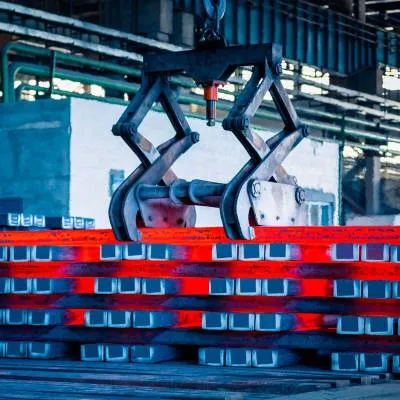
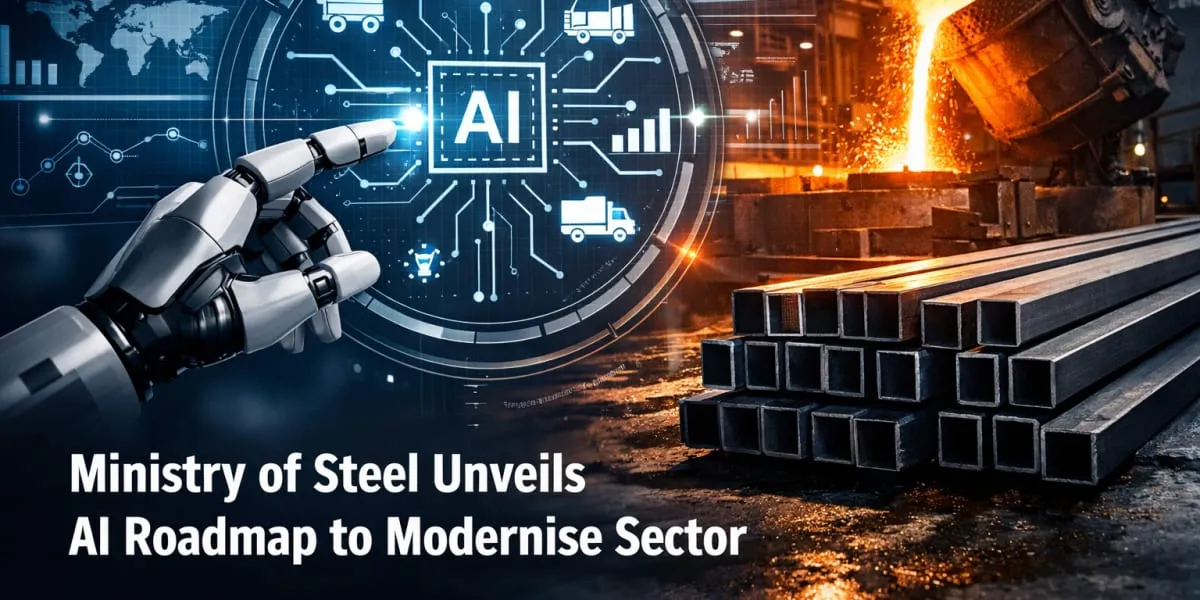
The Ministry of Steel unveiled a comprehensive digital roadmap at the India AI Impact Summit 2026 at Bharat Mandapam, signalling a strategic shift towards AI-led transformation across the steel value chain. The plan frames technology, predictive analytics and automation as essential to scaling capacity and improving decision making. The roadmap positions AI as a systemic enabler rather than a peripheral tool in mining, production, logistics and governance.

Central to the initiative is the AI in Steel Pavilion, a collaborative platform that presents real business problem statements and invites solution providers, startups, technology firms and research institutions to co-create scalable interventions. The Pavilion operates as a problem to solution marketplace, emphasising measurable outcomes over demonstrations. It is intended to accelerate the transition from isolated pilots to mission-mode integration across operations, quality control, safety and market intelligence.

A high level session convened leading producers, miners, policymakers and AI innovators to identify priority use cases and execution pathways. Industry representatives outlined needs such as predictive maintenance algorithms, computer vision systems, supply chain optimisation models and intelligent decision support. The discussion aimed to create a structured innovation pipeline so promising solutions can be tested, validated and scaled rapidly across the ecosystem.

The Secretary highlighted that India's steel consumption has nearly doubled from 77 million tonnes (mn t) in 2014 to 2015 to 152 million tonnes in 2024 to 2025, reflecting strong infrastructure and manufacturing demand. Crude steel capacity is targeted to rise from roughly 200 mn t to 300 mn t by 2030 to 2031 and to 400 mn t by 2035 to 2036, requiring parallel expansion in mining, logistics and downstream capacity. Such scaling will depend on intelligent capacity utilisation, real-time monitoring, energy efficiency and decarbonisation strategies driven by data and automation.

Industry leaders outlined support needs for startups, including domain customisation, scalable architectures and cybersecurity resilience to aid adoption. The Ministry invited developers, startups and research institutions to collaborate with the Steel Research and Technology Mission of India as a live sandbox. The roadmap framed the sector's future as one shaped by data, algorithms and collaborative innovation to ensure competitiveness and sustainability.

The Ministry of Steel unveiled a comprehensive digital roadmap at the India AI Impact Summit 2026 at Bharat Mandapam, signalling a strategic shift towards AI-led transformation across the steel value chain. The plan frames technology, predictive analytics and automation as essential to scaling capacity and improving decision making. The roadmap positions AI as a systemic enabler rather than a peripheral tool in mining, production, logistics and governance. Central to the initiative is the AI in Steel Pavilion, a collaborative platform that presents real business problem statements and invites solution providers, startups, technology firms and research institutions to co-create scalable interventions. The Pavilion operates as a problem to solution marketplace, emphasising measurable outcomes over demonstrations. It is intended to accelerate the transition from isolated pilots to mission-mode integration across operations, quality control, safety and market intelligence. A high level session convened leading producers, miners, policymakers and AI innovators to identify priority use cases and execution pathways. Industry representatives outlined needs such as predictive maintenance algorithms, computer vision systems, supply chain optimisation models and intelligent decision support. The discussion aimed to create a structured innovation pipeline so promising solutions can be tested, validated and scaled rapidly across the ecosystem. The Secretary highlighted that India's steel consumption has nearly doubled from 77 million tonnes (mn t) in 2014 to 2015 to 152 million tonnes in 2024 to 2025, reflecting strong infrastructure and manufacturing demand. Crude steel capacity is targeted to rise from roughly 200 mn t to 300 mn t by 2030 to 2031 and to 400 mn t by 2035 to 2036, requiring parallel expansion in mining, logistics and downstream capacity. Such scaling will depend on intelligent capacity utilisation, real-time monitoring, energy efficiency and decarbonisation strategies driven by data and automation. Industry leaders outlined support needs for startups, including domain customisation, scalable architectures and cybersecurity resilience to aid adoption. The Ministry invited developers, startups and research institutions to collaborate with the Steel Research and Technology Mission of India as a live sandbox. The roadmap framed the sector's future as one shaped by data, algorithms and collaborative innovation to ensure competitiveness and sustainability.

Next Story
Products

Panasonic Launches SIP Video Intercom System

Panasonic Life Solutions India has launched its VL-VQ Series SIP-based IP Video Intercom System, aimed at enhancing security and access management across modern residential developments. Designed for apartments, gated communities and large housing projects, the system offers a three-layered security framework integrating residences, building entrances and central security operations. It combines door stations, lobby display units, room monitors, guard stations and central management software into a unified platform, enabling real-time monitoring and communication. The system supports multipl..

Next Story
Real Estate

Mindspace REIT Tops Global Environmental Rankings

Mindspace Business Parks REIT has secured the No. 1 global rank for Environmental Performance in the 2025 S&P Global Corporate Sustainability Assessment (CSA) and has been recognised among the top 10 per cent of global performers in the S&P Global Sustainability Yearbook 2026. The REIT achieved the highest Environmental Dimension score of 84, ranking first among 379 global real estate companies. It has also been elevated from a Sustainability Yearbook Member to Industry Distinction 2026, reflecting its position among the top-performing global peers. Mindspace REIT recorded an overall..

Next Story
Infrastructure Urban

Maharashtra Eyes $1.5 Trillion GDP Contribution by 2027

Maharashtra is poised to contribute nearly $1.5 trillion to India’s $5 trillion economy ambition by 2027, provided global economic conditions remain stable, Deputy Chief Minister Eknath Shinde said recently at iDAC Expo in Mumbai. Highlighting the state’s economic momentum, Shinde said Maharashtra continues to lead the country through strong investment inflows, industrial expansion and large-scale infrastructure development. He noted that projects such as the Mumbai Coastal Road, Atal Setu, Navi Mumbai International Airport, Samruddhi Mahamarg and the 350-km metro network in the Mumbai Me..

Advertisement

Subscribe to Our Newsletter

Get daily newsletters around different themes from Construction world.

STAY CONNECTED

Advertisement

Advertisement

Advertisement