+
India Inaugurates First SkyCast System At IGI Airport
AVIATION & AIRPORTS

India Inaugurates First SkyCast System At IGI Airport

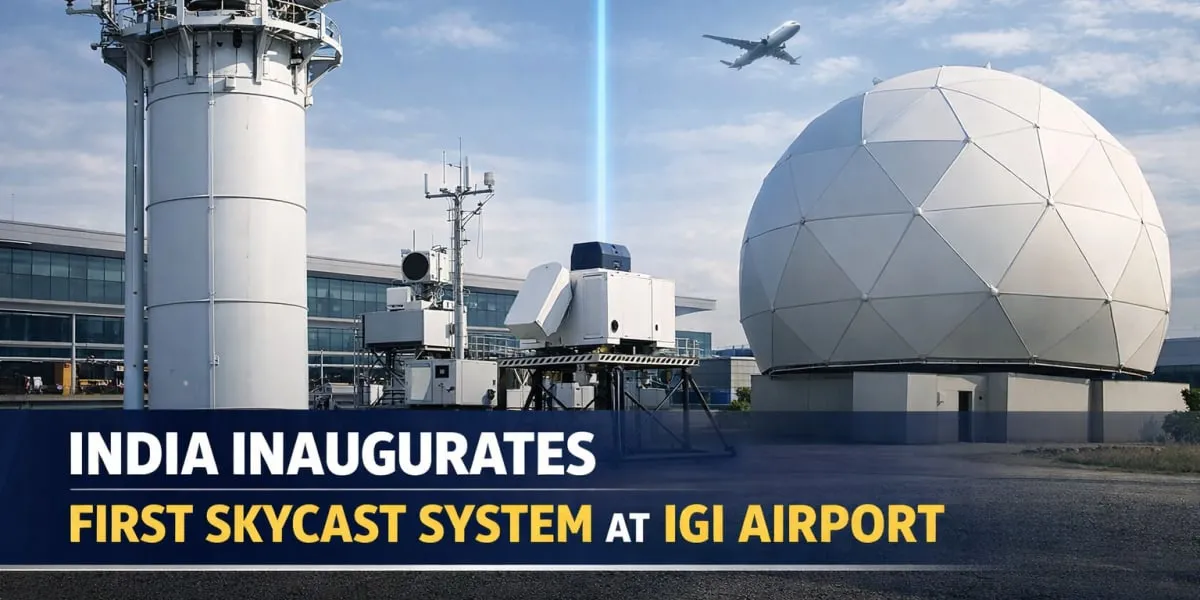
Union Minister Dr Jitendra Singh inaugurated India's first SkyCast system at Indira Gandhi International Airport, New Delhi, describing it as the start of a new era in Indian aviation. He noted that only 18 such integrated atmospheric remote sensing systems existed globally and that India had become the 19th to deploy the technology. The inauguration at IGI Airport included a technical briefing and demonstration by scientists from the Indian Institute of Tropical Meteorology and attendance by officials from the Ministry of Earth Sciences and the India Meteorological Department.

SkyCast integrates a Radar Wind Profiler, SODAR, Microwave Radiometer, a Ground-based Fog Aerosol Spectrometer (GFAS) and a CL61 Lidar-based Ceilometer to provide comprehensive monitoring of the boundary layer up to three kilometres. The Radar Wind Profiler continuously measures wind speed, wind direction, turbulence, vertical velocity and boundary layer dynamics that are critical during aircraft descent and landing. The Ground-based Fog Aerosol Spectrometer provides detailed information on fog droplets and aerosol interactions that influence visibility.

The system consolidates real-time measurements of fog, aerosols, turbulence, moisture and visibility into a single aviation weather intelligence framework to support pilots, airlines, airport operators and air traffic managers. It is designed to deliver nowcasting and early warning services, with advanced alerts available within short windows of around three hours to enable safer operational decisions and to reduce diversions, cancellations and delays. A second SkyCast facility is planned for Jewar Airport, with further rollout to other airports across India.

The SkyCast initiative draws on research from the Winter Fog Experiment, which began at IGI Airport in 2015 and informed the development of this operational capability. Officials said the facility will strengthen vertical profiling of wind, humidity and temperature and improve forecast accuracy as networks expand under Mission Mausam. Beyond aviation, SkyCast observations will support advanced forecasting models, artificial intelligence-enabled decision support systems, urban weather forecasting, pollution management, transport advisories and disaster preparedness. The system was described as a key element in efforts to build weather-smart infrastructure and to strengthen aviation resilience for passengers and operators.

Union Minister Dr Jitendra Singh inaugurated India's first SkyCast system at Indira Gandhi International Airport, New Delhi, describing it as the start of a new era in Indian aviation. He noted that only 18 such integrated atmospheric remote sensing systems existed globally and that India had become the 19th to deploy the technology. The inauguration at IGI Airport included a technical briefing and demonstration by scientists from the Indian Institute of Tropical Meteorology and attendance by officials from the Ministry of Earth Sciences and the India Meteorological Department. SkyCast integrates a Radar Wind Profiler, SODAR, Microwave Radiometer, a Ground-based Fog Aerosol Spectrometer (GFAS) and a CL61 Lidar-based Ceilometer to provide comprehensive monitoring of the boundary layer up to three kilometres. The Radar Wind Profiler continuously measures wind speed, wind direction, turbulence, vertical velocity and boundary layer dynamics that are critical during aircraft descent and landing. The Ground-based Fog Aerosol Spectrometer provides detailed information on fog droplets and aerosol interactions that influence visibility. The system consolidates real-time measurements of fog, aerosols, turbulence, moisture and visibility into a single aviation weather intelligence framework to support pilots, airlines, airport operators and air traffic managers. It is designed to deliver nowcasting and early warning services, with advanced alerts available within short windows of around three hours to enable safer operational decisions and to reduce diversions, cancellations and delays. A second SkyCast facility is planned for Jewar Airport, with further rollout to other airports across India. The SkyCast initiative draws on research from the Winter Fog Experiment, which began at IGI Airport in 2015 and informed the development of this operational capability. Officials said the facility will strengthen vertical profiling of wind, humidity and temperature and improve forecast accuracy as networks expand under Mission Mausam. Beyond aviation, SkyCast observations will support advanced forecasting models, artificial intelligence-enabled decision support systems, urban weather forecasting, pollution management, transport advisories and disaster preparedness. The system was described as a key element in efforts to build weather-smart infrastructure and to strengthen aviation resilience for passengers and operators.

Related Stories

Gold Stories

Next Story
Products

Interio by Godrej launches modular workplace solutions

Interio by Godrej has launched Workscapes, a modular workplace solutions category designed to help organisations configure and adapt workspaces to changing requirements. The portfolio combines mobile and compatible furniture and support elements that can be rearranged across different work modes without changes to fixed layouts.Workscapes includes Collaboration Tables, Privacy Solutions, Mobile Markerboards and Space Dividers, Power Solutions, Storage and Support Elements, Meeting and Presentation Tools, and Seating Elements. The range is designed for focused work, collaboration, informal disc..

Next Story
Infrastructure Urban

CAFE-III Gives Auto Industry Investment Clarity

The government’s new Corporate Average Fuel Economy (CAFE-III) norms have provided the automobile industry with a clearer framework for technology investments, according to industry representatives. The framework seeks to balance environmental objectives with flexibility for manufacturers while encouraging the adoption of flex-fuel vehicles and biofuels. Society of Indian Automobile Manufacturers (SIAM) President Shenu Agarwal said the five-year framework would give automakers greater predictability to plan investments and accelerate innovation. He said the regulation established annual targ..

Next Story
Infrastructure Energy

Mines Ministry to Auction Two Offshore Mineral Blocks in Andaman Sea

The Ministry of Mines will launch an auction of two offshore mineral blocks in the Andaman Sea on Thursday, seeking to unlock India’s offshore mineral potential and strengthen long-term mineral resource security. The blocks will be offered under a composite licence, which permits exploration and development activities in accordance with the applicable regulatory framework. The ministry said the auction was intended to encourage systematic exploration, attract investment and promote the use of advanced technologies for offshore mineral exploration and development. The initiative is also aimed..

Advertisement

Subscribe to Our Newsletter

Get daily newsletters around different themes from Construction world.

STAY CONNECTED

Advertisement

SPECIAL OFFER
QR Code