Centre Revises Funding Norms For Ring Roads And Bypasses
ROADS & HIGHWAYS

Centre Revises Funding Norms For Ring Roads And Bypasses

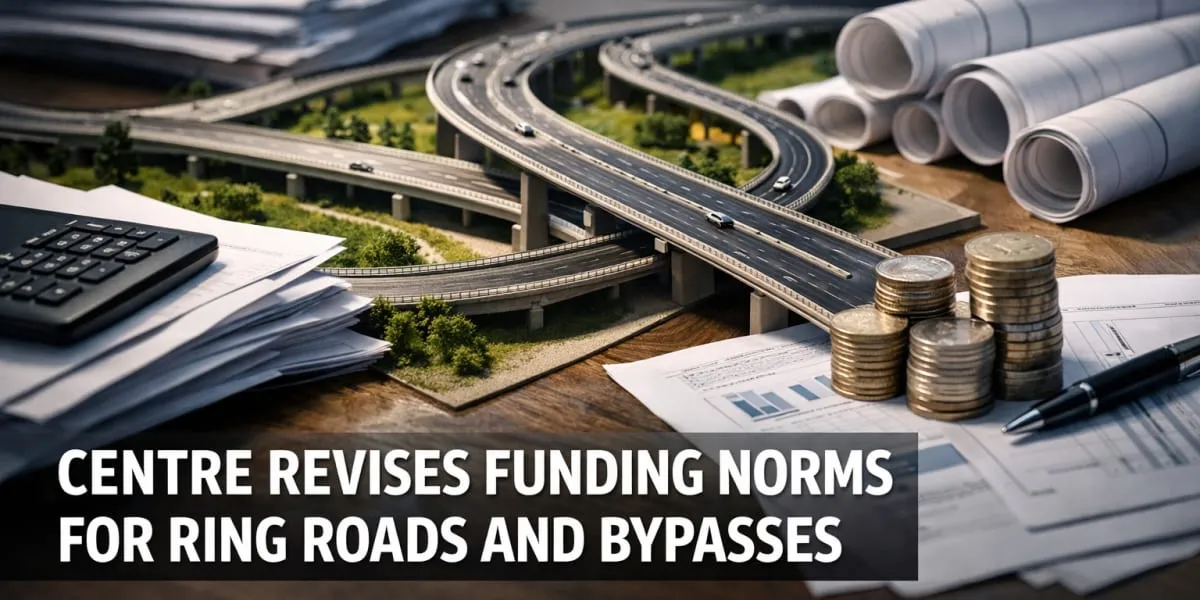
The Centre has made it mandatory for state governments to share project costs for the construction of new ring roads and highway bypasses, marking a significant alteration in the funding of urban decongestion infrastructure. The Ministry of Road Transport and Highways (MoRTH) has incorporated the requirement into its Urban Congestion Policy, under which proposals for ring roads and bypasses will be considered only where states agree to contribute financially. The change shifts greater fiscal responsibility to local administrations.

Demand for ring roads and bypasses has risen as state administrations seek to ease traffic congestion in rapidly expanding urban centres. Such projects are intended to divert through traffic away from city centres, reduce travel time, lower vehicle emissions and improve logistics efficiency, thereby supporting economic activity. The government views these interventions as essential components of a wider urban mobility strategy that also includes elevated corridors and access controlled highways.

Under the revised framework states will be expected to bear a portion of project costs, with emphasis on land acquisition and associated infrastructure, while the Centre retains a role in financing core highway elements. The policy is designed to foster greater ownership and local buy in so that only projects with robust state support proceed through appraisal and approval. Observers say closer coordination between the Centre and states could improve project planning and execution, although fiscally constrained states may face difficulties in mobilising resources and this could affect the pace of approvals.

The decision forms part of a broader shift towards collaborative funding models as infrastructure spending requirements rise, and it is likely to shape future highway development strategies. As India continues to invest in transport infrastructure to support urbanisation, trade and economic growth, mechanisms that balance national priorities with state capacity are set to become central to policy design and project delivery.

The Centre has made it mandatory for state governments to share project costs for the construction of new ring roads and highway bypasses, marking a significant alteration in the funding of urban decongestion infrastructure. The Ministry of Road Transport and Highways (MoRTH) has incorporated the requirement into its Urban Congestion Policy, under which proposals for ring roads and bypasses will be considered only where states agree to contribute financially. The change shifts greater fiscal responsibility to local administrations. Demand for ring roads and bypasses has risen as state administrations seek to ease traffic congestion in rapidly expanding urban centres. Such projects are intended to divert through traffic away from city centres, reduce travel time, lower vehicle emissions and improve logistics efficiency, thereby supporting economic activity. The government views these interventions as essential components of a wider urban mobility strategy that also includes elevated corridors and access controlled highways. Under the revised framework states will be expected to bear a portion of project costs, with emphasis on land acquisition and associated infrastructure, while the Centre retains a role in financing core highway elements. The policy is designed to foster greater ownership and local buy in so that only projects with robust state support proceed through appraisal and approval. Observers say closer coordination between the Centre and states could improve project planning and execution, although fiscally constrained states may face difficulties in mobilising resources and this could affect the pace of approvals. The decision forms part of a broader shift towards collaborative funding models as infrastructure spending requirements rise, and it is likely to shape future highway development strategies. As India continues to invest in transport infrastructure to support urbanisation, trade and economic growth, mechanisms that balance national priorities with state capacity are set to become central to policy design and project delivery.

Next Story
Infrastructure Transport

Andhra Cabinet Clears Amaravati Eye Aviation Policy And International University

The Andhra Pradesh Cabinet, chaired by Chief Minister N Chandrababu Naidu, approved a package of initiatives to boost tourism and aviation infrastructure. Ministers cleared the proposed Amaravati Eye, a giant observation wheel modelled on the London Eye to be sited on the banks of the Krishna River that will offer panoramic views of Amaravati and the riverfront. The authority has been directed to invite tenders under a design, build, finance, operate and transfer model for development on six acres. The Cabinet approved the Andhra Pradesh Aviation Policy 2026–31, aimed at transforming the Sta..

Next Story
Infrastructure Urban

Centre Expands Aviation Relief With Rs 100 Billion ATF Fund

The Union Cabinet approved a Rs 100 billion (Rs 100 bn) aviation turbine fuel price stabilisation fund to support airlines and oil marketing companies. The budgetary support will be provided as an interest-free advance to oil marketing companies to enable supply of aviation turbine fuel at a benchmark price for domestic and international operations. The Rs 100 bn fund will be administered through a tripartite arrangement among the ministries of civil aviation and petroleum and fuel retailers. The mechanism will compensate retailers whenever import parity prices exceed the benchmark and relief ..

Next Story
Infrastructure Urban

South West Pinnacle Wins Exploration And Drilling Work Orders

South West Pinnacle Exploration (SWPE) said it has won multiple exploration and drilling contracts worth Rs 215.3 mn including GST. The awards comprise a detailed exploration contract from Central Mine Planning and Design Institute Limited (CMPDI), two drilling work orders from Geomysore Services (India) Private Limited (GSIPL) and one work order awarded to its wholly owned subsidiary South West Resources Private Limited (SWRPL). The contracts span coal and gold projects in Chhattisgarh and Andhra Pradesh and cover both reverse circulation and diamond core drilling. CMPDI, which is a wholly ow..

Advertisement

Subscribe to Our Newsletter

Get daily newsletters around different themes from Construction world.

STAY CONNECTED

Advertisement

Advertisement

Advertisement