Gandhidham Gets Rs 1.76 Billion Boost After Becoming Corporation
ROADS & HIGHWAYS

Gandhidham Gets Rs 1.76 Billion Boost After Becoming Corporation

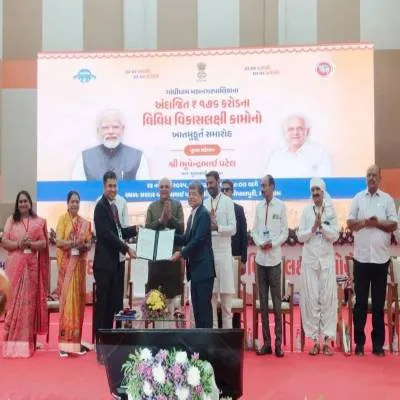
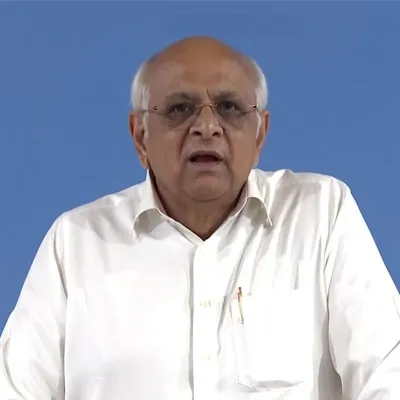
Gandhidham received a major developmental push on Saturday as Chief Minister Bhupendra Patel announced 66 projects worth Rs 1.76 billion during his first visit to the city since its transition from a municipality to a municipal corporation.

At Oslo Circle, the Chief Minister paid floral tributes to Dr Babasaheb Ambedkar, unveiled his reinstalled statue and inaugurated the newly constructed Dr Babasaheb Ambedkar Bridge, along with circle development and parking facilities. Later, at an event held at Sardar Vallabhbhai Patel Auditorium in Gopalpuri, he performed the e-foundation stone ceremony for projects totalling Rs 1.76 billion.

Congratulating residents on Gandhidham’s new municipal corporation status, Patel said the city—known as the economic capital of Kutch and one of Gujarat’s major industrial hubs—would be taken to new heights of development. Eleven neighbouring villages have been merged with the former municipality to form the new corporation, enabling faster and broader urban growth.

The Chief Minister noted that Gandhidham Municipality earlier operated with an annual budget of Rs 1.10 billion, but following its upgrade, the newly approved budget stands at Rs 6.08 billion—nearly six times higher. Over the last three years, the city has also received Rs 2.55 billion under various urban development schemes.

He said the projects included in the foundation-laying ceremony reflect a holistic model of development, combining people-centric works such as roads, water supply, drainage, gardens and ponds with modern amenities like a fire station and a contemporary library. He added that Gujarat’s cities have demonstrated exceptional scale and speed in urban growth, transforming development from a discussion point into visible progress under Prime Minister Narendra Modi’s leadership.

Patel recalled how the Prime Minister steered Kutch out of the devastation of the earthquake and set it on a path of rapid advancement. He emphasised Modi’s approach of treating urbanisation as an opportunity, not a challenge, which inspired Gujarat’s vision for structured city development. This included celebrating Urban Development Year in 2005 and launching the Swarnim Jayanti Mukhyamantri Shaheri Vikas Yojana in 2010, under which more than Rs 570 billion has been allocated to smaller cities over the last 15 years.

The Chief Minister said Gujarat’s urban development budget has been increased by 40 per cent to Rs 300 billion for 2025. The state is also focusing on developing cities as growth hubs to meet future needs, supported by regional Vibrant Conferences aimed at boosting local industry and attracting investment. He expressed confidence that the upcoming Saurashtra–Kutch Regional Vibrant Conference in Rajkot will play a significant role in strengthening local industries.

Patel urged citizens to help build future-ready cities for a Viksit Bharat and Aatmanirbhar Bharat by 2047, highlighting the need for collective effort under “Sauno Saath, Sauno Vikas, Sauno Vishwas, Sauno Prayas”.

Minister of State for Higher and Technical Education Trikambhai Chhanga praised Gandhidham’s transformation from a Partition-era settlement to an important centre of port and economic activity. He said municipal corporation status would bring faster, more organised development to a city that is culturally, economically and socially vibrant. He also noted the Prime Minister’s longstanding affection for Kutch and highlighted the state government’s ongoing work on Narmada, roads, infrastructure and other key areas.

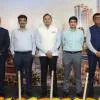
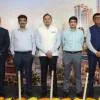
The event saw participation from MP Vinodbhai Chavda, District Panchayat President Janaksinh Jadeja, MLAs Maltiben Maheshwari and Virendrasinh Jadeja, former Speaker Dr Nimaben Acharya, Municipal Commissioner Manish Gurwani, Deendayal Port Chairman Sushil Kumar Singh and several community leaders and citizens.

Gandhidham received a major developmental push on Saturday as Chief Minister Bhupendra Patel announced 66 projects worth Rs 1.76 billion during his first visit to the city since its transition from a municipality to a municipal corporation. At Oslo Circle, the Chief Minister paid floral tributes to Dr Babasaheb Ambedkar, unveiled his reinstalled statue and inaugurated the newly constructed Dr Babasaheb Ambedkar Bridge, along with circle development and parking facilities. Later, at an event held at Sardar Vallabhbhai Patel Auditorium in Gopalpuri, he performed the e-foundation stone ceremony for projects totalling Rs 1.76 billion. Congratulating residents on Gandhidham’s new municipal corporation status, Patel said the city—known as the economic capital of Kutch and one of Gujarat’s major industrial hubs—would be taken to new heights of development. Eleven neighbouring villages have been merged with the former municipality to form the new corporation, enabling faster and broader urban growth. The Chief Minister noted that Gandhidham Municipality earlier operated with an annual budget of Rs 1.10 billion, but following its upgrade, the newly approved budget stands at Rs 6.08 billion—nearly six times higher. Over the last three years, the city has also received Rs 2.55 billion under various urban development schemes. He said the projects included in the foundation-laying ceremony reflect a holistic model of development, combining people-centric works such as roads, water supply, drainage, gardens and ponds with modern amenities like a fire station and a contemporary library. He added that Gujarat’s cities have demonstrated exceptional scale and speed in urban growth, transforming development from a discussion point into visible progress under Prime Minister Narendra Modi’s leadership. Patel recalled how the Prime Minister steered Kutch out of the devastation of the earthquake and set it on a path of rapid advancement. He emphasised Modi’s approach of treating urbanisation as an opportunity, not a challenge, which inspired Gujarat’s vision for structured city development. This included celebrating Urban Development Year in 2005 and launching the Swarnim Jayanti Mukhyamantri Shaheri Vikas Yojana in 2010, under which more than Rs 570 billion has been allocated to smaller cities over the last 15 years. The Chief Minister said Gujarat’s urban development budget has been increased by 40 per cent to Rs 300 billion for 2025. The state is also focusing on developing cities as growth hubs to meet future needs, supported by regional Vibrant Conferences aimed at boosting local industry and attracting investment. He expressed confidence that the upcoming Saurashtra–Kutch Regional Vibrant Conference in Rajkot will play a significant role in strengthening local industries. Patel urged citizens to help build future-ready cities for a Viksit Bharat and Aatmanirbhar Bharat by 2047, highlighting the need for collective effort under “Sauno Saath, Sauno Vikas, Sauno Vishwas, Sauno Prayas”. Minister of State for Higher and Technical Education Trikambhai Chhanga praised Gandhidham’s transformation from a Partition-era settlement to an important centre of port and economic activity. He said municipal corporation status would bring faster, more organised development to a city that is culturally, economically and socially vibrant. He also noted the Prime Minister’s longstanding affection for Kutch and highlighted the state government’s ongoing work on Narmada, roads, infrastructure and other key areas. The event saw participation from MP Vinodbhai Chavda, District Panchayat President Janaksinh Jadeja, MLAs Maltiben Maheshwari and Virendrasinh Jadeja, former Speaker Dr Nimaben Acharya, Municipal Commissioner Manish Gurwani, Deendayal Port Chairman Sushil Kumar Singh and several community leaders and citizens.

Next Story
Real Estate

Integrated Waterproofing Strategies

Waterproofing buildings used to be an annual pre-monsoon affair but the evolution of real-estate development has changed that approach. In new developments, developers are weaving waterproofing solutions into both the design and construction phases, an approach that Nikhil Madan, Managing Director, Mahima Group, says, “is all about ensuring lasting durability [of the building] and keeping lifecycle risks including water seepage and extensive maintenance to a minimum.”Watertight by designAluminium formwork systems aren’t commonly thought of as a waterproofing tool but at the Mahima Group,..

Next Story
Infrastructure Urban

GROHE Showcases Water-Led Design At Milan

GROHE unveiled its GROHE SPA Aqua Sanctuary at Milan Design Week 2026, transforming Piccolo Teatro Studio Melato into an immersive showcase of water, design and wellbeing. Built on the philosophy of ‘Wellbeing Through Water’, the installation reimagined bathrooms as holistic spaces for relaxation, rejuvenation and self-care.The Aqua Sanctuary was presented through three interconnected sanctums. The first showcased the 3D-printed GROHE SPA AquaTree shower and faucet, highlighting bespoke innovation and biophilic design. The second featured the Atrio Private Collection and GROHE SPA x Buster..

Next Story
Infrastructure Transport

Rahee Group Expands Rail Manufacturing Capacity

Rahee Group has outlined a multi-year investment roadmap to expand its operational footprint and strengthen manufacturing capabilities for India’s growing railway and urban transit sector. The Group is expanding in Odisha with a new Track Component Casting Unit, for which the groundbreaking ceremony was held on 8 April 2026 in the presence of Odisha Chief Minister Mohan Charan Majhi.The Group’s flagship EPC arm, Rahee Infratech Ltd, continues to focus on complex rail infrastructure projects, including track systems, bridges, viaducts and ballastless infrastructure. Its wholly owned subsidi..

Advertisement

Subscribe to Our Newsletter

Get daily newsletters around different themes from Construction world.

STAY CONNECTED

Advertisement

Advertisement

Advertisement