Jaipur To Shift Toward Fully AI-Based Traffic Management
ROADS & HIGHWAYS

Jaipur To Shift Toward Fully AI-Based Traffic Management

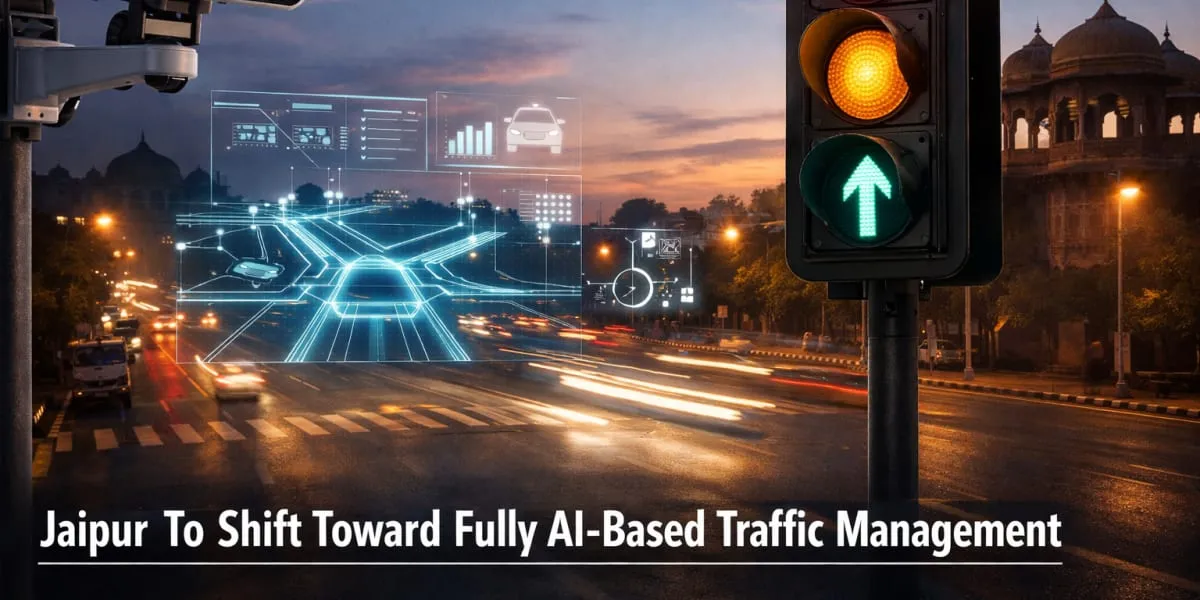
Jaipur will move to a fully AI-based traffic management system after a successful pilot at Rambagh Circle, officials said. The 39-day trial of the artificial intelligence driven Intelligent Traffic Management System (ITMS) achieved 100 per cent success and has prompted plans for citywide expansion. Authorities described the result as evidence that adaptive signal control can replace conventional fixed-timer signals.

Under the next phase, 253 major intersections out of Jaipur's total 423 junctions will be fitted with AI-based smart cameras and integrated with the ITMS. The pilot was carried out by Jaipur Traffic Police (JTP) in collaboration with Data Core Infotech between June three and July eleven. Company directors Basant Goswami and Ojas Shukla said the AI system dynamically adjusts signal timings instead of running fixed cycles regardless of traffic density.

Cameras installed at intersections continuously monitor vehicle volume and queue length in real time, automatically increasing green time on roads with higher traffic pressure and reducing it on relatively empty roads. The system operates round the clock without manual intervention and also supports automated enforcement. During the trial, over 0.488 mn vehicles passed through Rambagh Circle smoothly, with drivers recording time savings of eight to 45 seconds per lane and an average green signal time of 33.63 seconds.

Each camera processed around 4,200 vehicles daily and automatically recorded details of about 450 traffic violations, including overspeeding, jumping red lights and wrong-side driving. Officials said the system will make it harder for violators to escape detection and that the move is part of a broader effort to reduce congestion and pollution. The authorities plan to monitor performance and refine algorithms during phased rollout across the city.

Jaipur will move to a fully AI-based traffic management system after a successful pilot at Rambagh Circle, officials said. The 39-day trial of the artificial intelligence driven Intelligent Traffic Management System (ITMS) achieved 100 per cent success and has prompted plans for citywide expansion. Authorities described the result as evidence that adaptive signal control can replace conventional fixed-timer signals. Under the next phase, 253 major intersections out of Jaipur's total 423 junctions will be fitted with AI-based smart cameras and integrated with the ITMS. The pilot was carried out by Jaipur Traffic Police (JTP) in collaboration with Data Core Infotech between June three and July eleven. Company directors Basant Goswami and Ojas Shukla said the AI system dynamically adjusts signal timings instead of running fixed cycles regardless of traffic density. Cameras installed at intersections continuously monitor vehicle volume and queue length in real time, automatically increasing green time on roads with higher traffic pressure and reducing it on relatively empty roads. The system operates round the clock without manual intervention and also supports automated enforcement. During the trial, over 0.488 mn vehicles passed through Rambagh Circle smoothly, with drivers recording time savings of eight to 45 seconds per lane and an average green signal time of 33.63 seconds. Each camera processed around 4,200 vehicles daily and automatically recorded details of about 450 traffic violations, including overspeeding, jumping red lights and wrong-side driving. Officials said the system will make it harder for violators to escape detection and that the move is part of a broader effort to reduce congestion and pollution. The authorities plan to monitor performance and refine algorithms during phased rollout across the city.

Next Story
Infrastructure Transport

Surya Roshni delivers customised lighting for NCRTC RRTS stations

Surya Roshni has supplied customised indoor lighting solutions for 18 elevated stations on the National Capital Region Transport Corporation's (NCRTC) Rapid Rail Transit System (RRTS), strengthening its presence in India's infrastructure lighting segment.The project involved the design and deployment of lighting systems for platforms, concourses, foot overbridges (FOBs) and back-of-house (BOH) areas. According to the company, the luminaires were developed specifically to meet NCRTC's design, operational and performance requirements rather than using standard products.Surya introduced two custo..

Next Story
Real Estate

Hilton debuts Tapestry Collection brand in Vietnam

Hilton has opened NHAAN Resort & Spa Hoi An, Tapestry Collection by Hilton, marking the debut of the Tapestry Collection brand in Vietnam and expanding its lifestyle hospitality portfolio in Southeast Asia.Located along the Co Co River in Cam Thanh village, the 174-key resort provides access to Hoi An Ancient Town, Cua Dai Beach and the Cam Thanh Nipa Forest. The property has been designed by Vietnamese architect Vo Trong Nghia, incorporating biophilic architecture, locally sourced materials and riverfront landscapes.The resort offers a mix of guest rooms and suites, including family-frien..

Next Story
Building Material

Electrent expands lithium energy storage system portfolio

Electrent Energy has expanded its lithium-based energy storage portfolio with the launch of the ESS 850 and ESS 1050, targeting compact and maintenance-free power backup solutions for Indian homes.The new systems integrate a Home UPS and a LiFePO4 lithium battery into a single unit, extending the company's product range following the launch of its ESS 1350 and ESS 2500 models.Designed for apartments and smaller homes, the ESS 850 provides up to 1 hour 15 minutes of backup, while the ESS 1050 offers up to 1 hour 45 minutes on a typical 400 W household load. The systems can power essential appli..

Advertisement

Subscribe to Our Newsletter

Get daily newsletters around different themes from Construction world.

STAY CONNECTED

Advertisement

Advertisement

Advertisement