NHAI To Mechanise Drain Cleaning And Automate Pothole Repair
ROADS & HIGHWAYS

NHAI To Mechanise Drain Cleaning And Automate Pothole Repair

The National Highways Authority of India (NHAI), in coordination with the Ministry of Road Transport and Highways (MoRTH), has issued comprehensive guidelines to adopt mechanised and automated systems for maintenance of National Highways and expressways. The measures mandate mechanised drain cleaning in urban and built-up sections and promote deployment of automatic pothole filling, compacting and patching machines and mechanised road sweeping machines. The initiative seeks to improve maintenance efficiency, strengthen sustainability and enhance travel experience for National Highways users.

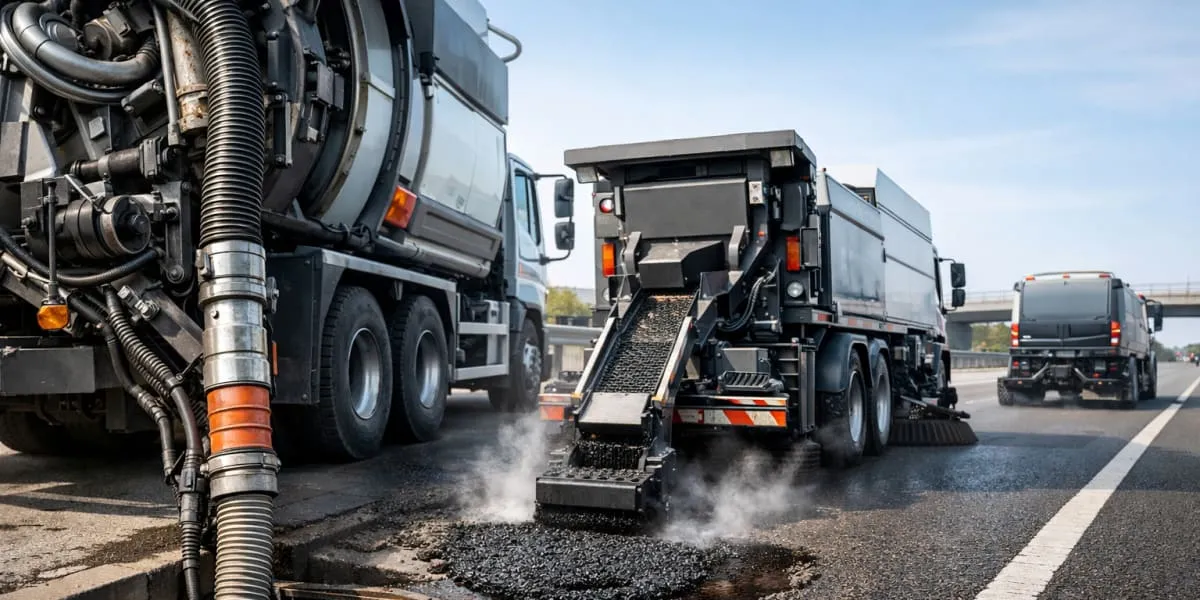
The mechanised drain cleaning framework is aimed at improving stormwater management ahead of the monsoon season by mandating mechanised cleaning of lined drains in urban and built-up areas. It envisages integrated deployment of equipment such as high-flow super suction and jetting units, hydraulic grab machines and dewatering pump sets for dewatering, loosening of accumulated silt, suction of slurry and removal of heavy debris from drainage channels. Mechanised cleaning will be made a mandatory provision in future maintenance contracts for urban National Highway sections.

NHAI has directed contractors and concessionaires to adhere strictly to prescribed maintenance programmes and inspection schedules for cleaning and repair of drains and to rectify deficiencies within stipulated timelines. The authority will closely monitor compliance and take measures to ensure time-bound remediation to prevent delay and deterioration in pavement and drainage quality. The framework emphasises preventive maintenance and accountability under performance-based maintenance contracts.

The guidelines also include structured assessment and approval of costs for deployment of automatic pothole filling, compacting and patching machines and mechanised road sweeping machines under performance-based maintenance contracts to accelerate adoption across the network. Automatic pothole repair units will reduce maintenance response time and preserve pavement integrity while mechanised sweeper deployment will improve corridor cleanliness, visibility and road safety. Initial deployments have been reported on the Varanasi-Aurangabad and Handia-Rajatalab national highways and across projects in Haryana, Punjab and Gujarat.

The National Highways Authority of India (NHAI), in coordination with the Ministry of Road Transport and Highways (MoRTH), has issued comprehensive guidelines to adopt mechanised and automated systems for maintenance of National Highways and expressways. The measures mandate mechanised drain cleaning in urban and built-up sections and promote deployment of automatic pothole filling, compacting and patching machines and mechanised road sweeping machines. The initiative seeks to improve maintenance efficiency, strengthen sustainability and enhance travel experience for National Highways users. The mechanised drain cleaning framework is aimed at improving stormwater management ahead of the monsoon season by mandating mechanised cleaning of lined drains in urban and built-up areas. It envisages integrated deployment of equipment such as high-flow super suction and jetting units, hydraulic grab machines and dewatering pump sets for dewatering, loosening of accumulated silt, suction of slurry and removal of heavy debris from drainage channels. Mechanised cleaning will be made a mandatory provision in future maintenance contracts for urban National Highway sections. NHAI has directed contractors and concessionaires to adhere strictly to prescribed maintenance programmes and inspection schedules for cleaning and repair of drains and to rectify deficiencies within stipulated timelines. The authority will closely monitor compliance and take measures to ensure time-bound remediation to prevent delay and deterioration in pavement and drainage quality. The framework emphasises preventive maintenance and accountability under performance-based maintenance contracts. The guidelines also include structured assessment and approval of costs for deployment of automatic pothole filling, compacting and patching machines and mechanised road sweeping machines under performance-based maintenance contracts to accelerate adoption across the network. Automatic pothole repair units will reduce maintenance response time and preserve pavement integrity while mechanised sweeper deployment will improve corridor cleanliness, visibility and road safety. Initial deployments have been reported on the Varanasi-Aurangabad and Handia-Rajatalab national highways and across projects in Haryana, Punjab and Gujarat.

Next Story
Building Material

Saint-Gobain, CEPT partner on sustainable construction

Saint-Gobain and CEPT University have entered into a strategic partnership to establish a Tech Commons Centre aimed at advancing research, innovation and skill development in sustainable and energy-efficient construction.The centre will serve as a platform for building science research, prototyping, industry collaboration and knowledge exchange, bringing together Saint-Gobain's expertise in sustainable construction and CEPT's capabilities in education and research. The collaboration will focus on sustainability, energy efficiency, climate resilience and wellbeing in the built environment.Accor..

Next Story
Building Material

Aludecor launches Stonic ACP surface series

Aludecor Lamination has launched its Stonic aluminium composite panel (ACP) surface series and the second phase of its 'Test Nahi Toh Trust Nahi' campaign as part of its 24th Foundation Day celebrations.Inspired by the natural craquelure patterns found in aged stone, the Stonic series is available in seven finishes and has been developed using the company's Spray Fusion technology. The ACP range is designed for use in façades, feature walls, entranceways, soffits, balcony fascia, ceilings and other commercial, residential and hospitality applications.The company also introduced 'The Fikar-Fre..

Next Story
Real Estate

NABARD, MAHAPREIT partner on rural green infrastructure

NABARD has signed a memorandum of understanding (MoU) with Mahatma Phule Renewable Energy and Infrastructure Technology (MAHAPREIT) to finance and promote green, climate-resilient infrastructure in rural India, with an initial focus on Maharashtra.The partnership will combine NABARD's expertise in rural development and climate finance with MAHAPREIT's experience in renewable energy and sustainable infrastructure. The collaboration will identify, develop and finance projects aimed at strengthening village infrastructure, Panchayati Raj Institutions and other community assets.Priority areas incl..

Advertisement

Subscribe to Our Newsletter

Get daily newsletters around different themes from Construction world.

STAY CONNECTED

Advertisement

Advertisement

Advertisement