+
Uttar Pradesh Orders IIT Audits For Rs One Billion Plus Projects
ROADS & HIGHWAYS

Uttar Pradesh Orders IIT Audits For Rs One Billion Plus Projects

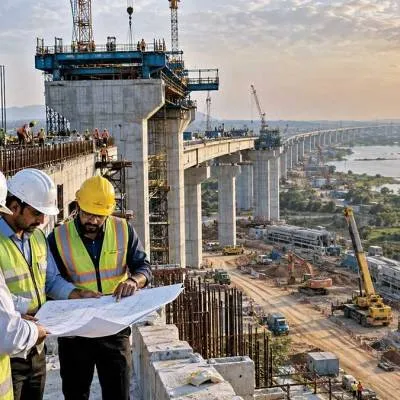
The Uttar Pradesh government has moved to strengthen monitoring of large infrastructure projects by mandating third-party quality audits for projects costing more than Rs one billion (Rs one bn). The initiative, launched by the state Planning Department and formalised in an order from the Finance Department, assigns premier technical institutes to conduct independent inspections. Indian Institute of Technology Kanpur (IIT Kanpur), Indian Institute of Technology Banaras Hindu University, Varanasi (IIT-BHU) and Indian Institute of Technology Roorkee (IIT Roorkee) are among the institutions listed.\n\nThe order specifies that audits will cover roads, bridges, sewerage, water supply and other public utility projects across the state. IIT Kanpur will inspect projects above Rs one billion in districts across the Kanpur, Lucknow, Banda, Prayagraj, Ayodhya, Agra, Jhansi and Devipatan divisions. IIT-BHU will oversee audits in the Basti, Gorakhpur, Azamgarh, Varanasi and Mirzapur divisions while IIT Roorkee will be responsible for the Saharanpur, Moradabad, Bareilly, Meerut and Aligarh divisions.\n\nA third-party quality audit is intended to provide an independent assessment of a project's design, construction processes, materials and compliance with prescribed technical and safety standards. Teams from the institutes will inspect projects at stages ranging from commencement through completion and will prepare detailed reports identifying defects and recommending corrective measures. The audits are designed to enhance transparency in project monitoring and to reduce potential conflicts of interest in oversight.\n\nThe decision follows a recent incident in which a section of the Greenfield National Elevated Expressway in Unnao caved in 12 days after its inauguration, prompting renewed scrutiny of construction quality. Officials said the audit framework aims to improve accountability and to ensure that large public infrastructure projects in Uttar Pradesh meet required quality and safety standards. Implementation details and timelines will be managed by the Planning Department and the assigned institutes.

The Uttar Pradesh government has moved to strengthen monitoring of large infrastructure projects by mandating third-party quality audits for projects costing more than Rs one billion (Rs one bn). The initiative, launched by the state Planning Department and formalised in an order from the Finance Department, assigns premier technical institutes to conduct independent inspections. Indian Institute of Technology Kanpur (IIT Kanpur), Indian Institute of Technology Banaras Hindu University, Varanasi (IIT-BHU) and Indian Institute of Technology Roorkee (IIT Roorkee) are among the institutions listed.\n\nThe order specifies that audits will cover roads, bridges, sewerage, water supply and other public utility projects across the state. IIT Kanpur will inspect projects above Rs one billion in districts across the Kanpur, Lucknow, Banda, Prayagraj, Ayodhya, Agra, Jhansi and Devipatan divisions. IIT-BHU will oversee audits in the Basti, Gorakhpur, Azamgarh, Varanasi and Mirzapur divisions while IIT Roorkee will be responsible for the Saharanpur, Moradabad, Bareilly, Meerut and Aligarh divisions.\n\nA third-party quality audit is intended to provide an independent assessment of a project's design, construction processes, materials and compliance with prescribed technical and safety standards. Teams from the institutes will inspect projects at stages ranging from commencement through completion and will prepare detailed reports identifying defects and recommending corrective measures. The audits are designed to enhance transparency in project monitoring and to reduce potential conflicts of interest in oversight.\n\nThe decision follows a recent incident in which a section of the Greenfield National Elevated Expressway in Unnao caved in 12 days after its inauguration, prompting renewed scrutiny of construction quality. Officials said the audit framework aims to improve accountability and to ensure that large public infrastructure projects in Uttar Pradesh meet required quality and safety standards. Implementation details and timelines will be managed by the Planning Department and the assigned institutes.

Related Stories

Gold Stories
Next Story
Real Estate

BMC OC Amnesty Scheme Requires Key Approvals from Mumbai Societies

The Brihanmumbai Municipal Corporation (BMC) has clarified that housing societies applying under its Occupation Certificate (OC) amnesty scheme must possess key approvals linked to the original construction. The requirements include a valid Intimation of Disapproval (IOD), an approved building plan and a Commencement Certificate (CC), along with a No Objection Certificate (NOC) from the developer or original construction applicant. The Standard Operating Procedure (SOP) makes clear that the absence of an OC alone will not qualify a building for relief. Societies must establish that their build..

Next Story
Real Estate

Gurugram Emerges as Luxury Senior Living Hub

Gurugram is emerging as a potential hub for luxury senior living, supported by available land, healthcare infrastructure, connectivity and a concentration of affluent professionals, high-net-worth individuals and non-resident Indians. These factors could give the city an advantage over land-constrained metros such as Mumbai. A report by the Association of Senior Living India (ASLI) and JLL estimates that India’s organised senior living market could represent a $10.1 bn opportunity by 2030. The sector had about 25,050 organised units as of June 2026, while penetration stood at only 1.5 per ce..

Next Story
Real Estate

Corrosion Costs India’s Infrastructure Rs. 142 bn Annually

Corrosion costs India an estimated Rs. 1.42 tn annually, equivalent to 4.3 per cent of gross domestic product, according to a report by the Confederation of Indian Industry and the National Research Institute. Infrastructure accounts for Rs. 142 bn of the annual burden, making it the sector with the largest absolute cost among those examined. The report, presented at the CII Annual Infrastructure Summit 2026, said the infrastructure-sector cost equals about 2.9 per cent of the sector’s gross domestic product. It estimated that effective measures could generate maximum savings of Rs. 495.8 bn..

Advertisement

Subscribe to Our Newsletter

Get daily newsletters around different themes from Construction world.

STAY CONNECTED

Advertisement

SPECIAL OFFER
QR Code