Indian Railways Approves Kavach 4.0 For Ahmedabad Division
RAILWAYS & METRO RAIL

Indian Railways Approves Kavach 4.0 For Ahmedabad Division

Indian Railways has approved the installation of Kavach Version 4.0 on 598 route kilometres covering 48 block sections of the Ahmedabad Division of Western Railway in Gujarat.

The project has been sanctioned at a cost of Rs 1.4 billion (Rs 1.4 bn) and forms part of an umbrella programme for the provision of Kavach with an LTE-based communication backbone on the balance routes of Indian Railways.

Earlier approvals had covered about 702 route kilometres in the Ahmedabad Division and the present sanction will bring the remaining sections of the division under the system. The cumulative effect will be the wider deployment of the indigenous train protection system across the division and improved continuity of safety coverage along routes. Implementation will proceed under the ministry framework already in place.

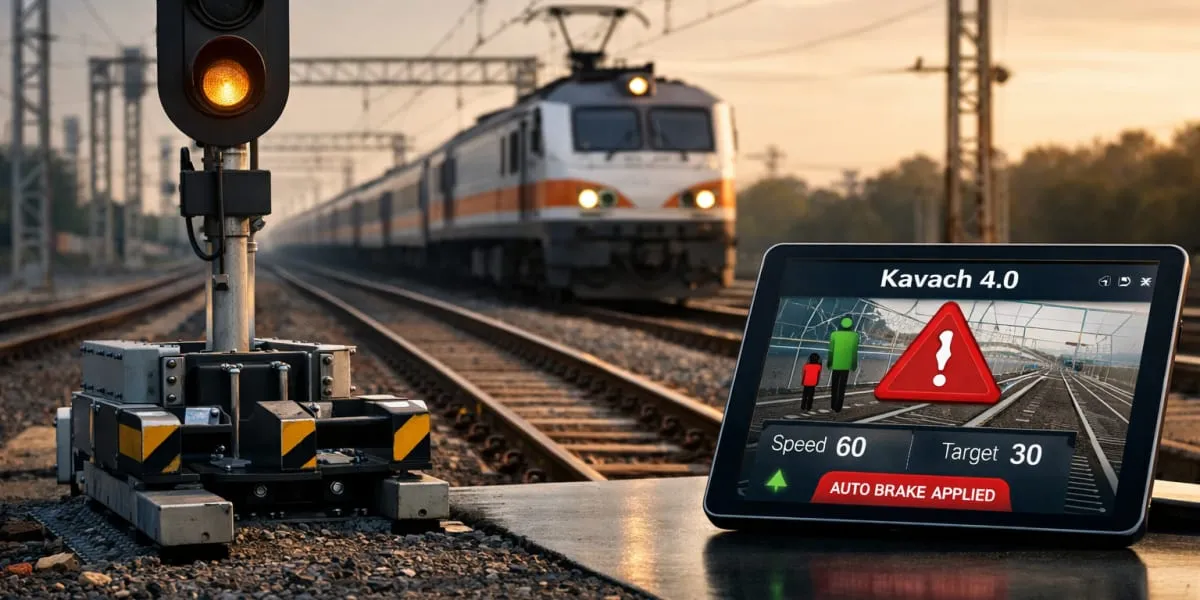
Kavach is an indigenously developed Automatic Train Protection (ATP) system designed to enhance operational safety by preventing Signal Passing at Danger and by applying brakes automatically to avoid unsafe situations. The system also controls train speed in critical conditions and substantially reduces the risk of collisions through automated intervention. Integration with LTE communications improves responsiveness and reliability of train to ground information. The automated safeguards reduce the scope for human error and support safer timetabling and operational consistency without altering existing track infrastructure.

Indian Railways is progressively expanding Kavach across its network as part of efforts to strengthen safety and modernise train operations and signalling. The installation in the Ahmedabad Division complements existing safety measures and supports uniform standards of train protection across routes. The ministry will continue phased deployments to extend coverage and operational benefits. Deployment is managed within existing administrative structures and draws on domestic design and manufacturing for system components.

Indian Railways has approved the installation of Kavach Version 4.0 on 598 route kilometres covering 48 block sections of the Ahmedabad Division of Western Railway in Gujarat. The project has been sanctioned at a cost of Rs 1.4 billion (Rs 1.4 bn) and forms part of an umbrella programme for the provision of Kavach with an LTE-based communication backbone on the balance routes of Indian Railways. Earlier approvals had covered about 702 route kilometres in the Ahmedabad Division and the present sanction will bring the remaining sections of the division under the system. The cumulative effect will be the wider deployment of the indigenous train protection system across the division and improved continuity of safety coverage along routes. Implementation will proceed under the ministry framework already in place. Kavach is an indigenously developed Automatic Train Protection (ATP) system designed to enhance operational safety by preventing Signal Passing at Danger and by applying brakes automatically to avoid unsafe situations. The system also controls train speed in critical conditions and substantially reduces the risk of collisions through automated intervention. Integration with LTE communications improves responsiveness and reliability of train to ground information. The automated safeguards reduce the scope for human error and support safer timetabling and operational consistency without altering existing track infrastructure. Indian Railways is progressively expanding Kavach across its network as part of efforts to strengthen safety and modernise train operations and signalling. The installation in the Ahmedabad Division complements existing safety measures and supports uniform standards of train protection across routes. The ministry will continue phased deployments to extend coverage and operational benefits. Deployment is managed within existing administrative structures and draws on domestic design and manufacturing for system components.

Related Stories

Gold Stories

Next Story
Infrastructure Urban

KONE Opens India's First Digital Experience Centre in Pune

KONE, a global elevator and escalator manufacturer, has inaugurated its first Digital Experience Centre (DEC) in India, located in Pune. The facility aims to showcase how artificial intelligence (AI), connectivity and data-driven technologies can enhance customer experiences and improve building operations.The centre was inaugurated by Jussi Herlin, Executive Vice Chair, KONE Corporation; Philippe Delorme, President and CEO, KONE; and Nandan Nilekani, Co-founder and Chairman of the Board, Infosys.Designed as an interactive customer environment, the facility demonstrates digital solutions cover..

Next Story
Infrastructure Urban

CII GreenCo Launches Circularity Guidelines for Indian Industry

The Confederation of Indian Industry (CII) GreenCo Council has launched the CII GreenCo Circularity Guidelines – Pilot Version at the 17th CII GreenCo Waste & Resource Management Summit 2026 in Chennai. The initiative aims to strengthen resource efficiency, waste reduction and circular economy practices across Indian manufacturing and process industries.The guidelines introduce a structured framework with circularity indices covering raw materials, consumables, packaging and other resource inputs. These indicators will help industries assess existing practices, identify opportunities to ..

Next Story
Infrastructure Energy

Global Electronics Association Launches IPC-1783-CO2E Standard

The Global Electronics Association has introduced IPC-1783-CO2E, a new international standard aimed at improving consistency, transparency and comparability in product carbon footprint reporting across the electronics manufacturing industry.The standard, titled International Standard for Data Collection and Reporting of CO2 Equivalent (CO2e) Emissions for the Electronics Manufacturing Supply Chain, provides industry-specific guidance for collecting, estimating and reporting carbon emissions data.With increasing regulatory requirements and customer expectations, electronics manufacturers face c..

Advertisement

Subscribe to Our Newsletter

Get daily newsletters around different themes from Construction world.

STAY CONNECTED

Advertisement

SPECIAL OFFER
QR Code