+
INOX India Supplies LNG Systems For Indian Railways DEMU Trial
RAILWAYS & METRO RAIL

INOX India Supplies LNG Systems For Indian Railways DEMU Trial

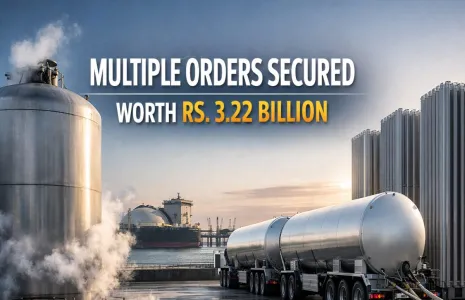
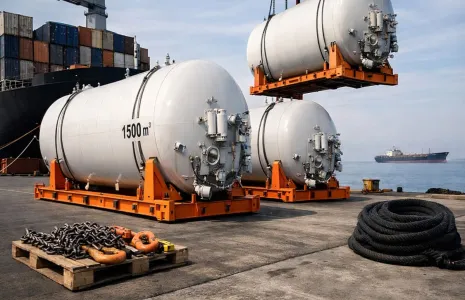
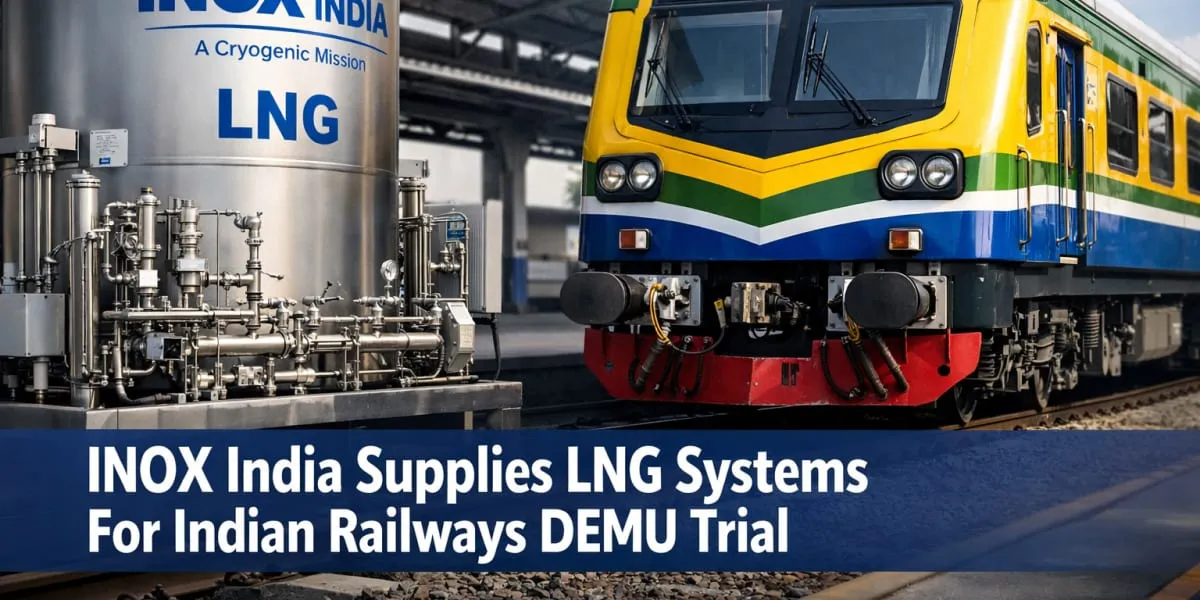
Indian Railways has operationalised the nation’s first liquefied natural gas (LNG)–diesel dual-fuel Diesel Electric Multiple Unit (DEMU) at Sabarmati, Ahmedabad, after integration of cryogenic systems supplied by INOX India Limited (INOXCVA). INOXCVA provided 2,200-litre LNG Receiving, Storage and Regasification Systems for integration with 1,400 HP Driving Power Cars (DPUs) of the Dual-Fuel DEMU trains. The systems support dual-fuel operation using LNG and diesel and reduce reliance on conventional diesel.

Deployment of the technology allows substitution of up to 40 per cent of diesel with LNG, improving fuel efficiency and lowering greenhouse gas emissions on short- and medium-distance routes. The achievement was described as a major step in advancing energy-efficient, low-emission rail mobility and as reinforcing INOXCVA’s role as an enabler of Indian Railways’ decarbonisation journey. The dual-fuel capability supports cleaner operations while maintaining operational flexibility.

The dual-fuel initiative was launched by the Alternative Fuels Division to convert an initial batch of 10 DPUs from conventional diesel engines to a hybrid model. INOXCVA had earlier delivered two units that underwent trials and certifications at the Sabarmati Division, after which Indian Railways approved further inductions. The company said it was ready to deliver additional systems under its contract.

INOXCVA mentioned that the ability to substitute diesel with LNG represented a technological milestone and a decisive shift in approaches to large-scale rail decarbonisation, while also enhancing operational efficiency and long-term sustainability. The company indicated that LNG would serve as a transition fuel and that liquid hydrogen was envisaged as a next frontier for zero-emission rail locomotives. It said these directions were supported by research and development capabilities and decades of cryogenic expertise.

The LNG fuel tank systems were delivered to Indian Railways through CLH Gaseous Fuel Applications Pvt. Ltd., and INOXCVA remains the sole provider in India to have delivered, tested and validated cryogenic LNG systems for rail applications. Plans are underway to double on-board LNG capacity so the trains can travel longer distances beyond current hauls. CLH handled the engine conversion from standalone diesel to the dual-fuel configuration, enabling cleaner fleet operations.

Indian Railways has operationalised the nation’s first liquefied natural gas (LNG)–diesel dual-fuel Diesel Electric Multiple Unit (DEMU) at Sabarmati, Ahmedabad, after integration of cryogenic systems supplied by INOX India Limited (INOXCVA). INOXCVA provided 2,200-litre LNG Receiving, Storage and Regasification Systems for integration with 1,400 HP Driving Power Cars (DPUs) of the Dual-Fuel DEMU trains. The systems support dual-fuel operation using LNG and diesel and reduce reliance on conventional diesel. Deployment of the technology allows substitution of up to 40 per cent of diesel with LNG, improving fuel efficiency and lowering greenhouse gas emissions on short- and medium-distance routes. The achievement was described as a major step in advancing energy-efficient, low-emission rail mobility and as reinforcing INOXCVA’s role as an enabler of Indian Railways’ decarbonisation journey. The dual-fuel capability supports cleaner operations while maintaining operational flexibility. The dual-fuel initiative was launched by the Alternative Fuels Division to convert an initial batch of 10 DPUs from conventional diesel engines to a hybrid model. INOXCVA had earlier delivered two units that underwent trials and certifications at the Sabarmati Division, after which Indian Railways approved further inductions. The company said it was ready to deliver additional systems under its contract. INOXCVA mentioned that the ability to substitute diesel with LNG represented a technological milestone and a decisive shift in approaches to large-scale rail decarbonisation, while also enhancing operational efficiency and long-term sustainability. The company indicated that LNG would serve as a transition fuel and that liquid hydrogen was envisaged as a next frontier for zero-emission rail locomotives. It said these directions were supported by research and development capabilities and decades of cryogenic expertise. The LNG fuel tank systems were delivered to Indian Railways through CLH Gaseous Fuel Applications Pvt. Ltd., and INOXCVA remains the sole provider in India to have delivered, tested and validated cryogenic LNG systems for rail applications. Plans are underway to double on-board LNG capacity so the trains can travel longer distances beyond current hauls. CLH handled the engine conversion from standalone diesel to the dual-fuel configuration, enabling cleaner fleet operations.

Next Story
Equipment

Kabelschlepp India Installs Robotic VMC in Bengaluru

Kabelschlepp India, part of the Tsubaki Group, has installed a state-of-the-art Vertical Machining Center (VMC) integrated with robotic automation at its Bengaluru facility. The inauguration was held in the presence of Henning Preis, President & CEO, Kabelschlepp Group, Jörg Schulz, Vice President – Production, and Srinivas P. Kamisetty, Managing Director, Kabelschlepp India.The high-precision CNC VMC is designed for advanced milling, drilling, tapping and multi-axis machining. Equipped with a vertical spindle orientation, automatic tool changer and intelligent CNC control system, it en..

Next Story
Infrastructure Transport

Highway Delivery Reset!

Project delays and inefficiencies continue to bedevil the progress of India’s National Highways network. A multi-pronged reform agenda is needed to inject greater transparency and accountability at every stage – from planning and procurement to execution, maintenance and oversight. This article offers key recommendations and reform strategies that government stakeholders – from the Ministry of Road Transport & Highways (MoRTH) and the National Highways Authority of India (NHAI) to state agencies and oversight bodies – should pursue to put highway development on a better track.Decen..

Next Story
Infrastructure Transport

MSIDC Executes ₹37,000 Crore Road Programme

With Rs 37,000 crore worth of road projects under execution across Maharashtra, Maharashtra State Infrastructure Development Corporation (MSIDC) is driving one of the state’s largest infrastructure programmes. Dr Brijesh Dixit, Managing Director, discusses the institutional reforms, execution frameworks, financing strategies and technology adoption enabling timely, high-quality delivery, in conversation with PRATAP PADODE, Editor-in-Chief, CW.With over Rs 37,000 crore worth of road projects underway across districts – many under tight timelines – what institutional and executio..

Advertisement

Subscribe to Our Newsletter

Get daily newsletters around different themes from Construction world.

STAY CONNECTED

Advertisement

Advertisement

Advertisement

Open In App