+
VOC Port First Indian Port to Implement Anti-Drone System
PORTS & SHIPPING

VOC Port First Indian Port to Implement Anti-Drone System

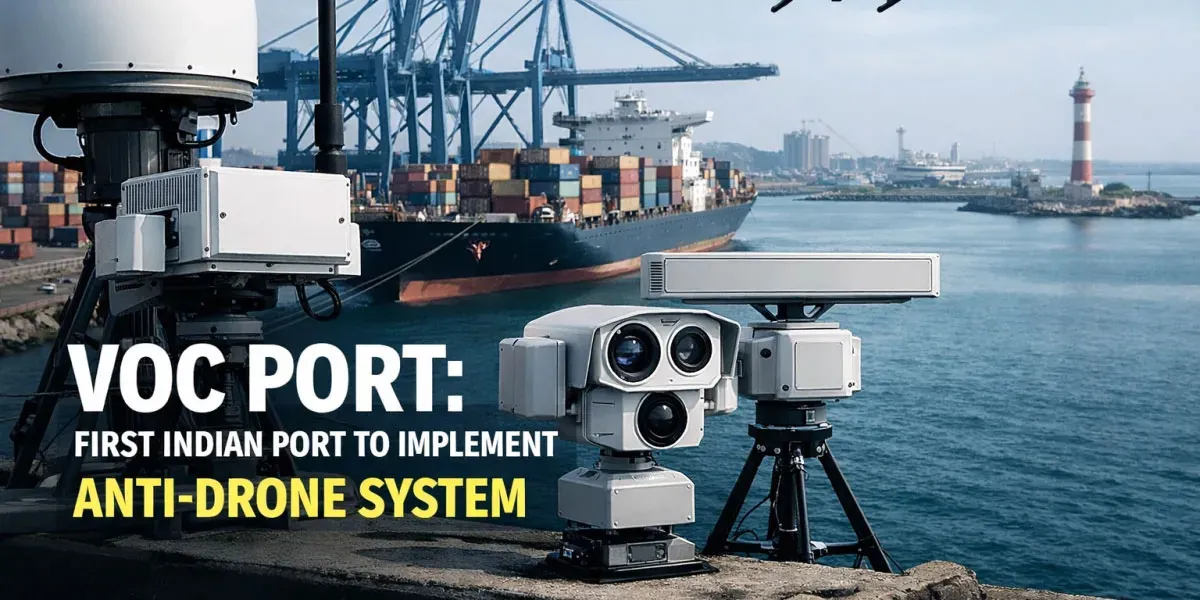
V.O. Chidambaranar Port Authority (VOC Port Authority) has become the first port in India to initiate implementation of an advanced anti-drone system aimed at strengthening maritime and coastal security. The initiative marks a milestone in the protection of critical port infrastructure and wider maritime resilience.

The project involves deployment of a comprehensive integrated radio frequency and radar-based drone detection and jamming system tailored to complex port environments, offering full 360 degree coverage and omnidirectional bearing. The system combines a drone detector, a drone detection radar and a man-pack jammer to provide omnidirectional coverage with an effective range of up to five km. Designed for rapid deployment, the solution enables real-time detection, tracking, classification and neutralisation of unauthorised drones, thereby safeguarding strategic assets, personnel and port operations.

The agreement was signed by A. Ganesan, Chief Mechanical Engineer of VOC Port Authority, and Anurag Agarwal on behalf of Central Electronics Limited (CEL), a government enterprise under the Department of Scientific and Industrial Research in the Ministry of Science and Technology, in the presence of chairperson Sushant Kumar Purohit and deputy chairperson Rajesh Soundararajan. The project is scheduled for completion within the next three months and is presented as an indigenous electronic countermeasure capability. Officials described the procurement as enhancing sensitive area security and improving emergency response preparedness.

Aligned with the Amrit Kaal Vision 2047 and the Maritime India Vision 2030 led by the prime minister, the initiative is intended to strengthen national safety, enhance airspace surveillance and ensure compliance with emerging coastal defence norms. The port authority anticipates that commissioning the anti-drone system will significantly enhance operational resilience and position VOC Port as a benchmark for security innovation across Indian ports. The chairperson noted that adopting advanced surveillance and counter-drone technologies reflects a proactive approach to securing critical maritime infrastructure and reinforcing national security.

V.O. Chidambaranar Port Authority (VOC Port Authority) has become the first port in India to initiate implementation of an advanced anti-drone system aimed at strengthening maritime and coastal security. The initiative marks a milestone in the protection of critical port infrastructure and wider maritime resilience. The project involves deployment of a comprehensive integrated radio frequency and radar-based drone detection and jamming system tailored to complex port environments, offering full 360 degree coverage and omnidirectional bearing. The system combines a drone detector, a drone detection radar and a man-pack jammer to provide omnidirectional coverage with an effective range of up to five km. Designed for rapid deployment, the solution enables real-time detection, tracking, classification and neutralisation of unauthorised drones, thereby safeguarding strategic assets, personnel and port operations. The agreement was signed by A. Ganesan, Chief Mechanical Engineer of VOC Port Authority, and Anurag Agarwal on behalf of Central Electronics Limited (CEL), a government enterprise under the Department of Scientific and Industrial Research in the Ministry of Science and Technology, in the presence of chairperson Sushant Kumar Purohit and deputy chairperson Rajesh Soundararajan. The project is scheduled for completion within the next three months and is presented as an indigenous electronic countermeasure capability. Officials described the procurement as enhancing sensitive area security and improving emergency response preparedness. Aligned with the Amrit Kaal Vision 2047 and the Maritime India Vision 2030 led by the prime minister, the initiative is intended to strengthen national safety, enhance airspace surveillance and ensure compliance with emerging coastal defence norms. The port authority anticipates that commissioning the anti-drone system will significantly enhance operational resilience and position VOC Port as a benchmark for security innovation across Indian ports. The chairperson noted that adopting advanced surveillance and counter-drone technologies reflects a proactive approach to securing critical maritime infrastructure and reinforcing national security.

Next Story
Infrastructure Urban

Implementation Status of Jal Jeevan Mission

Since August 2019 the Government has implemented Jal Jeevan Mission to provide assured potable water through household tap connections in rural India. At the start of the mission only 32.3 million (mn) rural households, representing 16.7 per cent, were reported to have tap water connections. States and union territories have reported that 125.8 mn additional rural households have since been provided with tap connections. As a result, of about 193.6 mn rural households roughly 158.2 mn, or 81.71 per cent, are reported to have tap water supply at home.\n\nThe State, district and village level st..

Next Story
Infrastructure Urban

Jal Jeevan Mission Reaches Eighty One Per Cent Rural Coverage

The Government reported substantial progress under the Jal Jeevan Mission, launched in August 2019 to provide tap water to every rural household. At launch only 32.3 million (mn) rural households had tap connections and states and Union territories reported provision of 125.8 mn additional households by March 2026. Consequently, out of about 193.6 mn rural households around 158.2 mn, or 81.71 per cent, are reported to have tap water at home. The Finance Minister announced extension of the mission until 2028 in the 2025-26 budget speech. The Swachh Bharat Mission Grameen, launched in October 20..

Next Story
Infrastructure Urban

Empowering Local Governance for Sustainable Rural Water Supply

The Ministry of Jal Shakti has aligned the Jal Jeevan Mission (JJM) with the 73rd Amendment to strengthen village level planning and community ownership of water supply. Gram Panchayats, village water and sanitation committees and Pani Samitis are to plan, implement, manage and maintain piped water systems, with gram sabha processes formalising handover and oversight. Implementation support agencies including non government organisations, community based organisations and self help groups have been empanelled to train local committees and promote women participation. Under JJM, the department ..

Advertisement

Subscribe to Our Newsletter

Get daily newsletters around different themes from Construction world.

STAY CONNECTED

Advertisement

Advertisement

Advertisement