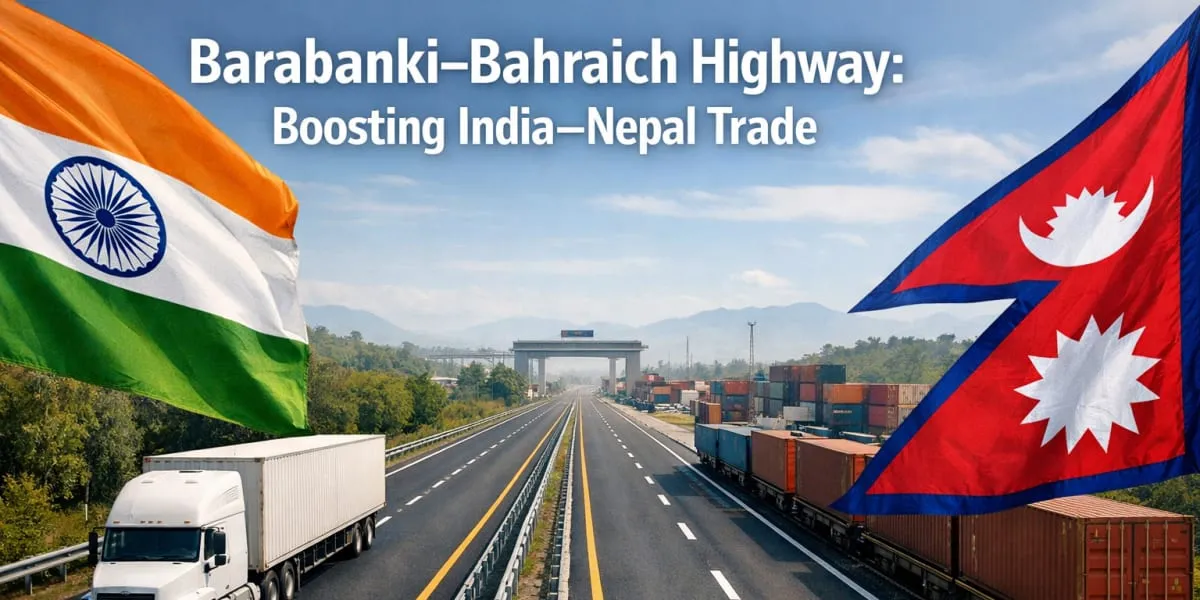
Barabanki–Bahraich Highway to Strengthen India–Nepal Trade
WAREHOUSING & LOGISTICS

Barabanki–Bahraich Highway to Strengthen India–Nepal Trade

The Union Cabinet has approved construction of a four-lane access-controlled Barabanki–Bahraich section of National Highway 927 (NH-927), a project intended to strengthen trade links between India and Nepal. India is Nepal’s largest trading partner, accounting for more than 60 per cent of Nepal’s total trade, and the new route is expected to improve connectivity to the strategically important Rupaidiha Land Port and Nepalgunj. Officials say the highway will support regional livelihoods, cross-border commerce and economic cooperation between the two neighbouring countries.

The project is designed to cut travel duration on the Barabanki to Bahraich corridor by nearly 50 per cent, shortening typical journeys from about 150 minutes to 75 minutes while raising average vehicle speeds from 40 kmph to 80 kmph. Faster transit will reduce spoilage of perishable goods such as vegetables and dairy products and will lower transport costs, directly benefiting farmers, traders and consumers on both sides of the border. Improved access is likely to allow producers in eastern Uttar Pradesh to reach markets in Nepal more reliably and to reduce post-harvest losses.

Beyond agricultural consignments, the corridor is expected to sustain supplies of medicines and essential consumer goods that are important for Nepal’s daily life. Previous disruptions at the border resulted in hundreds of trucks being stranded and caused significant financial harm to traders and consumers, illustrating the importance of resilient road infrastructure. A modern access-controlled highway is expected to reduce delays and to make supply chains more dependable.

The upgraded route will complement logistics development at Rupaidiha, where increased truck movements may generate demand for warehousing and transport services along the corridor. Border communities around Bahraich are likely to see expanded business activity, increased employment in transport and logistics and growth in hospitality and retail outlets. For truck drivers, farmers and small traders, faster and more reliable roads should translate into higher earnings and steadier income opportunities.

The Union Cabinet has approved construction of a four-lane access-controlled Barabanki–Bahraich section of National Highway 927 (NH-927), a project intended to strengthen trade links between India and Nepal. India is Nepal’s largest trading partner, accounting for more than 60 per cent of Nepal’s total trade, and the new route is expected to improve connectivity to the strategically important Rupaidiha Land Port and Nepalgunj. Officials say the highway will support regional livelihoods, cross-border commerce and economic cooperation between the two neighbouring countries. The project is designed to cut travel duration on the Barabanki to Bahraich corridor by nearly 50 per cent, shortening typical journeys from about 150 minutes to 75 minutes while raising average vehicle speeds from 40 kmph to 80 kmph. Faster transit will reduce spoilage of perishable goods such as vegetables and dairy products and will lower transport costs, directly benefiting farmers, traders and consumers on both sides of the border. Improved access is likely to allow producers in eastern Uttar Pradesh to reach markets in Nepal more reliably and to reduce post-harvest losses. Beyond agricultural consignments, the corridor is expected to sustain supplies of medicines and essential consumer goods that are important for Nepal’s daily life. Previous disruptions at the border resulted in hundreds of trucks being stranded and caused significant financial harm to traders and consumers, illustrating the importance of resilient road infrastructure. A modern access-controlled highway is expected to reduce delays and to make supply chains more dependable. The upgraded route will complement logistics development at Rupaidiha, where increased truck movements may generate demand for warehousing and transport services along the corridor. Border communities around Bahraich are likely to see expanded business activity, increased employment in transport and logistics and growth in hospitality and retail outlets. For truck drivers, farmers and small traders, faster and more reliable roads should translate into higher earnings and steadier income opportunities.

Next Story
Real Estate

Dubai Real Estate Sales Reach AED48 Billion

Dubai’s real estate market recorded 13,977 sales transactions worth AED48 billion in April 2026, reflecting continued resilience across residential and commercial segments.According to a market update by fäm Properties, sales volume rose 3.5 per cent month-on-month compared to March, while total sales value increased by 10.7 per cent. The commercial sector, including offices and shops, recorded the strongest growth, with 561 transactions valued at AED4 billion, up 33.9 per cent year-on-year and 36.2 per cent month-on-month.Apartment sales rose 6.5 per cent month-on-month to 11,377 transacti..

Next Story
Real Estate

Casagrand Launches 35-Acre Hyderabad Project

Casagrand has launched Casagrand Vybe, its largest residential project in Hyderabad, spread across 35 acres in Rajendra Nagar. The launch marks the company’s fifth residential rollout in 2026 and strengthens its expansion momentum in the city.As part of its Hyderabad growth strategy, Casagrand is adding 3.98 million sq ft of residential space to its portfolio. Since entering the Hyderabad residential market in 2023, the company has scaled its presence with projects across key micro-markets. In 2025, it launched four projects — Casagrand Evon, Casagrand Windsor Court, Casagrand Belair and C..

Next Story
Technology

Bentley Event Spotlights AI Infrastructure

Bentley Systems recently hosted Illuminate Mumbai 2026, bringing together infrastructure leaders, policymakers, technology experts and academia to discuss how AI-driven engineering and digital twins can accelerate India’s journey towards Viksit Bharat 2047.The event focused on scaling intelligent and connected infrastructure ecosystems beyond digital adoption. Discussions covered the use of infrastructure AI, open data environments and digital twin technologies to improve project delivery, sustainability and long-term asset performance across key sectors.Kamalakannan Thiruvadi, Regional Exec..

Advertisement

Subscribe to Our Newsletter

Get daily newsletters around different themes from Construction world.

STAY CONNECTED

Advertisement

Advertisement

Advertisement