Bhubaneswar Launches Phase 2 of Bio-Mining at Bhuasuni Dump Yard
WATER & WASTE

Bhubaneswar Launches Phase 2 of Bio-Mining at Bhuasuni Dump Yard

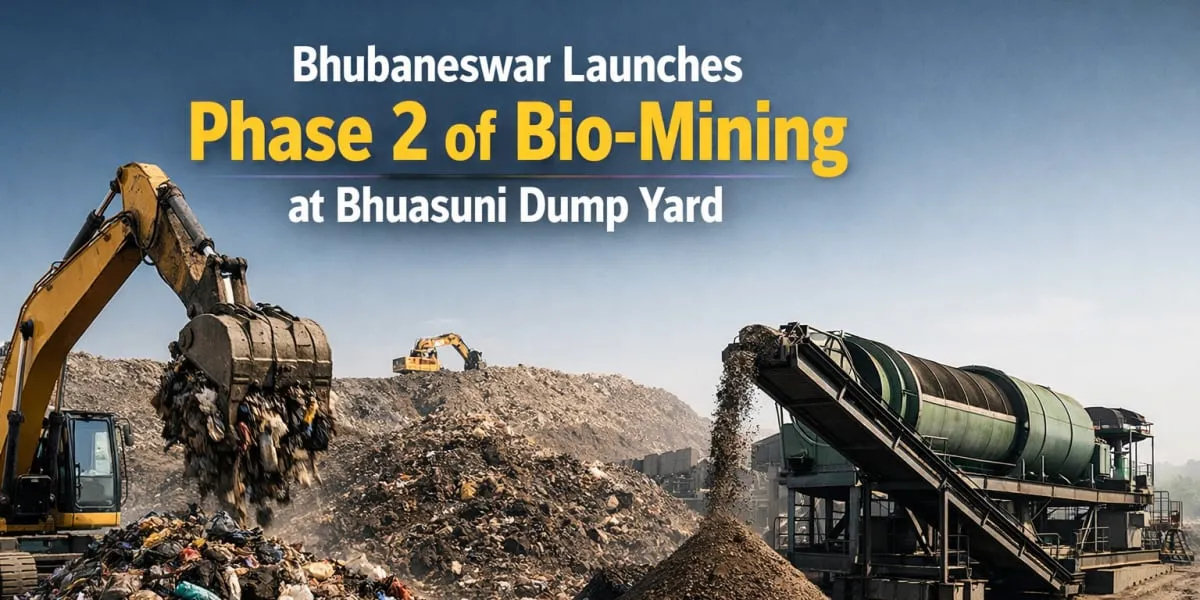
The Bhubaneswar Municipal Corporation has launched Phase 2 of a bio-mining project at the Bhuasuni dumping yard in Bhubaneswar to process 0.9 million (mn) metric tonnes (t) of legacy waste in a phased manner. The initiative builds on earlier work that removed nearly 1.2 mn t from the site over the past three years. Officials said the total volume processed will reach about 2.1 mn t once the phase is complete.

The second phase will be executed in three stages and is intended to expand remediation capacity at the former dumping ground. The site served as a major disposal location from 2008 to 2022 and remediation began after the civic authority moved to scientific methods. Work during the initial phase demonstrated technical gains in segregation and material recovery, the civic body indicated.

Bio-mining applies systematic segregation and treatment of mixed waste to enable recovery, recycling and safe disposal of different components. The shift to this approach followed directives from the National Green Tribunal in 2023 that required urban local bodies to end open dumping and adopt scientific processing. Officials also reported that no fresh waste is currently being diverted to alternative sites such as Daruthenga.

The project received cabinet approval in November 2021 but its implementation was delayed after residents protested over continued dumping. Local community members had sought a halt to fresh waste inputs before bio-mining began, and the civic body proceeded only after addressing those concerns and confirming mitigation measures. Engagement with stakeholders was described as a prerequisite for restarting large-scale remediation.

The launch is expected to strengthen Bhubaneswar’s compliance with environmental norms while improving public health outcomes and urban sanitation. Scaling bio-mining across legacy sites is seen as a key element of long-term waste management and circularity efforts in the city. Continued monitoring and adherence to regulatory directives will determine the pace at which the remaining legacy stock is processed.

The Bhubaneswar Municipal Corporation has launched Phase 2 of a bio-mining project at the Bhuasuni dumping yard in Bhubaneswar to process 0.9 million (mn) metric tonnes (t) of legacy waste in a phased manner. The initiative builds on earlier work that removed nearly 1.2 mn t from the site over the past three years. Officials said the total volume processed will reach about 2.1 mn t once the phase is complete. The second phase will be executed in three stages and is intended to expand remediation capacity at the former dumping ground. The site served as a major disposal location from 2008 to 2022 and remediation began after the civic authority moved to scientific methods. Work during the initial phase demonstrated technical gains in segregation and material recovery, the civic body indicated. Bio-mining applies systematic segregation and treatment of mixed waste to enable recovery, recycling and safe disposal of different components. The shift to this approach followed directives from the National Green Tribunal in 2023 that required urban local bodies to end open dumping and adopt scientific processing. Officials also reported that no fresh waste is currently being diverted to alternative sites such as Daruthenga. The project received cabinet approval in November 2021 but its implementation was delayed after residents protested over continued dumping. Local community members had sought a halt to fresh waste inputs before bio-mining began, and the civic body proceeded only after addressing those concerns and confirming mitigation measures. Engagement with stakeholders was described as a prerequisite for restarting large-scale remediation. The launch is expected to strengthen Bhubaneswar’s compliance with environmental norms while improving public health outcomes and urban sanitation. Scaling bio-mining across legacy sites is seen as a key element of long-term waste management and circularity efforts in the city. Continued monitoring and adherence to regulatory directives will determine the pace at which the remaining legacy stock is processed.

Related Stories

Gold Stories

Next Story
Infrastructure Urban

KONE Opens India's First Digital Experience Centre in Pune

KONE, a global elevator and escalator manufacturer, has inaugurated its first Digital Experience Centre (DEC) in India, located in Pune. The facility aims to showcase how artificial intelligence (AI), connectivity and data-driven technologies can enhance customer experiences and improve building operations.The centre was inaugurated by Jussi Herlin, Executive Vice Chair, KONE Corporation; Philippe Delorme, President and CEO, KONE; and Nandan Nilekani, Co-founder and Chairman of the Board, Infosys.Designed as an interactive customer environment, the facility demonstrates digital solutions cover..

Next Story
Infrastructure Urban

CII GreenCo Launches Circularity Guidelines for Indian Industry

The Confederation of Indian Industry (CII) GreenCo Council has launched the CII GreenCo Circularity Guidelines – Pilot Version at the 17th CII GreenCo Waste & Resource Management Summit 2026 in Chennai. The initiative aims to strengthen resource efficiency, waste reduction and circular economy practices across Indian manufacturing and process industries.The guidelines introduce a structured framework with circularity indices covering raw materials, consumables, packaging and other resource inputs. These indicators will help industries assess existing practices, identify opportunities to ..

Next Story
Infrastructure Energy

Global Electronics Association Launches IPC-1783-CO2E Standard

The Global Electronics Association has introduced IPC-1783-CO2E, a new international standard aimed at improving consistency, transparency and comparability in product carbon footprint reporting across the electronics manufacturing industry.The standard, titled International Standard for Data Collection and Reporting of CO2 Equivalent (CO2e) Emissions for the Electronics Manufacturing Supply Chain, provides industry-specific guidance for collecting, estimating and reporting carbon emissions data.With increasing regulatory requirements and customer expectations, electronics manufacturers face c..

Advertisement

Subscribe to Our Newsletter

Get daily newsletters around different themes from Construction world.

STAY CONNECTED

Advertisement

SPECIAL OFFER
QR Code