


India Adds 2.7 GW Rooftop Solar In Q1 2026
POWER & RENEWABLE ENERGY

India Adds 2.7 GW Rooftop Solar In Q1 2026

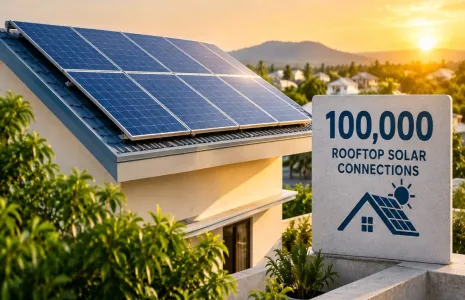
India added two point seven gigawatt (GW) of rooftop solar capacity in the first quarter of 2026, marking a quarter-on-quarter increase of 25 per cent and a year-on-year rise of 125 per cent, according to a Mercom India Research report. Rooftop capacity accounted for 18 per cent of the country’s total solar installations in the quarter, with the PM Surya Ghar programme, subsidy-backed systems, simplified approval processes and stronger state-level implementation cited as key drivers.

The residential segment emerged as the dominant contributor, representing 82 per cent of rooftop installations in Q1 2026, while industrial, commercial and government installations comprised 11 per cent, seven per cent and zero point four per cent respectively. The report indicated that installations under the capital expenditure model accounted for 81 per cent of quarterly additions, with the operational expenditure or RESCO model making up around 19 per cent.

Mercom India Research noted that strong residential demand under the PM Surya Ghar programme continued to underpin growth, and that future expansion would depend on execution efficiency, access to financing, DISCOM coordination and grid readiness. The analysis warned that sustained momentum would require improvements in project delivery and financing mechanisms at scale.

Maharashtra, Uttar Pradesh and Gujarat led state-level additions, contributing 17 per cent, 16 per cent and 15 per cent of quarterly new capacity respectively, and continued to top cumulative installations. India’s cumulative rooftop solar capacity reached 23.5 GW as of March 2026, with the top ten states accounting for nearly 80 per cent of cumulative deployments.

The report highlighted that Assam recorded the highest compounded quarterly growth rate between Q1 2025 and Q1 2026 at 40 per cent, followed by Uttar Pradesh and Andhra Pradesh. Tender activity was mixed, with rooftop solar tenders totalling 482 megawatt (MW) issued during the quarter, a decline of over 38 per cent quarter-on-quarter but nearly 32 per cent higher year-on-year, while auctioned capacity stood at 269 MW, down 67 per cent from Q4 2025.

System costs were largely stable across most module technologies during the quarter, although systems using Chinese modules experienced a noticeable increase in pricing, underscoring supply and tariff pressures amid robust residential demand.

"Join industry leaders at RAHSTA Expo, India's premier platform for roads, highways and traffic infrastructure. Register now to explore innovations, network with experts and shape the future of mobility."

India added two point seven gigawatt (GW) of rooftop solar capacity in the first quarter of 2026, marking a quarter-on-quarter increase of 25 per cent and a year-on-year rise of 125 per cent, according to a Mercom India Research report. Rooftop capacity accounted for 18 per cent of the country’s total solar installations in the quarter, with the PM Surya Ghar programme, subsidy-backed systems, simplified approval processes and stronger state-level implementation cited as key drivers. The residential segment emerged as the dominant contributor, representing 82 per cent of rooftop installations in Q1 2026, while industrial, commercial and government installations comprised 11 per cent, seven per cent and zero point four per cent respectively. The report indicated that installations under the capital expenditure model accounted for 81 per cent of quarterly additions, with the operational expenditure or RESCO model making up around 19 per cent. Mercom India Research noted that strong residential demand under the PM Surya Ghar programme continued to underpin growth, and that future expansion would depend on execution efficiency, access to financing, DISCOM coordination and grid readiness. The analysis warned that sustained momentum would require improvements in project delivery and financing mechanisms at scale. Maharashtra, Uttar Pradesh and Gujarat led state-level additions, contributing 17 per cent, 16 per cent and 15 per cent of quarterly new capacity respectively, and continued to top cumulative installations. India’s cumulative rooftop solar capacity reached 23.5 GW as of March 2026, with the top ten states accounting for nearly 80 per cent of cumulative deployments. The report highlighted that Assam recorded the highest compounded quarterly growth rate between Q1 2025 and Q1 2026 at 40 per cent, followed by Uttar Pradesh and Andhra Pradesh. Tender activity was mixed, with rooftop solar tenders totalling 482 megawatt (MW) issued during the quarter, a decline of over 38 per cent quarter-on-quarter but nearly 32 per cent higher year-on-year, while auctioned capacity stood at 269 MW, down 67 per cent from Q4 2025. System costs were largely stable across most module technologies during the quarter, although systems using Chinese modules experienced a noticeable increase in pricing, underscoring supply and tariff pressures amid robust residential demand.

Next Story
Infrastructure Transport

L&T Achieves Third Bullet Train Tunnel Breakthrough

Larsen & Toubro (L&T) has achieved the breakthrough of Mountain Tunnel-07 (MT-07) on the Mumbai-Ahmedabad High Speed Rail (MAHSR) C-3 package, marking its third tunnel breakthrough within five months. Located in the Sahyadri range near Ambesari village in Dahanu Taluka, Maharashtra, the 417-metre-long tunnel was excavated over 516 days using the New Austrian Tunnelling Method (NATM) and 117 controlled blasts.The 12.6-metre-wide tunnel, designed to accommodate both up and down tracks, was constructed under challenging geological conditions with continuous monitoring and support systems,..

Next Story
Infrastructure Urban

Meghalaya Opens North East’s Largest Spice Plant

Union Finance Minister Nirmala Sitharaman recently inaugurated the Organic Spice Industrial Unit, PRIME-HUB, at Bhoirymbong in Meghalaya. The facility is being positioned as the North East’s largest organic spice processing plant and is expected to strengthen Meghalaya’s agro-industrial and organic farming ecosystem.The project was developed with an investment of Rs 300 million (mn) and is designed to process over 10,000 metric tonnes of organic spices annually. It will directly benefit 5,500 farmers across 112 villages, supporting improved livelihoods, value addition and market access for..

Next Story
Infrastructure Urban

Recykal Raises USD 23 Mn Bridge Round

Recykal, a Hyderabad-based technology platform for waste management and the circular economy, recently raised USD 23 million in a bridge round through a mix of primary and secondary capital. The round saw participation from existing investors and select new family offices.The fresh capital will be used to strengthen Recykal’s technology platform, accelerate its Deposit Return System (DRS) deployments, expand behavioural change solutions in waste management, and support international growth. In FY26, the company reported gross revenue of Rs 14.98 billion, up 53.2 per cent from Rs 9.78 billion..

Advertisement

Subscribe to Our Newsletter

Get daily newsletters around different themes from Construction world.

STAY CONNECTED

Advertisement

Advertisement

Advertisement