+
KEC International Commissions 1,200 MW Power Pooling Substation
POWER & RENEWABLE ENERGY

KEC International Commissions 1,200 MW Power Pooling Substation

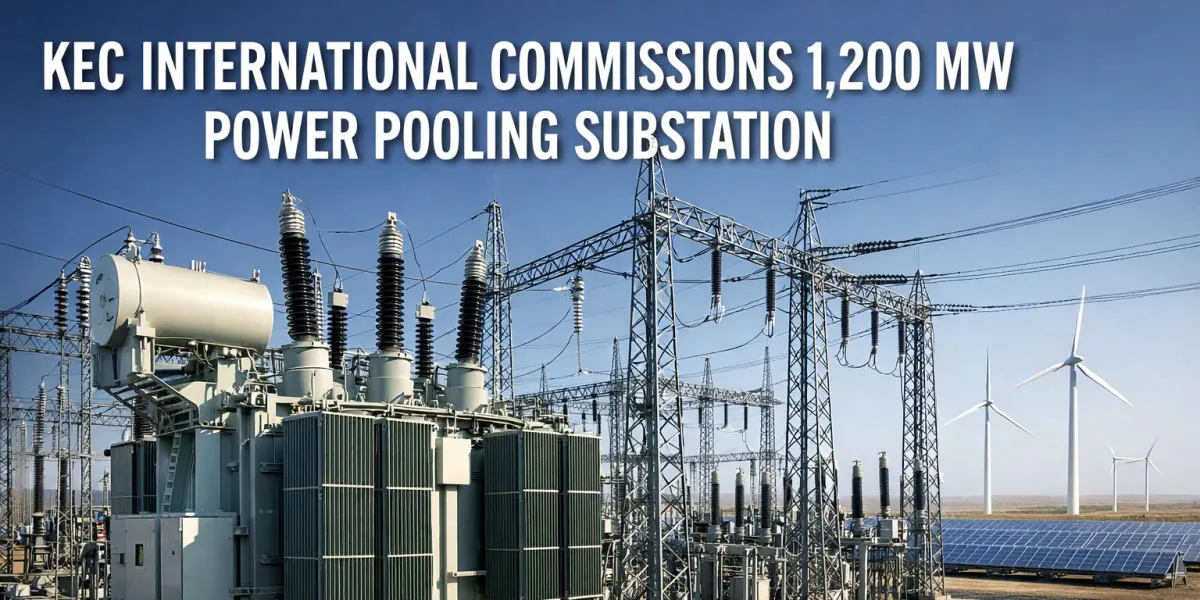
KEC International has commissioned a 1,200 Megawatt (MW) power pooling substation at Khavda Renewable Park to support large scale renewable energy evacuation and grid stability. The facility forms part of ongoing efforts to integrate variable renewable generation into regional transmission networks and is intended to streamline power pooling from multiple generating sources. KEC International executed the project under an engineering, procurement and construction contract and completed testing and commissioning in coordination with system operators. Project delivery followed standard safety and quality protocols during construction and energisation.

The substation includes high-voltage switchgear, transformers and control and protection systems designed to handle peak flows and facilitate grid balancing. A supervisory control and data acquisition system enables remote operation and monitoring while auxiliary systems provide operational resilience. Design and construction emphasised modularity and maintainability to reduce outage durations and support rapid ramping of renewable output. Operational testing established functional interfaces with regional control centres and validated protection schemes.

By enabling aggregated dispatch of generation, the installation is expected to reduce curtailment and enhance utilisation of renewable capacity in the park. Developers and utilities are anticipated to benefit from improved transmission access and predictable evacuation arrangements. The project is described as contributing to national and regional renewable integration objectives and to the stability of the wider grid. Improved evacuation capacity is anticipated to support investment confidence among developers and to lower integration risk.

KEC International said the project builds on its experience in power transmission and substation delivery across domestic and international markets. The company indicated that similar schemes may be advanced to support expanding renewable clusters and to meet rising demand for firm grid connections. Stakeholders will continue coordination to ensure commercial and technical integration as upcoming renewable capacity synchronises with transmission infrastructure. The company will monitor performance and provide maintenance support as the installation enters commercial operation.

KEC International has commissioned a 1,200 Megawatt (MW) power pooling substation at Khavda Renewable Park to support large scale renewable energy evacuation and grid stability. The facility forms part of ongoing efforts to integrate variable renewable generation into regional transmission networks and is intended to streamline power pooling from multiple generating sources. KEC International executed the project under an engineering, procurement and construction contract and completed testing and commissioning in coordination with system operators. Project delivery followed standard safety and quality protocols during construction and energisation. The substation includes high-voltage switchgear, transformers and control and protection systems designed to handle peak flows and facilitate grid balancing. A supervisory control and data acquisition system enables remote operation and monitoring while auxiliary systems provide operational resilience. Design and construction emphasised modularity and maintainability to reduce outage durations and support rapid ramping of renewable output. Operational testing established functional interfaces with regional control centres and validated protection schemes. By enabling aggregated dispatch of generation, the installation is expected to reduce curtailment and enhance utilisation of renewable capacity in the park. Developers and utilities are anticipated to benefit from improved transmission access and predictable evacuation arrangements. The project is described as contributing to national and regional renewable integration objectives and to the stability of the wider grid. Improved evacuation capacity is anticipated to support investment confidence among developers and to lower integration risk. KEC International said the project builds on its experience in power transmission and substation delivery across domestic and international markets. The company indicated that similar schemes may be advanced to support expanding renewable clusters and to meet rising demand for firm grid connections. Stakeholders will continue coordination to ensure commercial and technical integration as upcoming renewable capacity synchronises with transmission infrastructure. The company will monitor performance and provide maintenance support as the installation enters commercial operation.

Related Stories

Gold Stories

Next Story
Infrastructure Urban

KONE Opens India's First Digital Experience Centre in Pune

KONE, a global elevator and escalator manufacturer, has inaugurated its first Digital Experience Centre (DEC) in India, located in Pune. The facility aims to showcase how artificial intelligence (AI), connectivity and data-driven technologies can enhance customer experiences and improve building operations.The centre was inaugurated by Jussi Herlin, Executive Vice Chair, KONE Corporation; Philippe Delorme, President and CEO, KONE; and Nandan Nilekani, Co-founder and Chairman of the Board, Infosys.Designed as an interactive customer environment, the facility demonstrates digital solutions cover..

Next Story
Infrastructure Urban

CII GreenCo Launches Circularity Guidelines for Indian Industry

The Confederation of Indian Industry (CII) GreenCo Council has launched the CII GreenCo Circularity Guidelines – Pilot Version at the 17th CII GreenCo Waste & Resource Management Summit 2026 in Chennai. The initiative aims to strengthen resource efficiency, waste reduction and circular economy practices across Indian manufacturing and process industries.The guidelines introduce a structured framework with circularity indices covering raw materials, consumables, packaging and other resource inputs. These indicators will help industries assess existing practices, identify opportunities to ..

Next Story
Infrastructure Energy

Global Electronics Association Launches IPC-1783-CO2E Standard

The Global Electronics Association has introduced IPC-1783-CO2E, a new international standard aimed at improving consistency, transparency and comparability in product carbon footprint reporting across the electronics manufacturing industry.The standard, titled International Standard for Data Collection and Reporting of CO2 Equivalent (CO2e) Emissions for the Electronics Manufacturing Supply Chain, provides industry-specific guidance for collecting, estimating and reporting carbon emissions data.With increasing regulatory requirements and customer expectations, electronics manufacturers face c..

Advertisement

Subscribe to Our Newsletter

Get daily newsletters around different themes from Construction world.

STAY CONNECTED

Advertisement

SPECIAL OFFER
QR Code