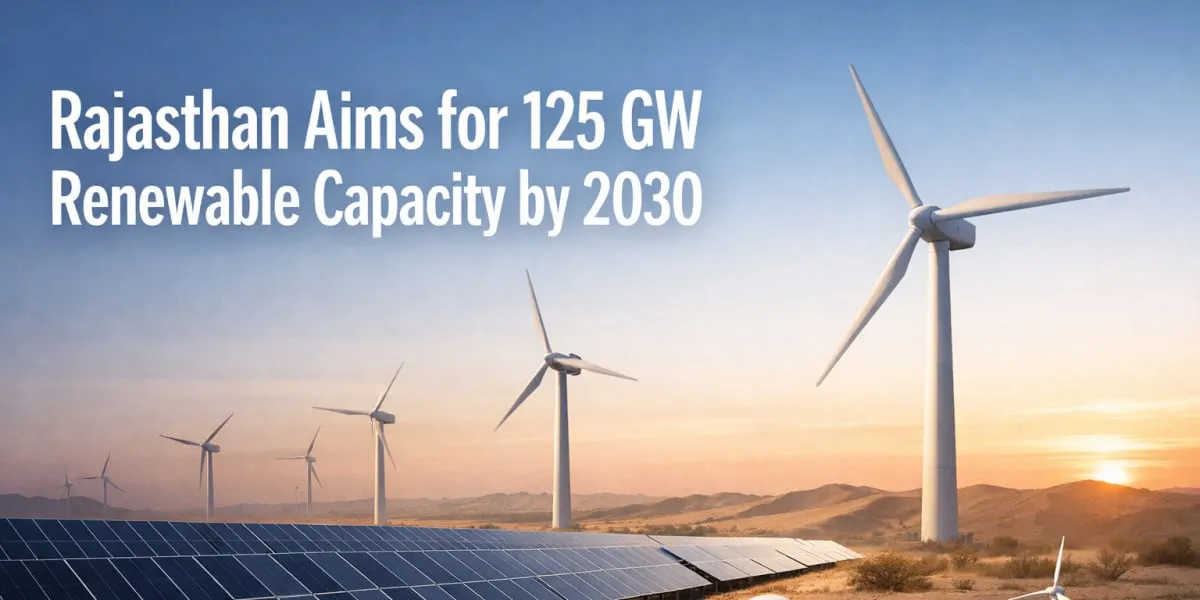
Rajasthan Aims For 125 Gigawatt (GW) Renewable Capacity By 2030
POWER & RENEWABLE ENERGY

Rajasthan Aims For 125 Gigawatt (GW) Renewable Capacity By 2030

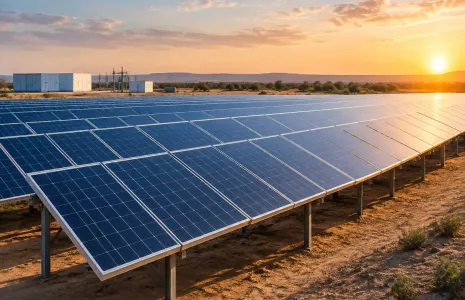
Rajasthan is targeting 125 gigawatt (GW) of renewable energy capacity by 2030, with around 50 GW already installed, and is seeking developers and investors to accelerate expansion. The target was outlined at a B2B roadshow for the BRE Summit and Expo 2026, where state officials presented opportunities in solar, wind and emerging technologies. The initiative forms part of India’s pursuit of a 500 GW clean energy capacity target and aims to align state investment pitches with national goals.

Rajesh Kulhari, Joint Secretary at the Ministry of New and Renewable Energy, said the roadshow provides a platform for states to showcase capabilities and attract investment while learning from developers. He highlighted that Rajasthan already hosts a wind blade industry in Jaisalmer and several module manufacturing plants, and noted that state pavilions and dedicated cabins at the summit will allow officials to present projects and incentives. Kulhari added that the state will promote ease of doing business to encourage inward investment.

Officials said the roadshow series has begun in Rajasthan and will move to Lucknow, Ahmedabad, Mumbai, Bengaluru, Kolkata and Chennai, and is expected to draw international participation including experts on green hydrogen from Europe, Japan and the United States. The ministry continues to engage the industry through monthly discussions with solar manufacturers, developers and wind players to address concerns and shape policy. State officials emphasised that greater participation from developers and investors is needed to accelerate capacity creation.

Ravi Verma, member of the governing council of the Sustainable Projects Development Association, said India has already crossed around 300 GW of non?fossil fuel capacity and remains on track to reach the 500 GW target by 2030, and could exceed that level with continued support from state and central policies. He identified schemes such as PM Surya Ghar and PM?KUSUM as avenues to expand deployment and strengthen access to power, and urged sustained policy stability to attract long?term investment. Industry representatives at the roadshow reiterated that coordinated state and central action can hasten capacity additions.

Rajasthan is targeting 125 gigawatt (GW) of renewable energy capacity by 2030, with around 50 GW already installed, and is seeking developers and investors to accelerate expansion. The target was outlined at a B2B roadshow for the BRE Summit and Expo 2026, where state officials presented opportunities in solar, wind and emerging technologies. The initiative forms part of India’s pursuit of a 500 GW clean energy capacity target and aims to align state investment pitches with national goals. Rajesh Kulhari, Joint Secretary at the Ministry of New and Renewable Energy, said the roadshow provides a platform for states to showcase capabilities and attract investment while learning from developers. He highlighted that Rajasthan already hosts a wind blade industry in Jaisalmer and several module manufacturing plants, and noted that state pavilions and dedicated cabins at the summit will allow officials to present projects and incentives. Kulhari added that the state will promote ease of doing business to encourage inward investment. Officials said the roadshow series has begun in Rajasthan and will move to Lucknow, Ahmedabad, Mumbai, Bengaluru, Kolkata and Chennai, and is expected to draw international participation including experts on green hydrogen from Europe, Japan and the United States. The ministry continues to engage the industry through monthly discussions with solar manufacturers, developers and wind players to address concerns and shape policy. State officials emphasised that greater participation from developers and investors is needed to accelerate capacity creation. Ravi Verma, member of the governing council of the Sustainable Projects Development Association, said India has already crossed around 300 GW of non?fossil fuel capacity and remains on track to reach the 500 GW target by 2030, and could exceed that level with continued support from state and central policies. He identified schemes such as PM Surya Ghar and PM?KUSUM as avenues to expand deployment and strengthen access to power, and urged sustained policy stability to attract long?term investment. Industry representatives at the roadshow reiterated that coordinated state and central action can hasten capacity additions.

Related Stories

Gold Stories

Next Story
Infrastructure Urban

Modi Urges End-to-End Reforms for Infrastructure Projects

Prime Minister Narendra Modi on Tuesday called for continuous reforms across all stages of infrastructure project execution during the 53rd PRAGATI meeting. He asked ministries and state governments to adopt an end-to-end approach and a proactive work culture to ensure timely delivery. The meeting reviewed six key infrastructure projects in the railway, road and power sectors across nine states with a cumulative investment of Rs 300 billion (Rs 300 bn). Officials assessed projects on timelines, inter-agency coordination and resolution of pending issues. He said infrastructure projects should b..

Next Story
Infrastructure Transport

GMR Airports Plans US$2 bn Expansion In Delhi And Hyderabad

GMR Airports plans a US$2 billion (bn) expansion of facilities at New Delhi and Hyderabad as part of a major modernisation drive. Hyderabad’s upgraded airport will be able to accommodate about 80 million (mn) passengers a year, more than double its current annual volume of 34 mn fliers. The company is India’s largest airport operator by number of fliers annually, while rival Adani Airport Holdings Ltd is the biggest by number of airports and is reported to be looking to invest US$15 bn to boost passenger capacity over the next five years. Executives indicated the build-outs in New Delhi an..

Next Story
Infrastructure Transport

Mumbai Airport to Demolish Part of Terminal One From 15 January

Adani Group-operated Mumbai International Airport (MIAL) will begin partial demolition of the north section of Terminal one-B at Chatrapati Shivaji Maharaj International Airport from 15 January 2027, according to a letter to the civil aviation ministry. The operator has begun redistributing air traffic to Terminal two and to Navi Mumbai International Airport to facilitate the work. The airport, managed by Mumbai International Airport, currently has a capacity of over 50 million (mn) passengers and handles over 950 flight movements daily. Terminal one is nearly 80 years old and parts of it have..

Advertisement

Subscribe to Our Newsletter

Get daily newsletters around different themes from Construction world.

STAY CONNECTED

Advertisement