+
SWR Commissions Rooftop Solar At 148 Railway Stations
POWER & RENEWABLE ENERGY

SWR Commissions Rooftop Solar At 148 Railway Stations

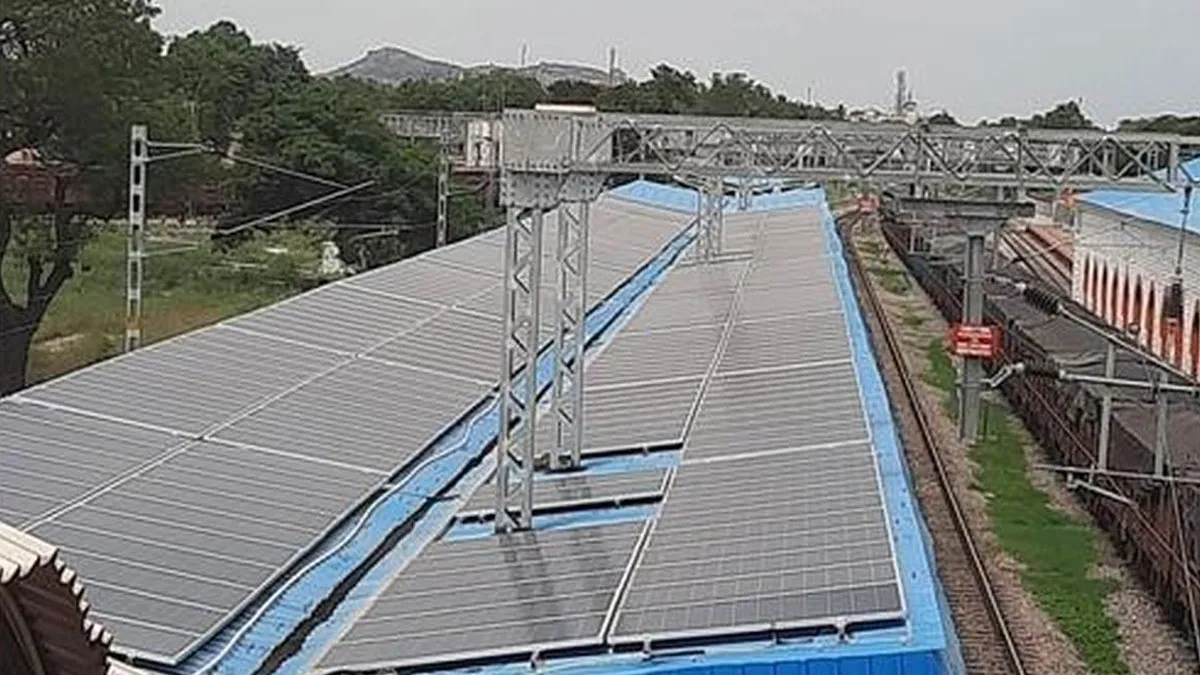
Rooftop solar plants have been commissioned at 148 railway stations across the South Western Railway zone as part of Indian Railways’ push towards renewable energy adoption and its target of achieving net-zero carbon emissions by 2030.

According to officials, the large-scale deployment of solar photovoltaic systems spans stations, service and administrative buildings, workshops, traction and non-traction installations, level crossing gates and water pumping systems across Karnataka and parts of Goa under SWR. Major stations equipped with rooftop solar facilities include Krantiveera Sangolli Rayanna Bengaluru station at Majestic, Hubballi, Mysuru, Dharwad, Belagavi, Hosapete, Gadag and Ballari.

In addition to stations, 38 service buildings such as Rail Soudha, divisional offices, railway hospitals and training institutes have been fitted with rooftop solar installations. Key production and maintenance units have also been covered, including the Hubballi Workshop with 1,045 kilowatt peak capacity, Mysuru Workshop with 530 kilowatt peak, Krishnarajapuram Diesel Loco Shed with 240 kilowatt peak and Hubballi EMD Shed with 640 kilowatt peak capacity.

Solar rooftop systems have also been installed at 302 level crossing gates to ensure uninterrupted and environment-friendly power supply. Officials said these measures have significantly strengthened the zone’s renewable energy footprint.

As of November 2025, the cumulative installed solar capacity in the SWR zone has reached 7,491.6 kilowatt peak, up from 6,986 kilowatt peak at the end of the previous financial year. Officials attributed the improvement to systematic expansion, regular cleaning, preventive maintenance and continuous performance monitoring, which have helped improve capacity utilisation and output.

During the current financial year 2025–26, up to October, SWR generated 4.13 million units of solar power, resulting in savings of approximately Rs 26.1 million. In 2024–25, solar generation stood at 6.86 million units, translating into savings of about Rs 40.7 million. Officials noted that steady year-on-year growth in solar generation has contributed to a sustained reduction in electricity procurement costs.

Beyond rooftop installations, SWR has also adopted open-access renewable power procurement, with 36 traction substations operating under such arrangements. Railway officials said green power sourcing has delivered substantial financial savings while reducing dependence on conventional energy sources.

Rooftop solar plants have been commissioned at 148 railway stations across the South Western Railway zone as part of Indian Railways’ push towards renewable energy adoption and its target of achieving net-zero carbon emissions by 2030. According to officials, the large-scale deployment of solar photovoltaic systems spans stations, service and administrative buildings, workshops, traction and non-traction installations, level crossing gates and water pumping systems across Karnataka and parts of Goa under SWR. Major stations equipped with rooftop solar facilities include Krantiveera Sangolli Rayanna Bengaluru station at Majestic, Hubballi, Mysuru, Dharwad, Belagavi, Hosapete, Gadag and Ballari. In addition to stations, 38 service buildings such as Rail Soudha, divisional offices, railway hospitals and training institutes have been fitted with rooftop solar installations. Key production and maintenance units have also been covered, including the Hubballi Workshop with 1,045 kilowatt peak capacity, Mysuru Workshop with 530 kilowatt peak, Krishnarajapuram Diesel Loco Shed with 240 kilowatt peak and Hubballi EMD Shed with 640 kilowatt peak capacity. Solar rooftop systems have also been installed at 302 level crossing gates to ensure uninterrupted and environment-friendly power supply. Officials said these measures have significantly strengthened the zone’s renewable energy footprint. As of November 2025, the cumulative installed solar capacity in the SWR zone has reached 7,491.6 kilowatt peak, up from 6,986 kilowatt peak at the end of the previous financial year. Officials attributed the improvement to systematic expansion, regular cleaning, preventive maintenance and continuous performance monitoring, which have helped improve capacity utilisation and output. During the current financial year 2025–26, up to October, SWR generated 4.13 million units of solar power, resulting in savings of approximately Rs 26.1 million. In 2024–25, solar generation stood at 6.86 million units, translating into savings of about Rs 40.7 million. Officials noted that steady year-on-year growth in solar generation has contributed to a sustained reduction in electricity procurement costs. Beyond rooftop installations, SWR has also adopted open-access renewable power procurement, with 36 traction substations operating under such arrangements. Railway officials said green power sourcing has delivered substantial financial savings while reducing dependence on conventional energy sources.

Next Story
Infrastructure Transport

Second Mountain Tunnel Breakthrough in Palghar Advances High Speed Rail

The Mumbai-Ahmedabad high speed rail (MAHSR) project reached a milestone with the breakthrough of a mountain tunnel in Palghar, Maharashtra. Mountain tunnel MT-six measures 454 metres long and 14.4 metres wide and will accommodate up and down tracks. The breakthrough follows MT-five near Saphale on second January 2026 and the MT-six excavation was completed from both ends using the New Austrian Tunnelling Method. The ministry reported that the tunnelling was completed within 12 months. The New Austrian Tunnelling Method is favoured for its flexibility in complex geology and irregular tunnel s..

Next Story
Infrastructure Transport

Modi Government Pushes Atmanirbhar Container Drive With BCSL MoU

The Union Government advanced a plan to create an integrated, domestically anchored container ecosystem with the signing of a Memorandum of Understanding to establish the Bharat Container Shipping Line (BCSL). The MoU was signed by key agencies including the Shipping Corporation of India and Container Corporation of India alongside major port authorities and Sagarmala Finance Corporation Limited under the Ministry of Ports, Shipping and Waterways, in the presence of senior ministers. The initiative aligns with the Container Manufacturing Assistance Scheme announced in the Union Budget 2026–2..

Next Story
Infrastructure Urban

Ministry Reports Gains In Mobility For Marginalised Communities

The Ministry of Social Justice and Empowerment is implementing skill development, education and rehabilitation schemes to promote socio-economic mobility and sustainable livelihoods for marginalised and disadvantaged communities across the country. Programmes target Scheduled Castes, Other Backward Classes, Economically Weaker Sections, De-notified Tribes and Safai Karamcharis through specialised implementing corporations and empanelled training institutes. Pradhan Mantri Dakshata Aur Kushalta Sampann Hitgrahi Yojana, or PM-DAKSH, provided skill training and placement support through the Nati..

Advertisement

Subscribe to Our Newsletter

Get daily newsletters around different themes from Construction world.

STAY CONNECTED

Advertisement

Advertisement

Advertisement

Open In App