Tripura To Provide Rooftop Solar For Rs 1,000 To Low Income Households
POWER & RENEWABLE ENERGY

Tripura To Provide Rooftop Solar For Rs 1,000 To Low Income Households

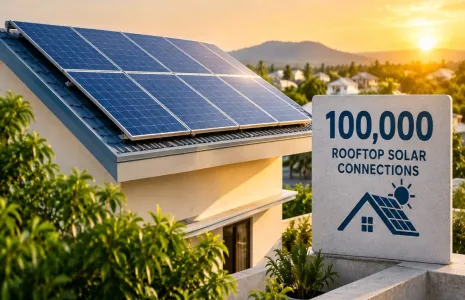
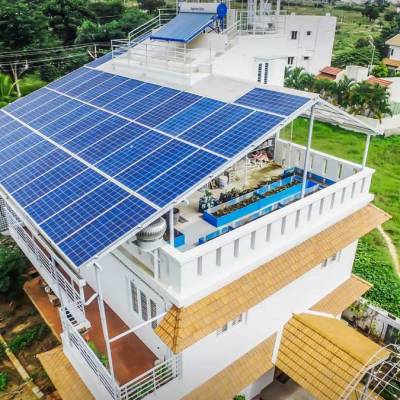
Tripura State Electricity Corporation Limited and the state government will provide rooftop solar systems worth about Rs 66,000 to selected low-income households for a one-time payment of Rs 1,000, the power minister announced after launching a Rooftop Solar PV System Handbook in Agartala. The minister said the initiative is part of efforts to expand renewable energy access and make electricity affordable for marginalised families.

Authorities identified 0.15 million (0.15 mn) families consuming less than fifty units per month for the first phase, from an estimated 0.3 million (0.3 mn) such consumers in the state, while the state has a total of one million (1 mn) electricity consumers. The minister outlined subsidy support under the PM Suryaghar scheme, noting that for one kilowatt the subsidy is Rs 33,000, for two kilowatts Rs 66,000 and for three kilowatts Rs 85,800, with eligible families required to pay only Rs 1,000 under the new plan.

He noted that 17,000 consumers have registered under the PM Suryaghar scheme and roughly 3,500 households have already installed rooftop systems. The project aims to add about 150 megawatts (MW) of solar capacity in the state and will be implemented jointly by TSECL, the state government and the Asian Development Bank (ADB), with work expected to begin next month. The total estimated cost is Rs 11.15 billion (Rs 11.15 bn); Rs 4.95 billion (Rs 4.95 bn) is to come from the Ministry of New and Renewable Energy and the remaining Rs 6.56 billion (Rs 6.56 bn) will be arranged through ADB loans and state contributions.

Germany-based GIZ is conducting training with TSECL for engineers, officials and vendors on installation, repair and maintenance, and two handbooks in English and Bengali were released for consumers, vendors, bank officials and engineers to improve understanding of rooftop technology. The minister said the aim is to complete beneficiary identification by 2026 and implement the scheme within a year, noting the central subsidy will continue until March 2027 and that each selected family will receive a one-kilowatt (kW) system after paying the one-time Rs 1,000.

Tripura State Electricity Corporation Limited and the state government will provide rooftop solar systems worth about Rs 66,000 to selected low-income households for a one-time payment of Rs 1,000, the power minister announced after launching a Rooftop Solar PV System Handbook in Agartala. The minister said the initiative is part of efforts to expand renewable energy access and make electricity affordable for marginalised families. Authorities identified 0.15 million (0.15 mn) families consuming less than fifty units per month for the first phase, from an estimated 0.3 million (0.3 mn) such consumers in the state, while the state has a total of one million (1 mn) electricity consumers. The minister outlined subsidy support under the PM Suryaghar scheme, noting that for one kilowatt the subsidy is Rs 33,000, for two kilowatts Rs 66,000 and for three kilowatts Rs 85,800, with eligible families required to pay only Rs 1,000 under the new plan. He noted that 17,000 consumers have registered under the PM Suryaghar scheme and roughly 3,500 households have already installed rooftop systems. The project aims to add about 150 megawatts (MW) of solar capacity in the state and will be implemented jointly by TSECL, the state government and the Asian Development Bank (ADB), with work expected to begin next month. The total estimated cost is Rs 11.15 billion (Rs 11.15 bn); Rs 4.95 billion (Rs 4.95 bn) is to come from the Ministry of New and Renewable Energy and the remaining Rs 6.56 billion (Rs 6.56 bn) will be arranged through ADB loans and state contributions. Germany-based GIZ is conducting training with TSECL for engineers, officials and vendors on installation, repair and maintenance, and two handbooks in English and Bengali were released for consumers, vendors, bank officials and engineers to improve understanding of rooftop technology. The minister said the aim is to complete beneficiary identification by 2026 and implement the scheme within a year, noting the central subsidy will continue until March 2027 and that each selected family will receive a one-kilowatt (kW) system after paying the one-time Rs 1,000.

Next Story
Products

Fynd Launches AI Platform to Accelerate Fashion Creation

Fynd, an AI-native retail technology company backed by Reliance Retail Ventures, has launched Fynd Create, a platform designed to bring design intelligence, sourcing and manufacturing onto a single connected ecosystem. The platform aims to help brands respond faster to changing consumer preferences and shorten product development cycles.As social media trends continue to compress traditional fashion seasons, brands are under increasing pressure to move from seasonal planning to demand-driven production. Conventional supply chains, often characterised by long lead times and fragmented operation..

Next Story
Resources

Modis Navnirman Appointed For Neel Kiran CHSL Redevelopment

Modis Navnirman (MNL) has been appointed as the developer for the redevelopment of Neel Kiran Co-operative Housing Society Ltd in Khar West, Mumbai, following a selection process in which members chose MNL as their preferred partner. The appointment will add approximately Rs two point five billion (Rs two point five bn) to the company's Gross Development Value pipeline and strengthen its focus on redevelopment and urban renewal projects across the Mumbai Metropolitan Region. The project site is a landmark residential society in Khar West, and the selection reflects members' preference for a pa..

Next Story
Infrastructure Energy

Diamond Power Commissions Eighth MV and EHV Cable Line

Diamond Power Infrastructure (DPIL) has commissioned its eighth Medium Voltage (MV) and Extra High Voltage (EHV) power cable production line at its manufacturing facility in Vadodara, Gujarat. The new line enhances the company's manufacturing capacity in the technologically advanced MV and EHV underground power cable segment. This segment supplies cables for power transmission networks, power generation projects and renewable energy evacuation systems. The development is presented as a step to meet evolving infrastructure needs. The MV and EHV cables produced at the Vadodara facility serve urb..

Advertisement

Subscribe to Our Newsletter

Get daily newsletters around different themes from Construction world.

STAY CONNECTED

Advertisement

Advertisement

Advertisement